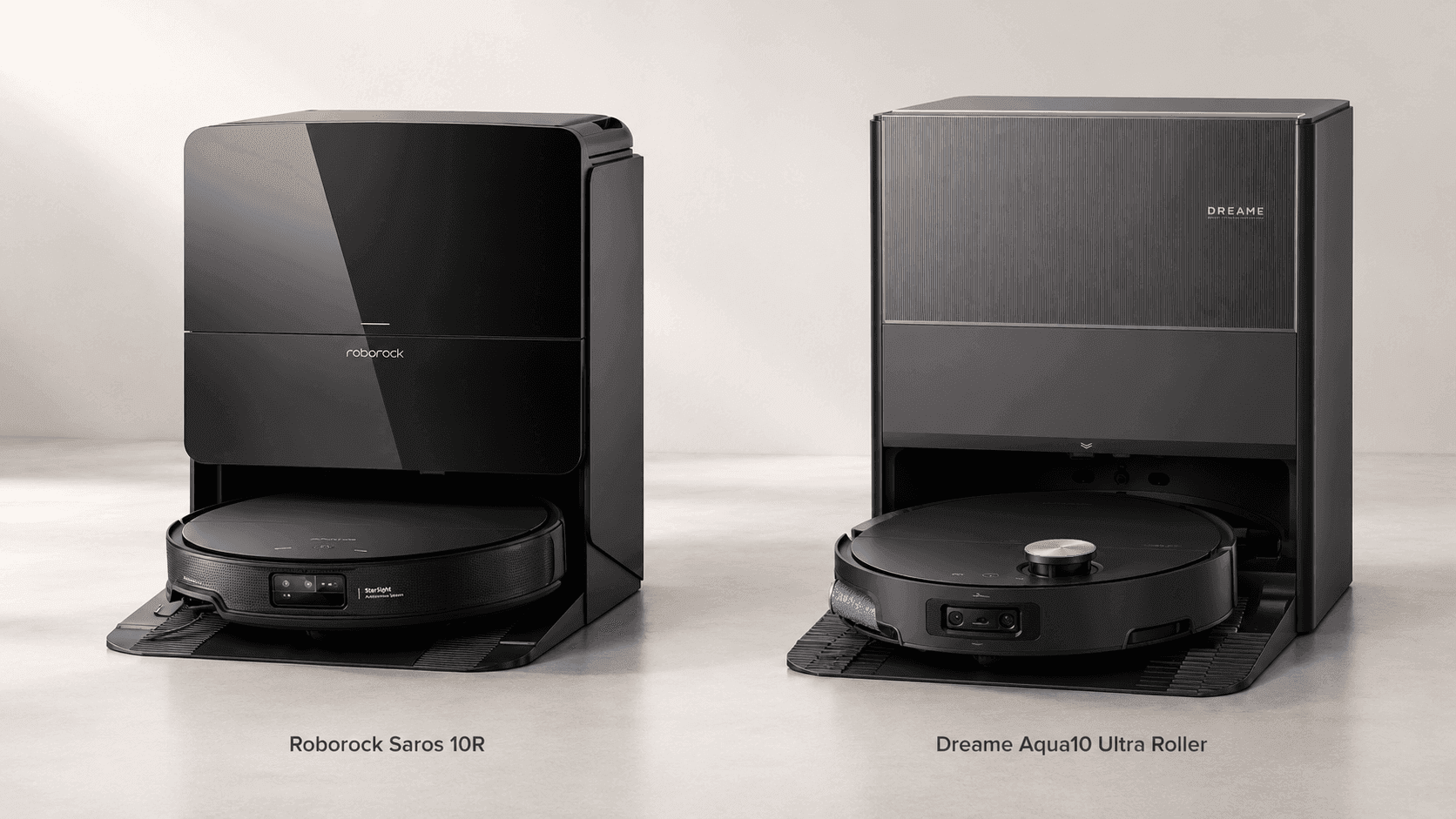
Choose the Roborock Saros 10R for low furniture and carpet-first cleaning with its mop pads left at the dock. Choose the Dreame Aqua10 Ultra Roller for frequent hard-floor washing and taller stepped transitions. The useful distinction is how each robot reaches your rooms and handles its wet-cleaning equipment.
The Saros 10R measures 3.14 inches tall without a raised navigation turret. StarSight 2.0 combines depth sensing with camera-based obstacle detection, and its dual rotating mop pads can detach before a vacuum-only run. That is useful when you want to vacuum bedroom carpet after mopping the kitchen.
The Aqua10 uses a continuously rinsed roller, carries a 30,000 Pa suction rating, and is rated to cross double-layer thresholds up to 3.15 inches. Its roller stays attached, with an AutoSeal guard covering it when carpet is detected. Both robots vacuum and mop, but their approaches suit different layouts and cleaning routines.
The Quick Take
Buy the Saros 10R for mixed flooring and low sofas: its slim body and detachable pads offer practical advantages for access and carpet-only runs. Buy the Aqua10 Ultra Roller for extensive tile or sealed hard flooring where regular mopping is the priority. Its higher suction rating does not establish better carpet pickup.
Roborock Saros 10R
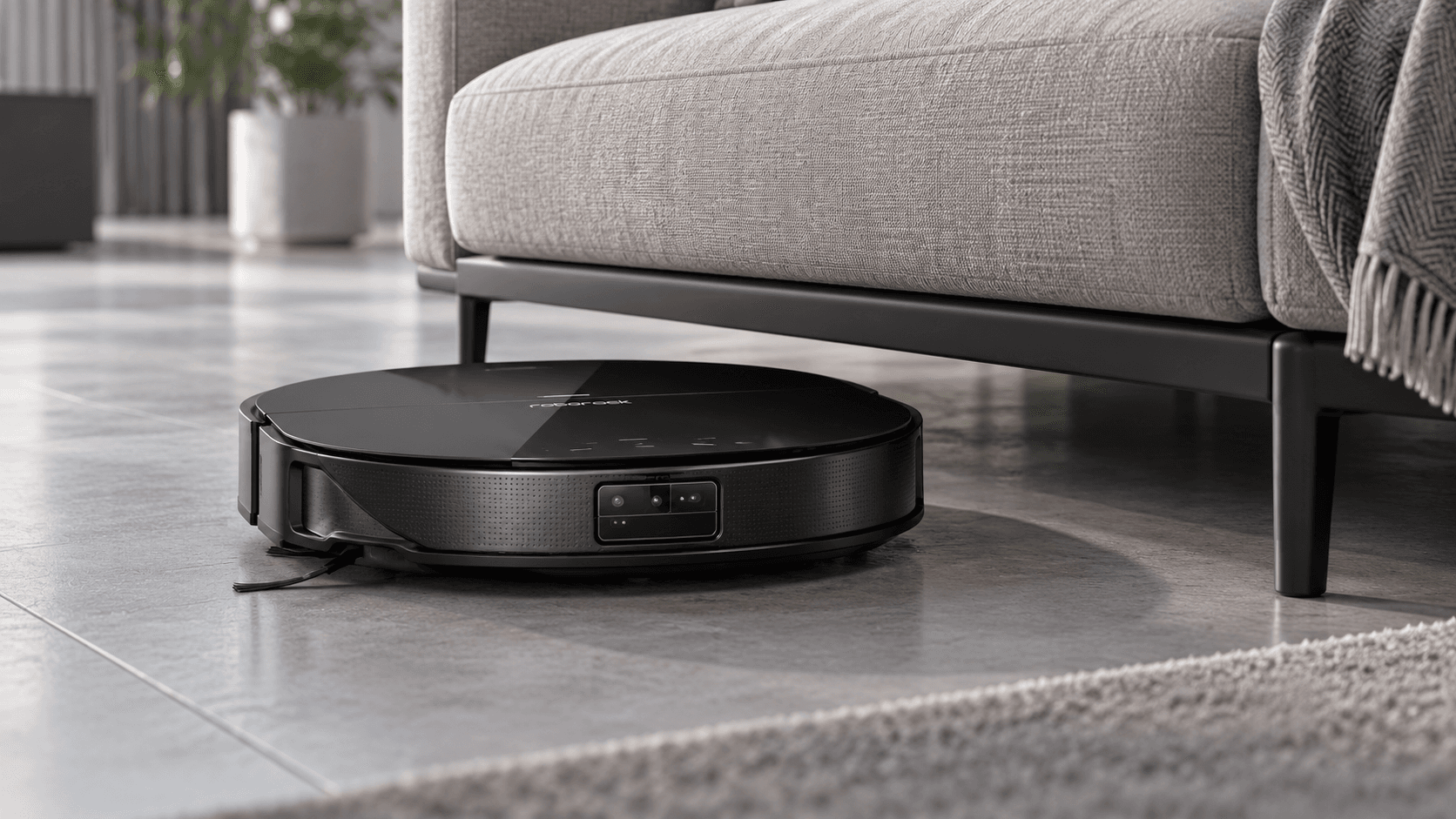
Best for carpeted bedrooms, mixed-floor living spaces, and furniture with limited clearance underneath.
Dreame Aqua10 Ultra Roller
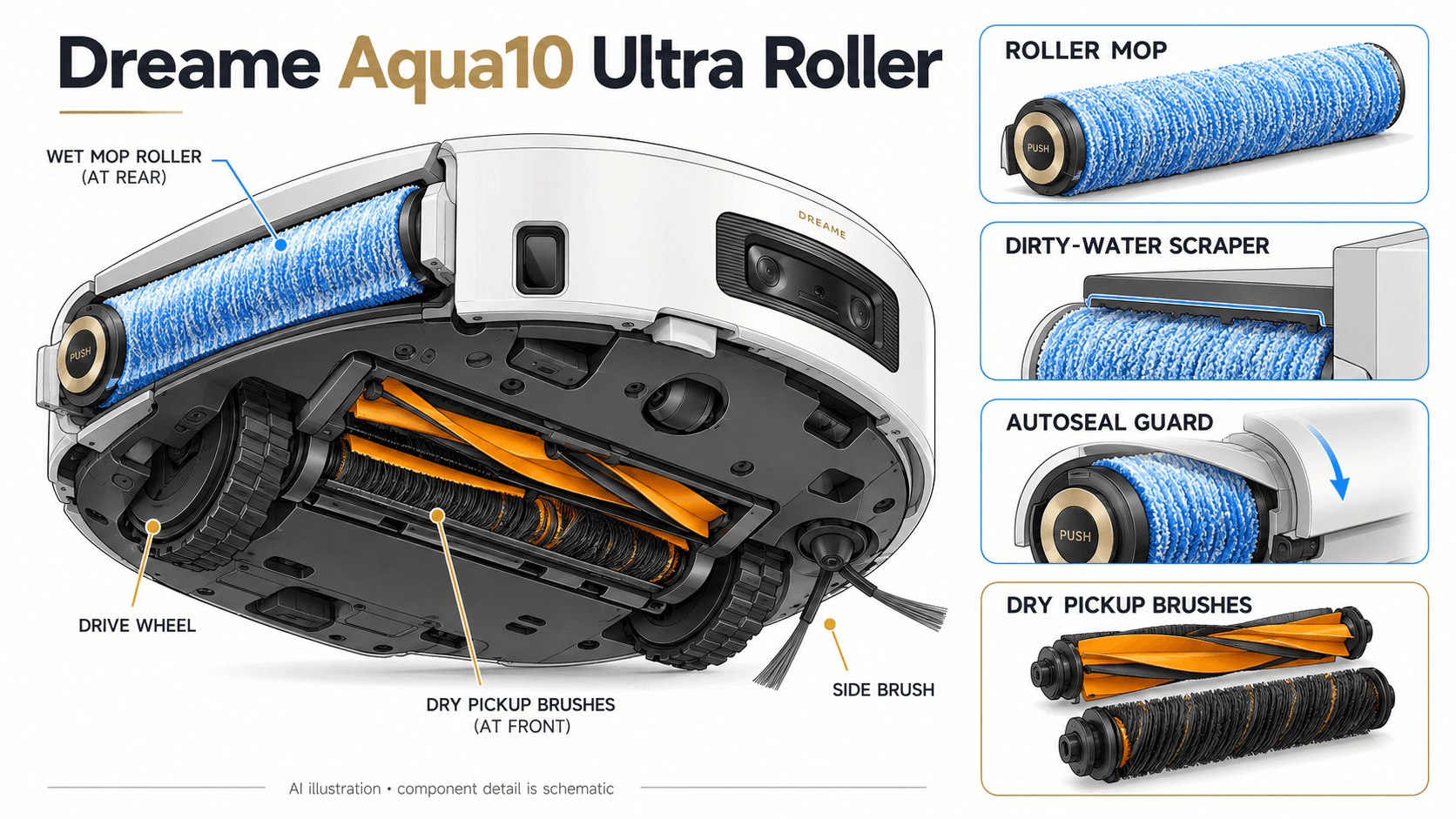
Best for frequently mopped kitchens, extensive hard flooring, and raised, stepped room transitions.
Roborock Saros 10R vs Dreame Aqua10 Ultra Roller: Specs Comparison
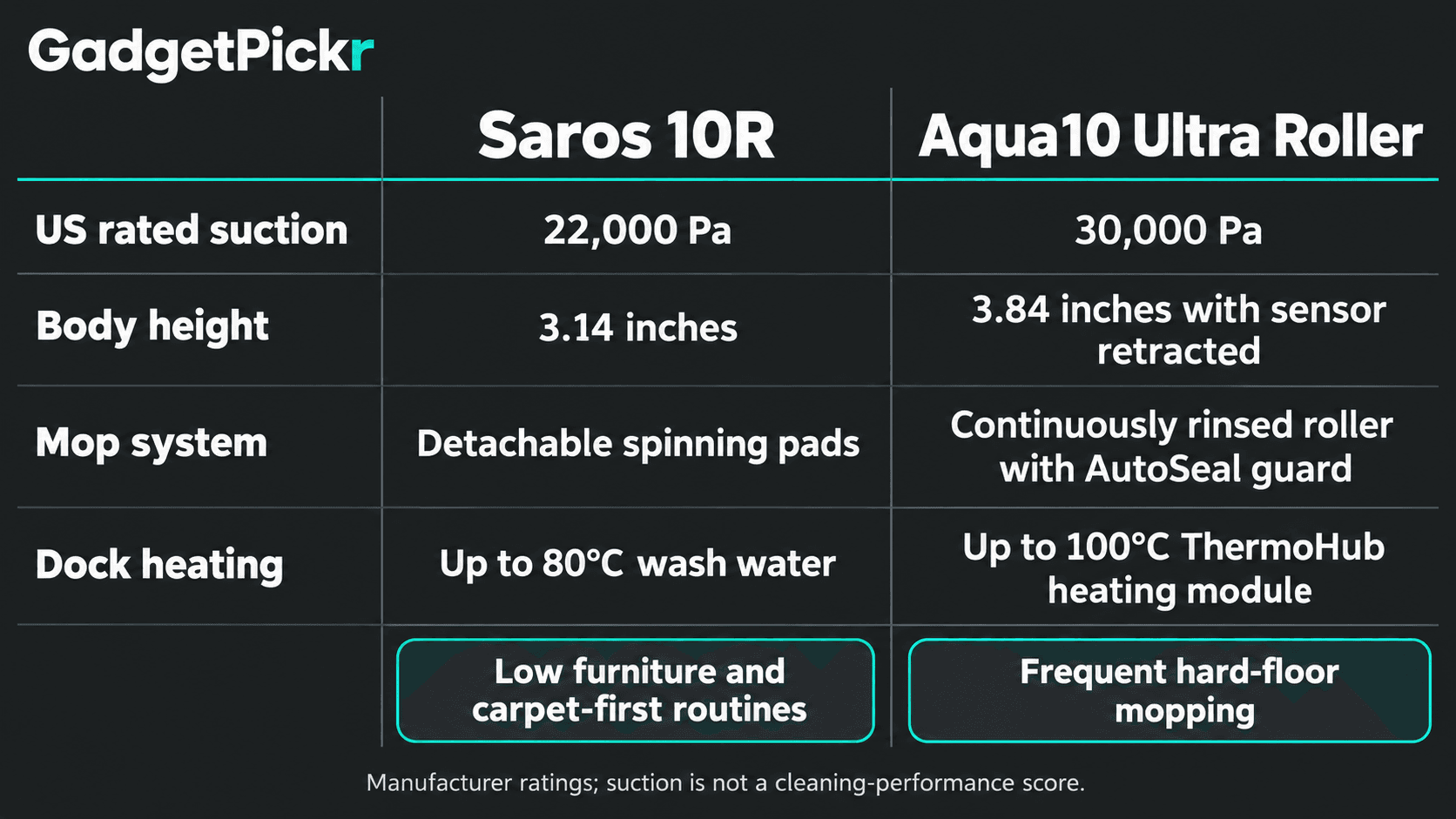
Furniture clearance and mop handling are more useful starting points than suction ratings. Vacuum pressure does not measure scrubbing ability, and a dock’s heating-module temperature does not describe the temperature applied to your floor. A dash means no supported figure is provided here.
| Specification | Roborock Saros 10R | Dreame Aqua10 Ultra Roller |
|---|---|---|
| Maximum Suction Power | 22,000 Pa, current US listing | 30,000 Pa |
| Mopping Mechanism | Dual rotating pads, up to 200 RPM; automatic dock detachment | Continuously rinsed roller; 9–11 N pressure; AutoSeal carpet guard |
| Chassis Height | 3.14 in (79.8 mm) | 3.84 in with navigation sensor retracted |
| Mop Washing Temperature | Up to 176°F (80°C) | ThermoHub heating module reaches up to 212°F (100°C) |
| Mop Drying Temperature | Up to 55°C heated air | Up to 158°F (70°C) |
| Threshold Crossing | Up to 4 cm, double-layer threshold | Up to 3.15 in (8 cm), double-layer; 1.65 in, single step |
| Battery Runtime | Up to 180 minutes, reported manufacturer rating | — |
| Battery Capacity | 6,400 mAh | 6,400 mAh |
| Dock Dirty Water Capacity | 3 L | 3.5 L |
| Dock Dust Bag Capacity | — | 3.2 L |
| Onboard Dustbin | 270 mL | 220 mL |
| Best For | Carpet-first routines and mixed-floor homes with low sofas | Frequent kitchen mopping and hard-floor layouts with taller stepped transitions |
Design & Build Quality
Measure beneath your furniture before choosing either robot. The Saros 10R’s 3.14-inch body has a clear clearance advantage over the Aqua10’s 3.84-inch body with its navigation sensor lowered. Roborock fits StarSight’s sensors into the body rather than using a raised top-mounted turret.
That difference matters beneath low media units, sofas, and platform beds. Check the entire route into the space, including supports and uneven undersides. The quoted robot height should not be treated as the exact gap needed in every room.
The Aqua10 devotes more of its design to the roller assembly and climbing hardware. Its navigation sensor retracts, but it remains taller than the Saros. Dreame specifies crossing double-layer thresholds up to 3.15 inches, with a separate 1.65-inch limit for a single step.
The larger figure does not mean it can climb a vertical obstacle of the same height. Measure the shape and depth of each transition as well as its total rise. A raised strip and a stepped doorway can present quite different challenges.
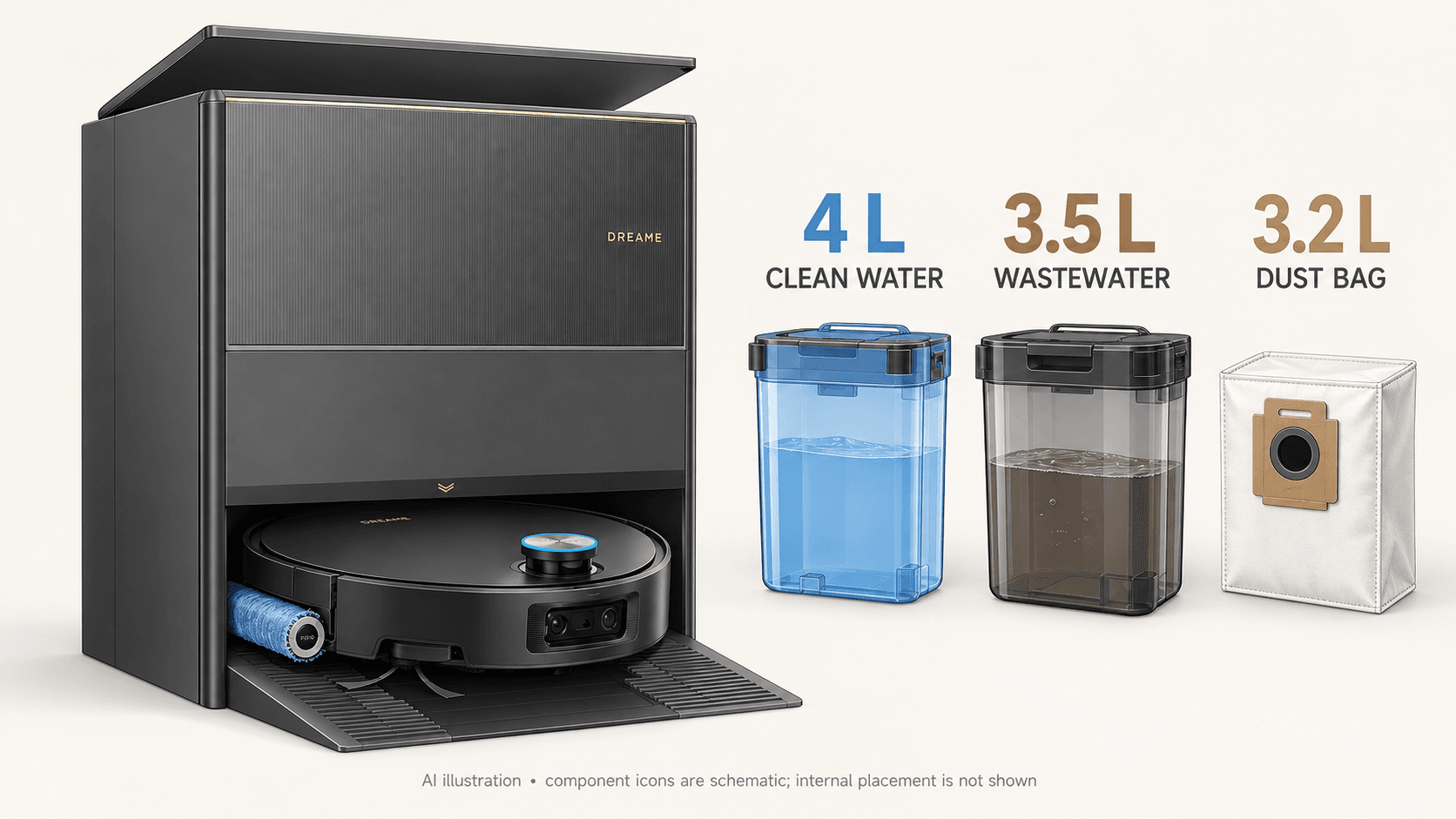
Roborock’s dock has a 4-liter clean-water tank and a 3-liter wastewater tank. Dreame’s specification table lists a 4-liter clean-water tank, while its FAQ says the base tank is 4.5 liters. Its listed wastewater capacity is 3.5 liters. The clean-water discrepancy needs resolving before making a firm capacity comparison, and tank size alone does not establish refill frequency.
Performance & Key Features
The Saros 10R combines dual pads spinning at up to 200 RPM with StarSight 2.0 navigation and VertiBeam lateral obstacle detection. Its US listing specifies 22,000 Pa suction. For mixed flooring, the more distinctive feature is automatic mop detachment before vacuum-only or carpet-first cleaning.
Enable the corresponding settings in the app to leave the mop assemblies at the dock. That keeps damp fabric off the robot during the selected carpet-cleaning routine. It is a specific reason to favor the Saros when tiled kitchens and carpeted bedrooms share the cleaning schedule.
The Aqua10 supplies fresh water to its roller while a scraper removes dirty moisture into a separate chamber. Dreame specifies 9–11 N of adaptive roller pressure alongside the 30,000 Pa suction rating. That water-handling process is the main reason to choose it for frequent hard-floor washing.
On carpet, the Aqua10 uses lifting mechanisms and an AutoSeal guard that covers the wet roller when carpet is detected. The roller remains attached. The Saros offers a more direct separation for carpet-only runs because its pads can stay at the station.
Both docks provide heated mop washing. Roborock specifies water up to 176°F, while Dreame’s ThermoHub heating module reaches up to 212°F during washing, followed by drying air up to 158°F. Dreame’s heating-module figure does not mean all wash water remains at boiling temperature.
Automatic washing and drying reduce the amount of mop handling left to you. They still leave tank emptying, wash-area cleaning, and accessory care in the ownership routine. The temperature specifications alone do not establish a hygiene winner.
Pros & Cons: Roborock Saros 10R
The Saros 10R’s strongest advantages are low clearance and automatic mop removal. Its slim body helps beneath furniture, while dock detachment lets it vacuum without wet pads aboard. That combination suits homes with bedroom carpet and kitchen tile.
The DuoDivide main brush and anti-tangle side brush are designed to guide hair toward the intake. FlexiArm extends the side brush and mop toward edges, and the dock handles dust emptying, robot water replenishment, mop washing, and drying.
The 270 mL onboard dustbin makes reliable dock emptying important during longer runs. Its suction rating is lower than Dreame’s, but the two pressure figures do not establish which collects more debris from carpet.
The Saros requires a 2.4 GHz Wi-Fi network; it does not support 5 GHz Wi-Fi. Also allow for cleaning solution in the ownership budget, since Roborock’s manual states that it is not included in the standard package.
Pros & Cons: Dreame Aqua10 Ultra Roller
Continuous roller rinsing is the Aqua10’s clearest reason to buy. Fresh-water delivery and dirty-water extraction operate during mopping, so refreshing the cleaning surface does not depend entirely on returning to the dock. That process makes it our pick when frequent hard-floor washing is the priority.
Other useful features include a 30,000 Pa suction rating, a 3.5-liter wastewater tank, a 3.2-liter dust bag, and climbing hardware for raised transitions. Both the side brush and mop extend toward boundaries. The station handles roller washing, drying, dust emptying, and robot water replenishment.
Height is the main compromise. The Aqua10 needs more furniture clearance even with its navigation sensor retracted. Its roller also stays attached during carpet cleaning, relying on lifting and the guard rather than removal at the dock.
Both robots have 6,400 mAh batteries, but equal capacity does not establish equal runtime or floor coverage. Cleaning settings and dock visits affect endurance, and a comparable, mode-specific Aqua10 runtime is not established here.
Real Buyer Scenarios
For low living-room furniture, carpeted bedrooms, and a tiled kitchen, choose the Saros 10R. Its height helps it reach underneath furniture, and detachable pads let it switch to carpet-only work without damp fabric aboard.
Pet owners should start with that same layout check. Anti-tangle hardware addresses hair wrapping; carpet pickup also depends on the brushes, floor covering, and cleaning settings. The Aqua10’s higher suction rating is not enough to settle the purchase.
For a home dominated by sealed hard flooring, with kitchen marks and muddy tracks creating regular mopping work, choose the Aqua10. Its continuously refreshed roller is more relevant to that routine than the Saros’s ability to leave its pads behind.
Taller transitions also favor Dreame when they match its specified single-step or double-layer geometry. Check the dimensions before assuming every room will be accessible. Neither cleaning system helps with a floor area the robot cannot reach.
Give the station an accessible position. You need room to lift out water tanks, replace dust bags, and clean the wash area. Automatic mop care reduces repetitive handling, but collected water and residue still need attention.
Alternatives Worth Considering
The Dreame Matrix10 Ultra is worth considering if you want different mop materials assigned to different areas. It combines a 30,000 Pa suction rating with a dock that switches mop sets, replacing the Aqua10’s continuously rinsed roller with a pad-based system and area-specific mop selection.
The Dreame X60 Max Ultra Complete offers a 3.13-inch body and a 35,000 Pa suction rating with dual spinning pads. It is close to the Saros in body height, while the main trade-off against the Aqua10 is giving up continuous roller mopping.
Final Verdict
Choose the Roborock Saros 10R for low furniture, carpeted bedrooms, and vacuum-only runs with the pads left at the station. Its strongest advantage is the combination of a slim body and detachable mops, which gives mixed-floor homes useful flexibility.
Choose the Dreame Aqua10 Ultra Roller for frequent hard-floor washing and taller stepped transitions within its specified limits. The continuously rinsed roller is its strongest buying argument. Its lifting system and roller guard address carpet crossings, while the Saros remains our pick when carpet-first cleaning and low clearance lead the purchase.
Sources & References
Specifications and claims in this analysis were cross-referenced against the sources below.
- Aqua10 Ultra Roller Robot Vacuum and Mop | Dreame USAdreametech.com
- Dreame Aqua10 Ultra Roller vs Roborock Saros 10Rrtings.com
- The 4 Best Robot Vacuums of 2026rtings.com
- Dreame Aqua10 Ultra Roller vs Roborock Saros 10R: Which ...roboratings.com
- Aqua10 Ultra Roller Robot Vacuum and Mop | Dreame CAca.dreametech.com
- Saros 10R - Beyond Slim. Beyond Powerful.us.roborock.com
- Roborock Saros 10R vs Dreame Aqua10 Ultra Roller Completegalaxus.be
- 【Certified Refurbished 90% New】Roborock Saros 10R Robot ...us.roborock.com
Frequently Asked Questions
Choose the Saros 10R for its detachable mop pads. With automatic removal enabled, it can leave them at the dock for vacuum-only cleaning. The Aqua10 uses lifting mechanisms and a roller guard, but its roller remains attached.