TCL QM8K Review: Mini LED Brightness Without the OLED Price Tag
Our spec-based TCL QM8K review breaks down the Mini LED QLED panel's contrast, 144Hz gaming performance, and anti-reflective screen — plus exactly who should buy it and who should skip it.
Noureddine M.··Specification analysis — not hands-on tested
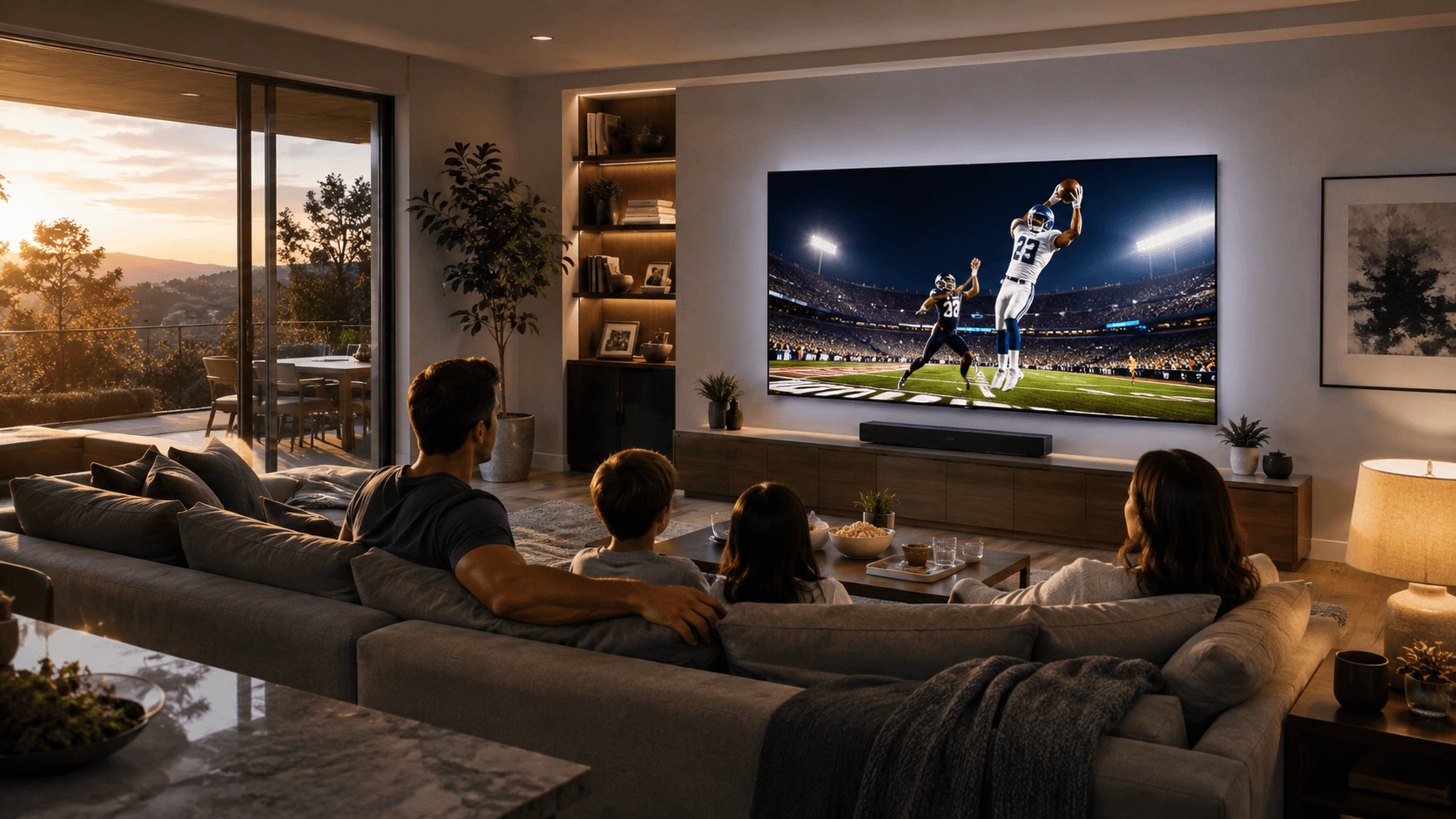
If your living room gets flooded with afternoon sun, you already know the problem: OLED looks fantastic until 2pm, then washes out the second direct light hits the panel. That's the exact gap TCL is chasing with the QM8K, and it's why this TCL QM8K review keeps coming back to one word: brightness. This is a spec-based analysis using published manufacturer specifications and market comparisons. No hands-on testing was conducted.
Here's the pitch, boiled down. Pack the backlight with a high density of individually controlled dimming zones, layer quantum dots on top for color, and you get contrast that inches toward OLED territory without OLED's burn-in risk or its fear of sunlight. That combination puts the QM8K squarely in the mid-to-high-tier bracket, going head to head with brand names that usually charge more for the same basic promise.
Home theater fans and console gamers are the two groups this TV was built around, and the spec sheet reflects that priority order everywhere you look — from the dimming architecture down to the port selection. What follows breaks down the hardware, where it earns its keep, and where you're better off looking elsewhere.
Some links in this article are affiliate links, which helps support GadgetPickr at no extra cost to you.
The Quick Take
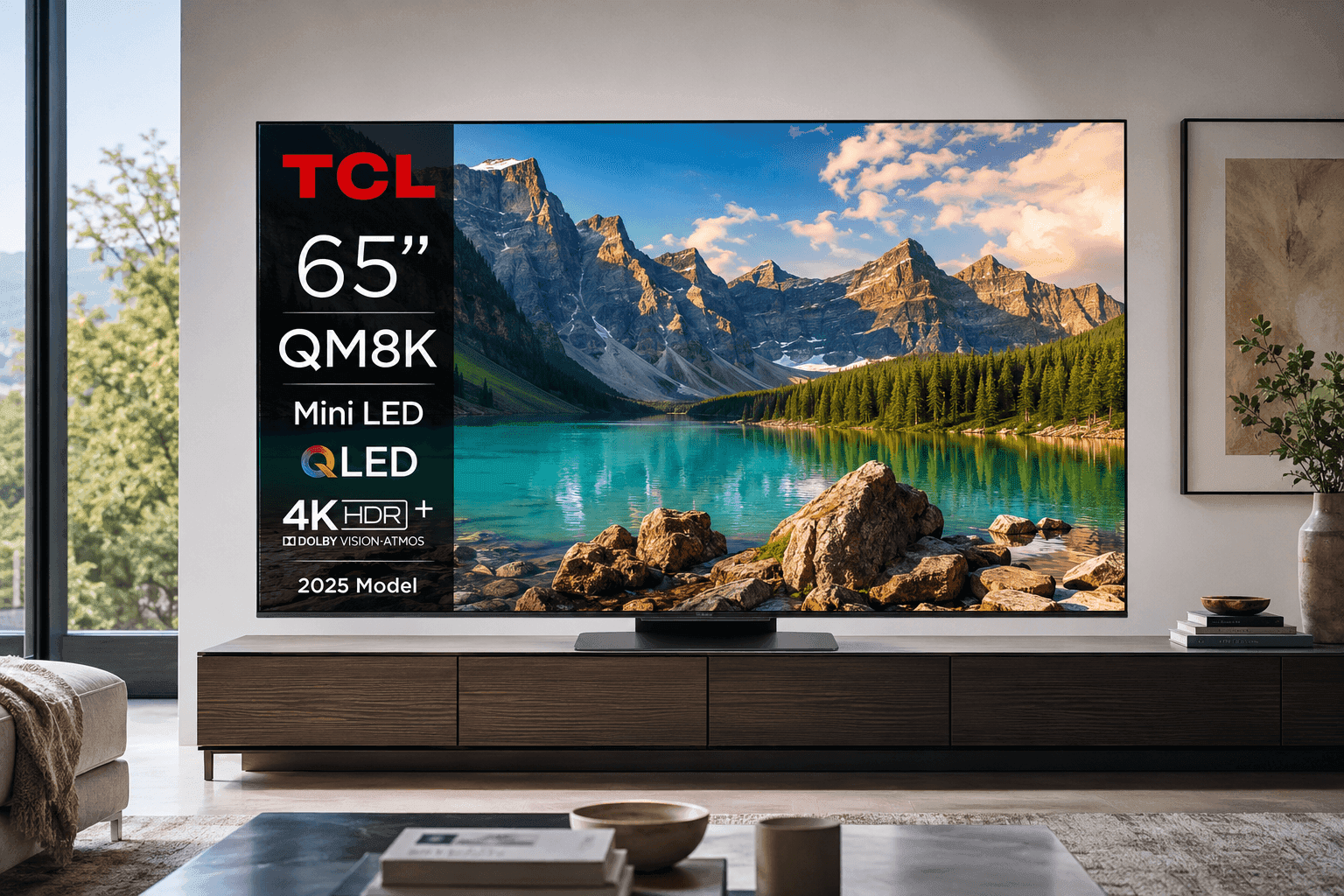
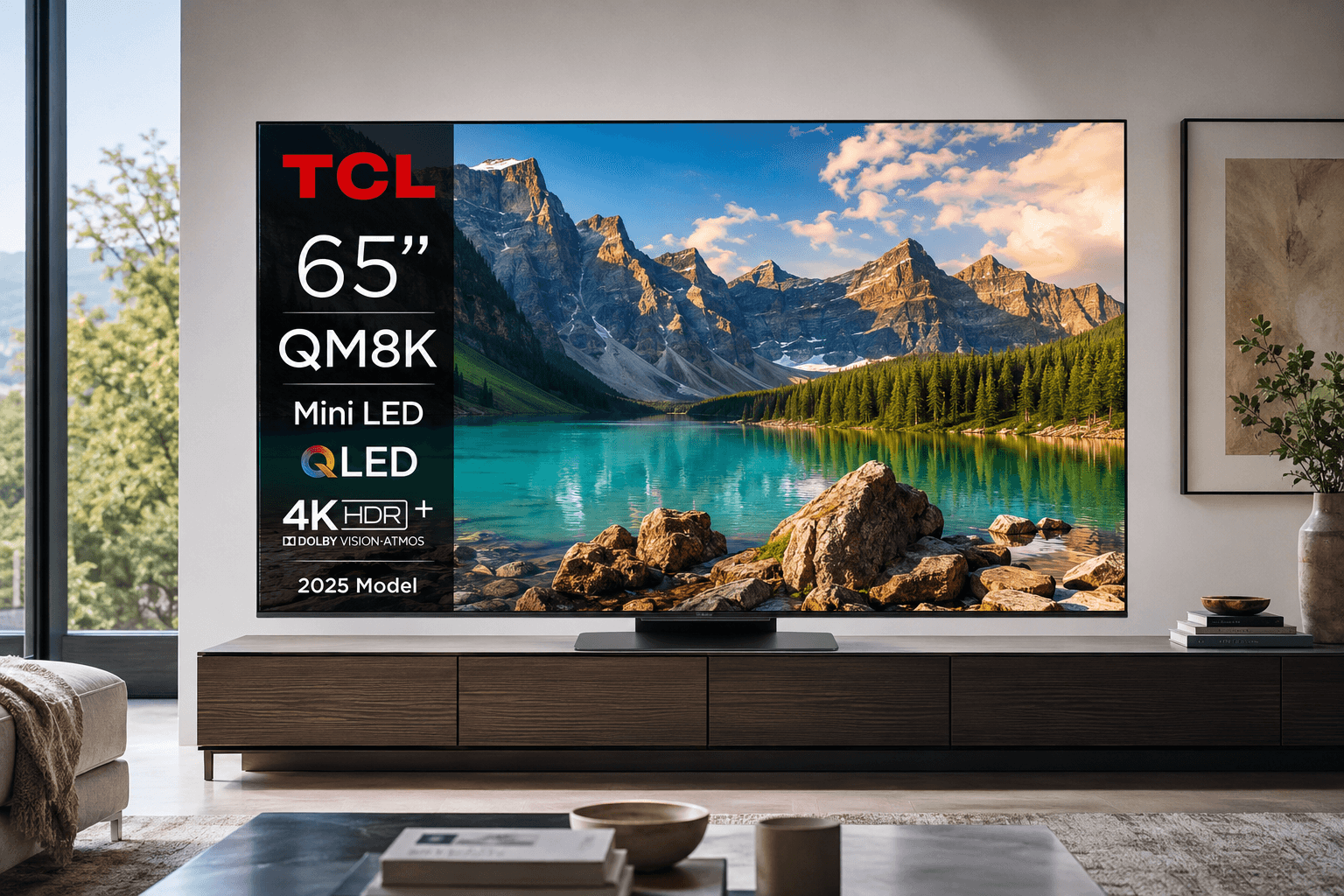
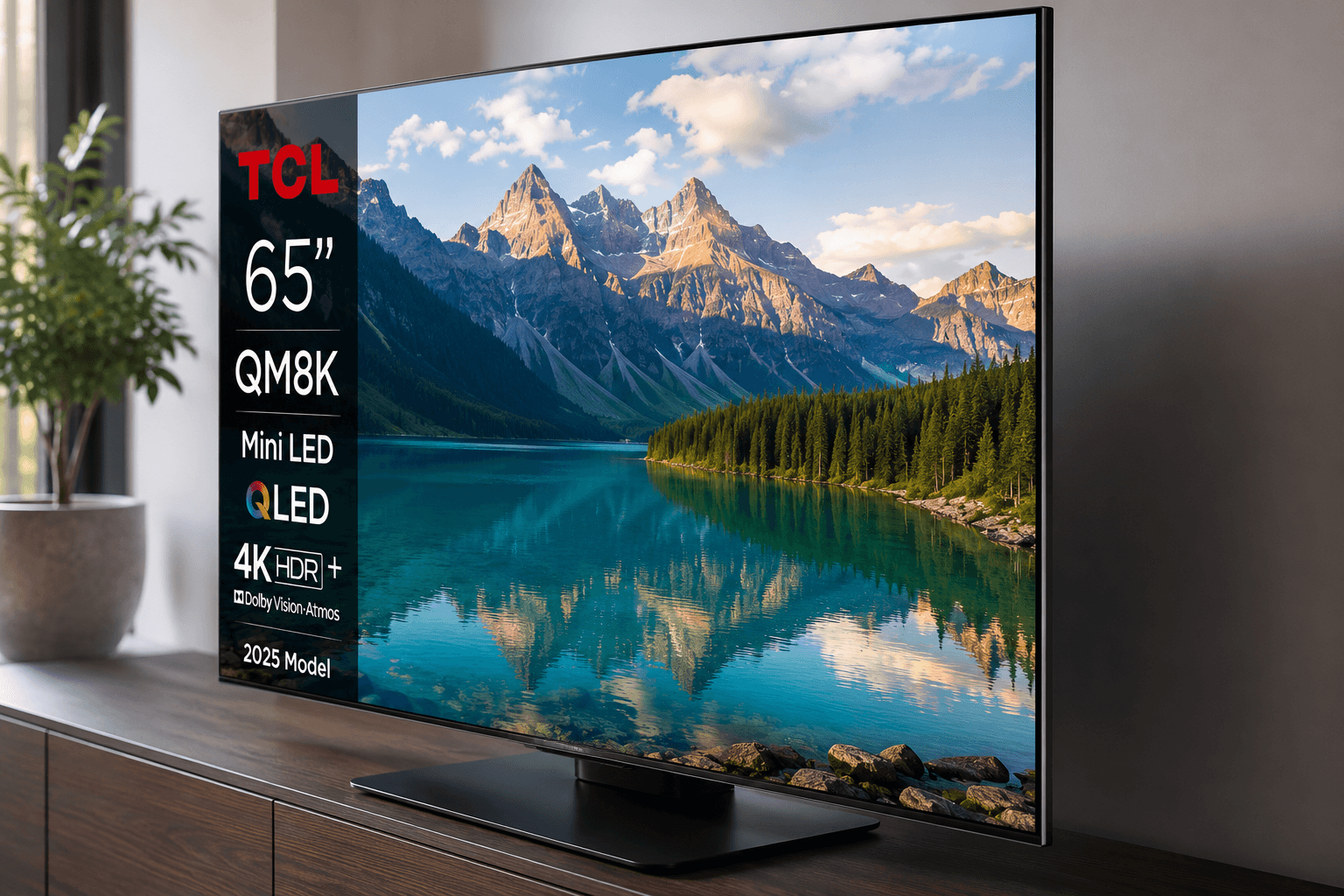
At a glance, the TCL 65-Inch QM8K Mini LED QLED 4K TV (2025 Model) is a bright-room specialist that leans on Mini LED backlighting and a QLED color layer to get contrast and highlight punch most LED TVs can't touch, and it backs that up with gaming specs and a smart platform that don't feel like an afterthought.
Verdict
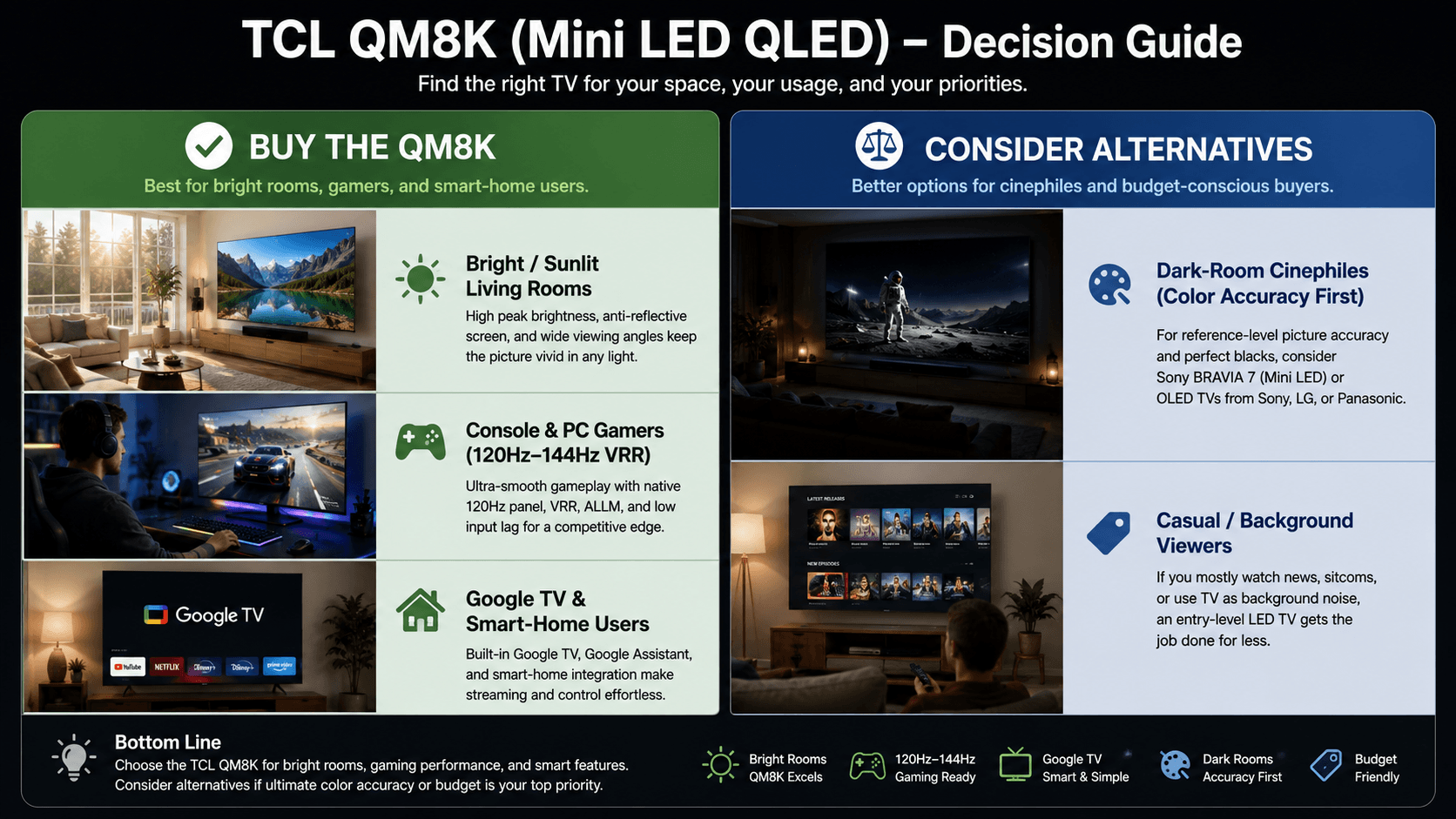
This TCL QM8K review comes down to a straightforward trade: Mini LED backlighting and a QLED color layer get contrast that pushes toward OLED territory, and the anti-reflective wide-angle screen solves the bright-room and off-angle problems that usually plague LED TVs. Gamers get real value out of the 120Hz-144Hz refresh range and low input lag, especially paired with a current-gen console or gaming PC.
Buy it if you want a bright, contrasty, gaming-capable TV without paying flagship-OLED or Neo QLED prices — that's the single strongest case for the QM8K. Skip it if dark-room color accuracy is your top priority or you're not gaming and don't need the extra brightness; a proper OLED or a basic entry-level LED TV will serve those two groups better, respectively. For everyone else — bright rooms, mixed-use households, dedicated gaming setups — this sits in a smart spot between mid-range value and high-end luxury.
TCL QM8K
Premium home theater, high-refresh rate gaming, bright room viewing
Mid-to-high-tier pricing, positioned below flagship OLED and Neo QLED rivals
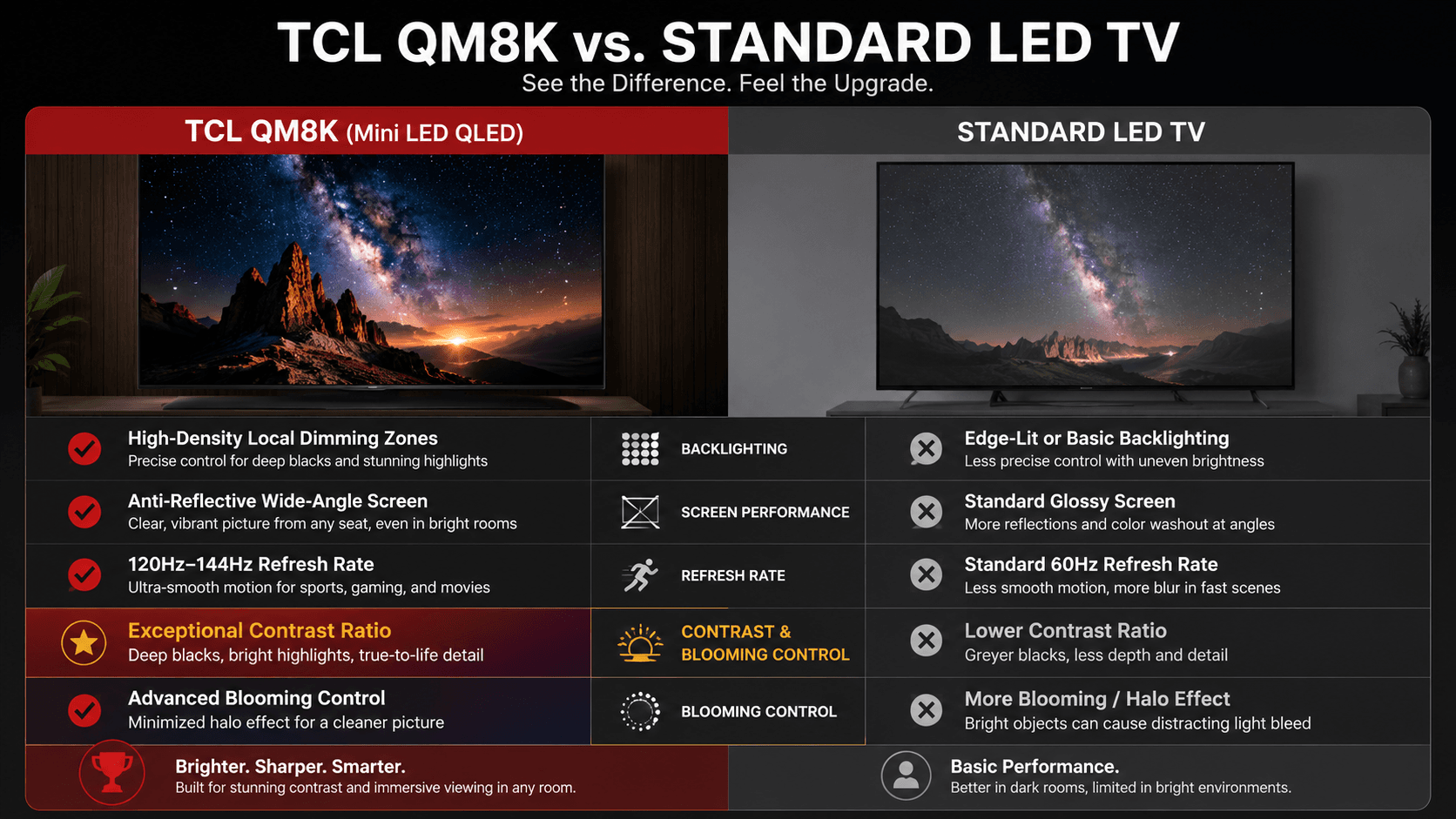
Strip away the marketing language and the QM8K comes down to two technologies stacked on top of each other. Mini LED backlighting supplies the raw light, broken into a dense grid of individually dimmable zones, and a quantum dot filter layer sits above it to sharpen and saturate the color. The result is a picture that gets close to OLED-level black depth while still hitting far higher peak brightness — the classic Mini LED trade-off, just executed with more zones than TCL's older panels.
More zones means finer control, which matters most when a bright object sits against a dark background. Cheap LED TVs bloom in that situation — you'll see a hazy glow around subtitles or a spaceship against a starfield. TCL's dimming algorithm is built specifically to keep that halo contained, and it's the single biggest reason this panel can chase OLED-like contrast while still being bright enough to fight back against a sunny window.
For the 2025 model year, TCL also added an anti-reflective, wide-angle screen coating. This is the fix for the classic VA-panel complaint: sit off to the side of a standard LED TV and the picture washes out fast because the liquid crystal layer simply doesn't transmit color evenly once you're off-axis. The new coating holds onto contrast and color from an angle, which is genuinely useful if your couch isn't centered dead-on with the screen, and it cuts glare from windows or overhead lighting during the day — a small hardware change that solves two separate complaints at once.
On the resolution side, you're getting native 4K UHD across the board. To support modern gaming consoles and high-performance PCs, the panel features a variable refresh rate up to 288Hz, with a native refresh rate of 144Hz at 4K. Pair it with a PlayStation 5, an Xbox Series X, or a gaming PC, and the display syncs to the source frame rate on its own — no software-side V-sync juggling required. Google TV runs the smart platform, pulling your streaming apps into one home screen, and it handles voice control and smart home integration without much fuss. Physically, it's a slim-bezel design on a central pedestal stand, so the 65-inch panel doesn't dominate a media console the way older, chunkier TVs used to.
TCL QM8K Review: Key Specs and Compatibility
Connectivity is where a TV either earns its home-theater ambitions or falls short of them, so it's worth a close look. The television features built-in support for Dolby Atmos, allowing it to decode multi-dimensional audio formats directly. To pass that audio through to an external soundbar or AV receiver, the chassis includes HDMI eARC capability for uncompressed transmission. The port selection includes two HDMI 2.1 bandwidth inputs (not all inputs), which support 4K @ 144Hz, VRR, and ALLM [1][2][4]
Zoom out and the QM8K's real competition is the Hisense U8N, the Samsung QN90D, and the Sony BRAVIA 7 — the usual suspects in this bracket. Samsung and Sony both lean on brand reputation and proprietary processing to justify asking more money, but on raw refresh rate the TCL matches or beats them at up to 144Hz. Google TV also gives you a more open, customizable app ecosystem than Samsung's Tizen platform, which some buyers will actually prefer.
None of this matters if the ports can't keep up, and that's the part shoppers tend to skip past. A gaming setup with two next-gen consoles and a PC will lean on every one of those HDMI 2.1 inputs, so it's worth confirming how many full-bandwidth ports the specific size you're buying actually has before you assume you can run everything at once. Put simply: you're getting gaming specs and bright-room performance that punch above the price bracket TCL is playing in.
What Stands Out
Backlight architecture is where the QM8K makes its first impression. Mini LED plus a QLED color layer gets you luminance and contrast that would've required spending a lot more money just a couple of years ago. The high-density local dimming zones are doing the heavy lifting — they keep bright subtitles and specular highlights crisp against dark backgrounds instead of smeared into a gray halo.
Then there's that anti-reflective, wide-angle screen. It's a direct answer to the biggest gripe people have with bright, contrasty TVs: sit off-center or in a room with bad window placement, and the picture usually falls apart. This coating diffuses reflections from windows and lamps and holds onto color saturation even from an angle — genuinely handy in a wide living room where nobody's getting the dead-center seat.
Google TV on this generation feels more mature than it did a couple of years back. It's responsive, it pulls streaming, live TV, and smart home controls into one dashboard, and paired with that 120Hz-to-144Hz refresh range, motion stays clean during sports and fast action sequences. Add Dolby Atmos processing and you've got a TV that feels like a home theater centerpiece out of the box — enough to put it in the same conversation as the Hisense U8N, Samsung QN90D, and Sony BRAVIA 7.
Strengths
Bright rooms are where this TV is happiest. The high-brightness Mini LED panel cuts through sunlight without the color washout you'd get from a cheaper LED set — daytime sports, talk shows, news broadcasts in a sun-drenched living room, all of it stays saturated instead of looking pale.
At night, it's a different TV. Local dimming pushes black levels close to what you'd expect from a self-emissive panel, so dark, moody scenes hold their shadow detail instead of crushing into a gray mess. HDR content benefits the most here, since the whole format depends on that gap between shadow and highlight being as wide as possible. Google TV keeps day-to-day use easy too — recommendations are decent, and hands-free voice control means you're not always hunting for the remote.
Gamers get a genuinely capable setup. Refresh rates up to 144Hz keep motion smooth, fast-moving objects stay sharp instead of smearing, and variable refresh rate support kills screen tearing during intense action. Jumping from a streaming app straight into a high-frame-rate gaming session doesn't require any real adjustment period — the hardware just handles it.
Weaknesses
Nothing here is a dealbreaker, but a few trade-offs are worth knowing before you buy. The anti-reflective, wide-angle coating is a real improvement over standard VA panels, but it doesn't erase off-angle color shifting entirely. Sit at the far end of a sectional and you'll still notice a slight contrast dip compared to the sweet spot dead-center.
Audio is the other soft spot. Dolby Atmos decoding creates a wider virtual soundstage, sure, but the physical speakers crammed into a thin TV chassis simply can't deliver the depth or impact of a real multi-channel setup. If the picture quality here is going to make you want matching audio, budget for a soundbar or AV receiver — don't expect the built-in speakers to carry a home theater on their own.
There's also the inherent limitation of zone-based backlighting. In extremely high-contrast scenes — white text on a black screen is the classic example — sensitive viewers might catch a faint halo or bloom around the edges as the dimming algorithm balances peak brightness against black level. TCL has clearly worked on this for the 2025 model, but it's a characteristic of Mini LED, not a bug that's ever fully going away short of switching to self-emissive tech.
And if you're the type who wants to grab a TV and go, fair warning: the picture settings menu is deep enough that dialing in SDR and HDR calibration can feel like more work than it should. You'll get the best results by spending a few minutes in the settings rather than trusting the out-of-box preset, which is a small ask but a real one for buyers who just want to plug in and watch.
Best Alternatives
Hisense's U8N is the most direct comparison point — same Mini LED approach, similarly aggressive peak brightness and black levels. The trade-off is mostly about software preference: Hisense's motion interpolation and interface appeal to a specific crowd, while the TCL counters with a more polished Google TV experience and that anti-reflective screen coating Hisense doesn't match.
Samsung's QN90D is the brand-name pick, running Tizen with a dedicated gaming hub and Samsung's usual polish. It also typically costs more, so the QM8K ends up the better value play if you want comparable high-refresh gaming and Mini LED contrast without paying for the Samsung badge.
Sony's BRAVIA 7 is the one to consider if color accuracy is your priority over raw brightness — Sony's cognitive processor handles color gradation and shadow detail with real precision, and its upscaling of lower-resolution content is a genuine strength. You're trading the QM8K's brighter picture and stronger gaming spec sheet for that processing refinement, and you'll pay more to make that trade.
Bottom line on alternatives: pick the TCL for brightness and value, the Samsung if you're already in that ecosystem and gaming hub matters, and the Sony if color science is non-negotiable and you don't mind paying for it.
Who Should Buy It
If your living room has big windows or just gets a lot of ambient light, this is the TV built for that problem — full stop. The Mini LED QLED panel cuts through glare, and the anti-reflective wide-angle screen means people sitting off to the side still get a solid, high-contrast picture instead of a washed-out one.
Console and PC gamers should also be paying attention. Refresh rates spanning 120Hz to 144Hz deliver the smooth, low-latency response competitive and fast-paced games actually need. And if you want a unified smart home hub with reliable voice control, Google TV covers that too. The single strongest reason to buy: near-OLED contrast and serious brightness without paying flagship-OLED prices.
Commission may be earned from this link, at no extra cost to you.
Who Should Skip It
Cinephiles chasing absolute color accuracy over raw brightness are the group most likely to be unhappy here — the local dimming algorithm can get a little aggressive during dark scenes with bright subtitles, and that occasional blooming will bother a trained eye. A proper OLED, or something like the Sony BRAVIA 7, is the better match if that's your priority, even at a higher price.
Casual viewers who mostly use their TV for background news or daytime noise are the other group — you're paying for 144Hz gaming and Mini LED brightness you'll never touch. The single strongest reason to skip it: if you're not gaming and not chasing HDR home-theater performance, a standard entry-level LED TV gets you the same daily experience for a lot less money.
Sources & References
Specifications and claims in this analysis were cross-referenced against the sources below.
Yes. It supports refresh rates up to 144Hz with VRR and ALLM over HDMI 2.1, giving consoles and gaming PCs smooth motion and low input lag without screen tearing.