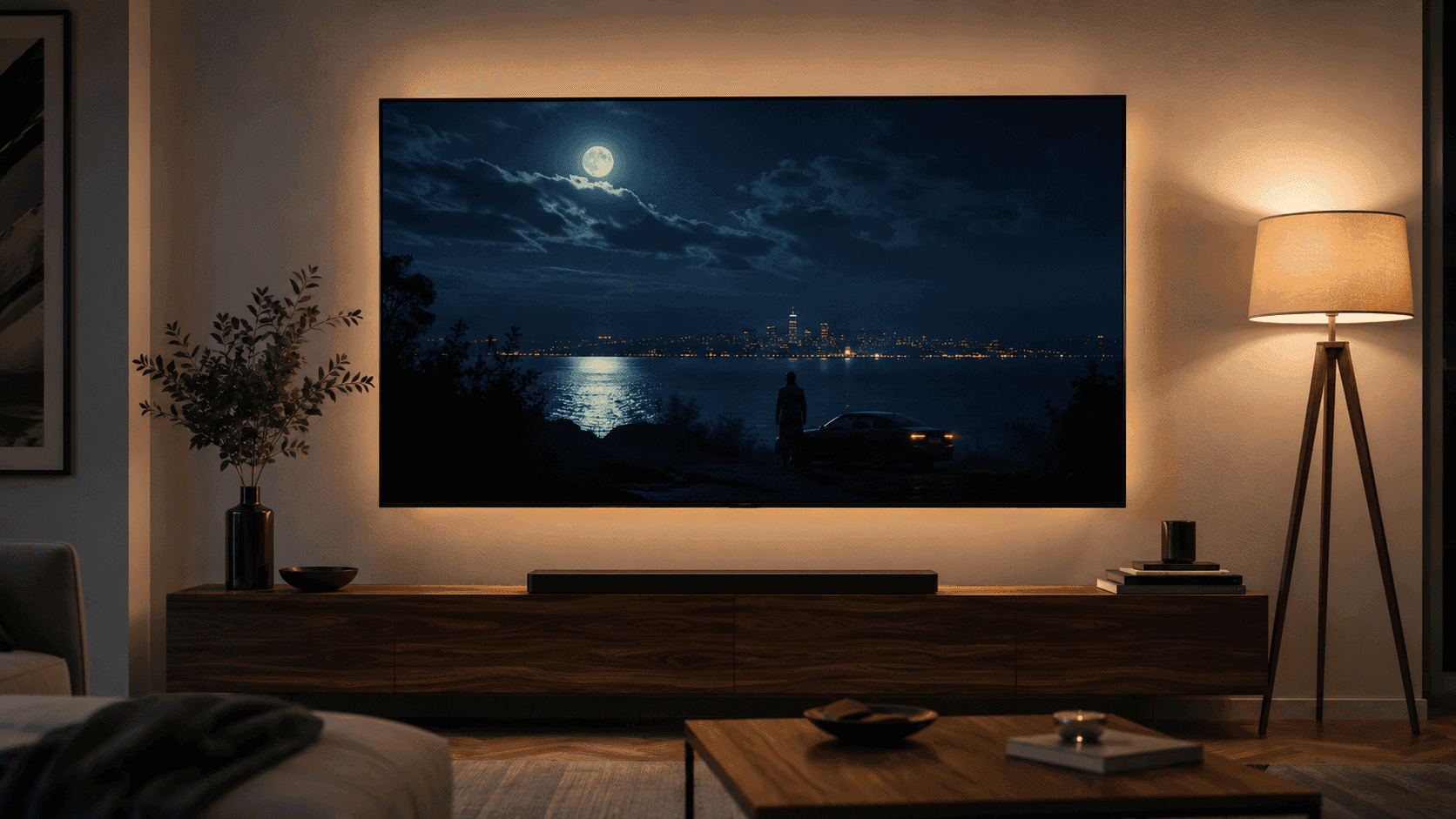
Sony BRAVIA XR A95L Review: QD-OLED Color at OLED Contrast
A spec-based look at the Sony BRAVIA XR A95L QD-OLED TV: panel architecture, Cognitive Processor XR, 120Hz gaming features, and the HDMI port limit that decides whether it fits your setup.
Noureddine M.··Specification analysis — not hands-on tested
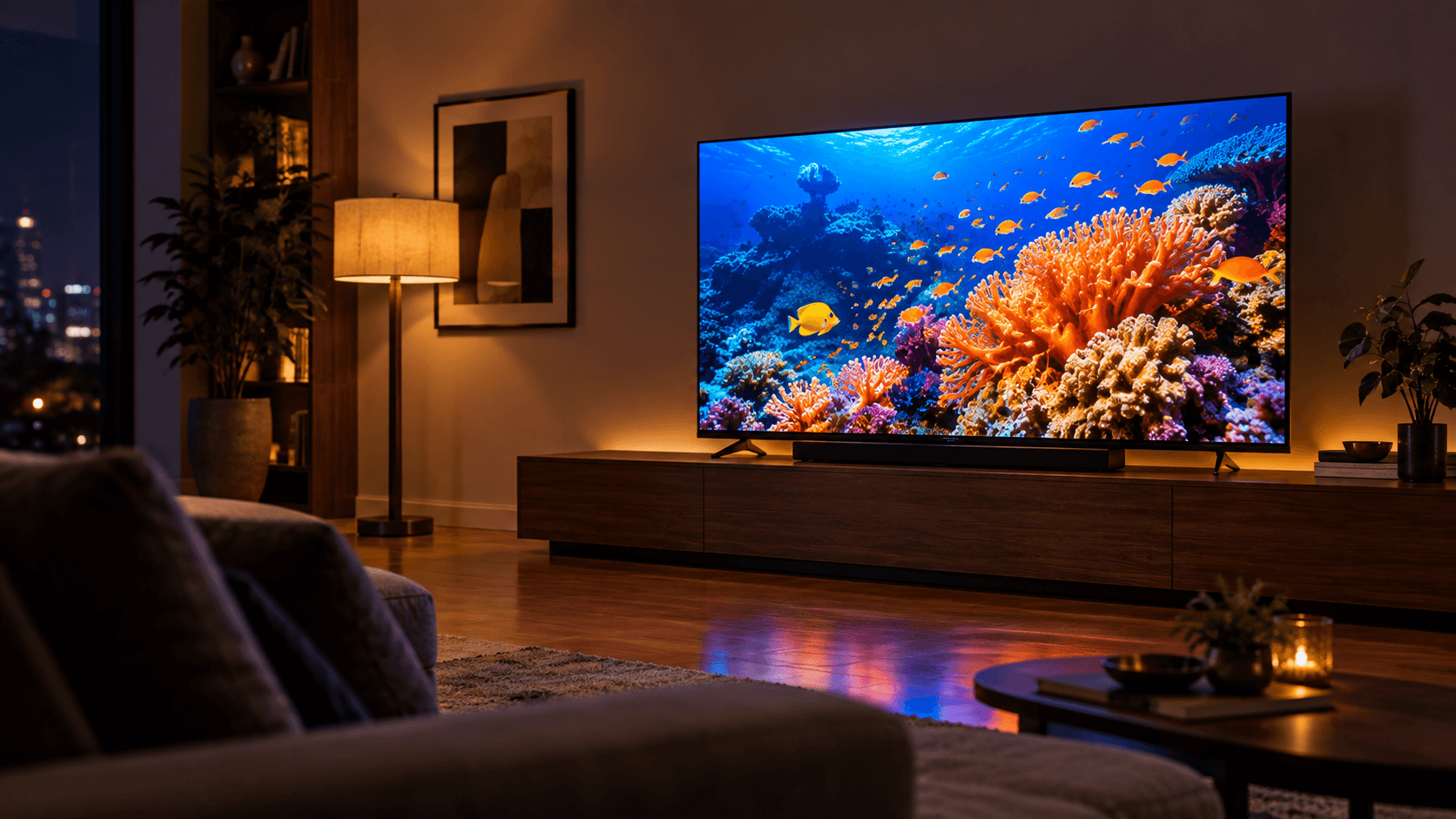
Flagship TV shopping usually collapses into one awkward question: what happens when a single frame has to be very dark and very bright at the same time? Sony's BRAVIA XR A95L answers it by pairing a Quantum Dot OLED (QD-OLED) panel with the Cognitive Processor XR, and by aiming squarely at cinephiles and purpose-built home theater rooms rather than at everyone. The pitch is refreshingly narrow. You stop choosing between the deep blacks organic LEDs are known for and the peak brightness that modern HDR mastering simply assumes you have.
QD-OLED gets there on a different road than the WOLED architecture inside most OLED sets. Blue self-emitting OLED layers excite quantum dot color converters, which is why saturation holds as luminance climbs instead of drifting toward white. Film is not the only target, either. There is PlayStation 5-aware behavior wired into the set and a 120Hz panel underneath it, so the same screen that handles a slow, shadowy drama also has to keep up with a shooter running at high frame rates.
This is a spec-based analysis using published manufacturer specifications and market comparisons. No hands-on testing was conducted. Everything in this Sony BRAVIA XR A95L QD-OLED 4K Smart TV review comes from published specifications and from how the set lines up against flagship rivals like the LG G4 OLED and Samsung S95D. Read the panel architecture, the processing stack, and the port layout in that order, and you will know quickly whether this display belongs in your room or whether your money is better spent elsewhere.
Some links in this article are affiliate links, which helps support GadgetPickr at no extra cost to you.
The Quick Take
Sony's flagship marries pixel-level OLED contrast with quantum dot color volume, so highlights stay saturated instead of bleaching toward white. Ideal for dark-room film nights and PlayStation 5 owners who want the console tuned for them. Frustrating if your rack holds a gaming PC, two consoles, and an eARC soundbar.
Verdict
Sony's flagship is the most complete argument yet for QD-OLED: self-emissive contrast married to the color saturation and high peak luminance quantum dots bring, with none of the white-subpixel compromise that flattens highlights on conventional OLED. XR processing handles nuanced image work, realistic depth, and highly accurate color across Dolby Vision, HDR10, and HLG. Vivid highlights alongside deep, inky blacks with no blooming — that combination is why this Sony BRAVIA XR A95L QD-OLED 4K Smart TV review lands where it does for home cinema purists.
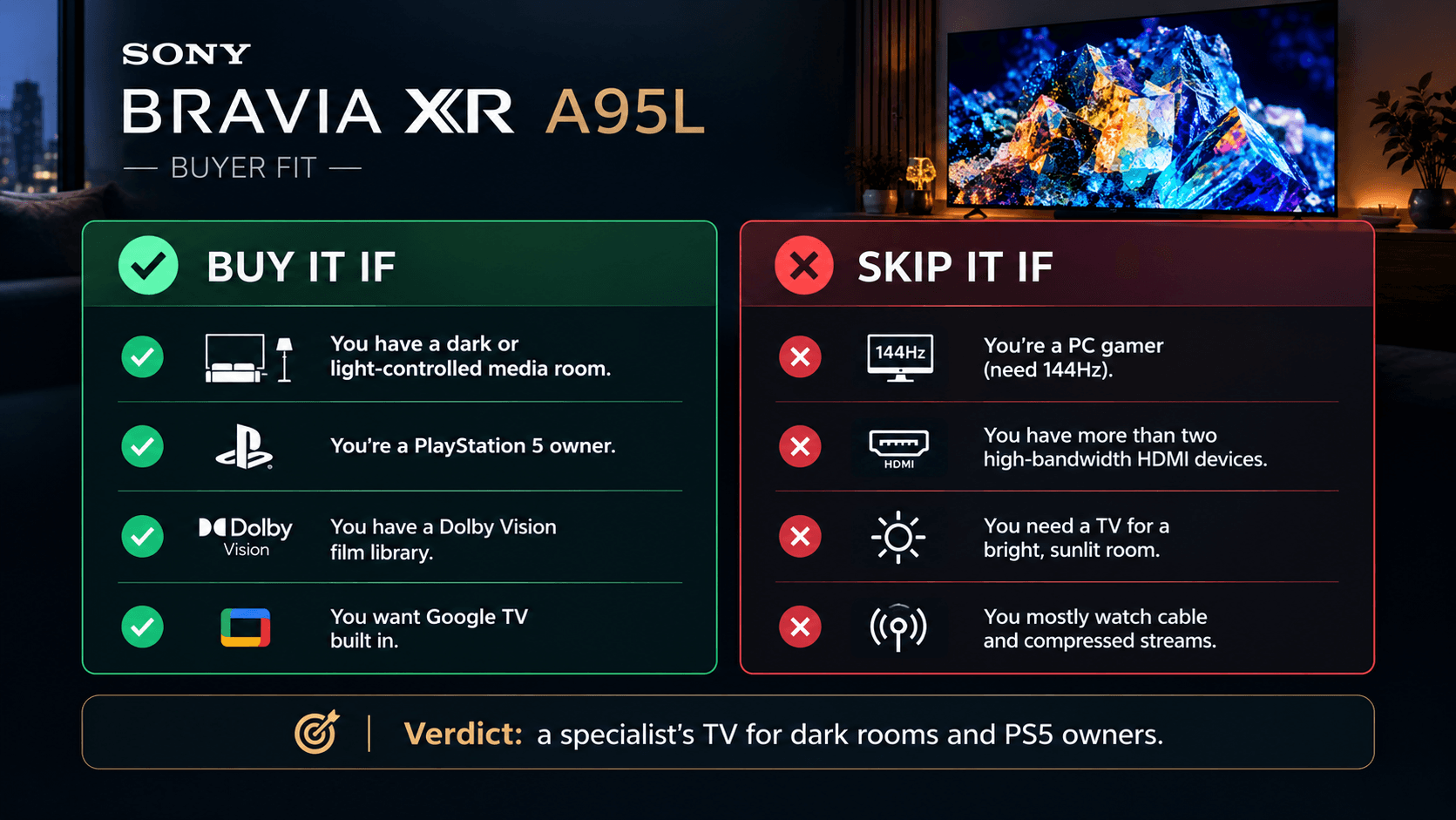
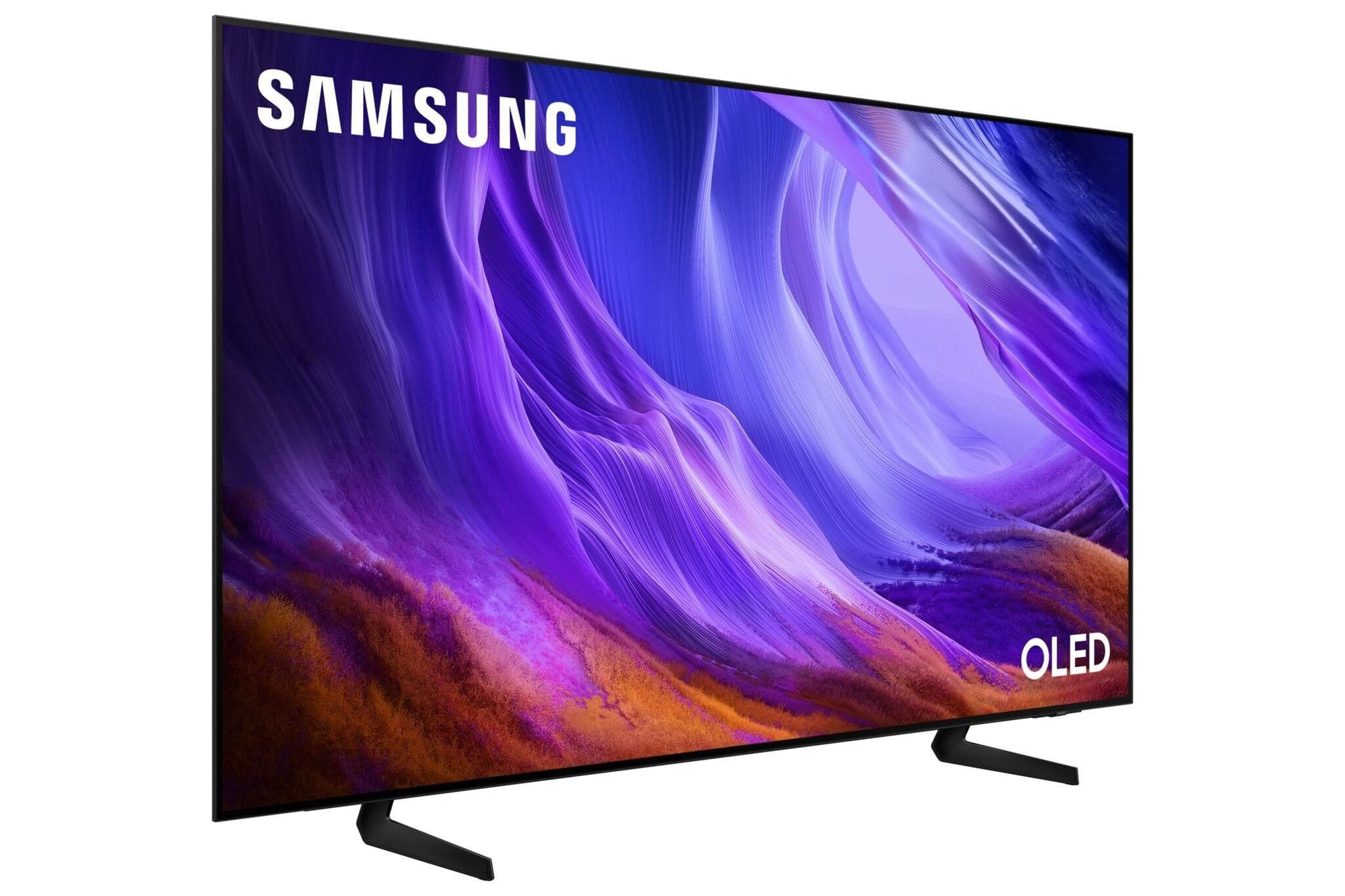
Buy it if you watch films in a light-controlled room or own a PlayStation 5, because nothing else pairs this contrast with console-specific tuning. Skip it if you need more than two high-bandwidth HDMI ports or a 144Hz ceiling, because that limit never moves and no firmware update will change it. The LG G4 OLED answers the port and refresh question with four full-bandwidth HDMI 2.1 inputs; Samsung's flagship S95D counters with intense QD-OLED brightness and an anti-glare finish, though it sacrifices Dolby Vision support to do it.
In the end, the A95L rewards one specific setup: a controlled-light room, a PS5 on the good HDMI port, and a viewer who would rather have color accuracy, realistic tone processing, and high-end upscaling than a fourth high-speed input. Fit that description and its market position makes sense. Don't, and one of the alternatives above will make you happier for less money.
Sony BRAVIA XR A95L QD-OLED 4K Smart TV
4K HDR movie watching, PS5 gaming, high-end home theater
Sony BRAVIA XR A95L QD-OLED 4K Smart TV Review: Product Overview
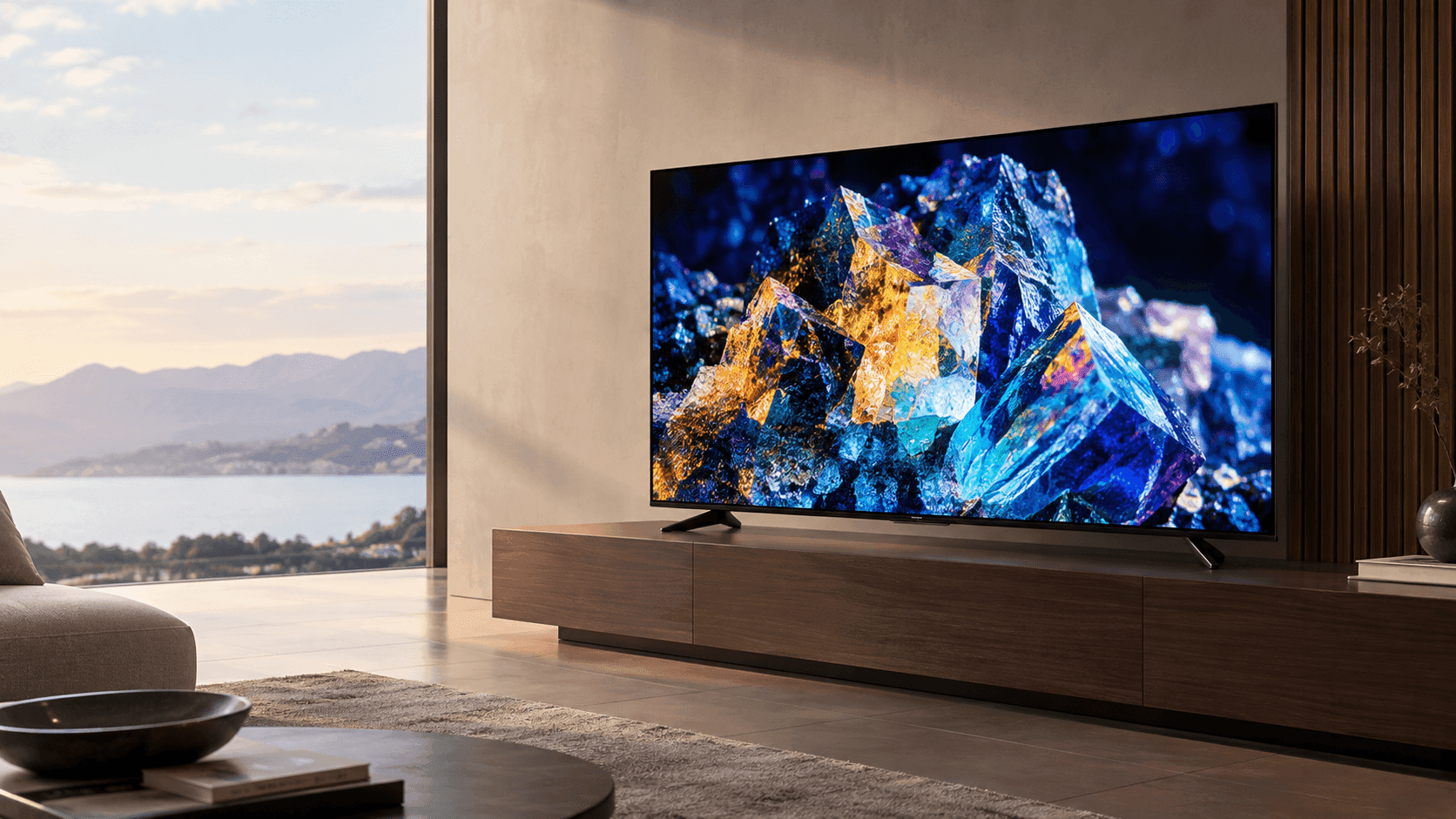
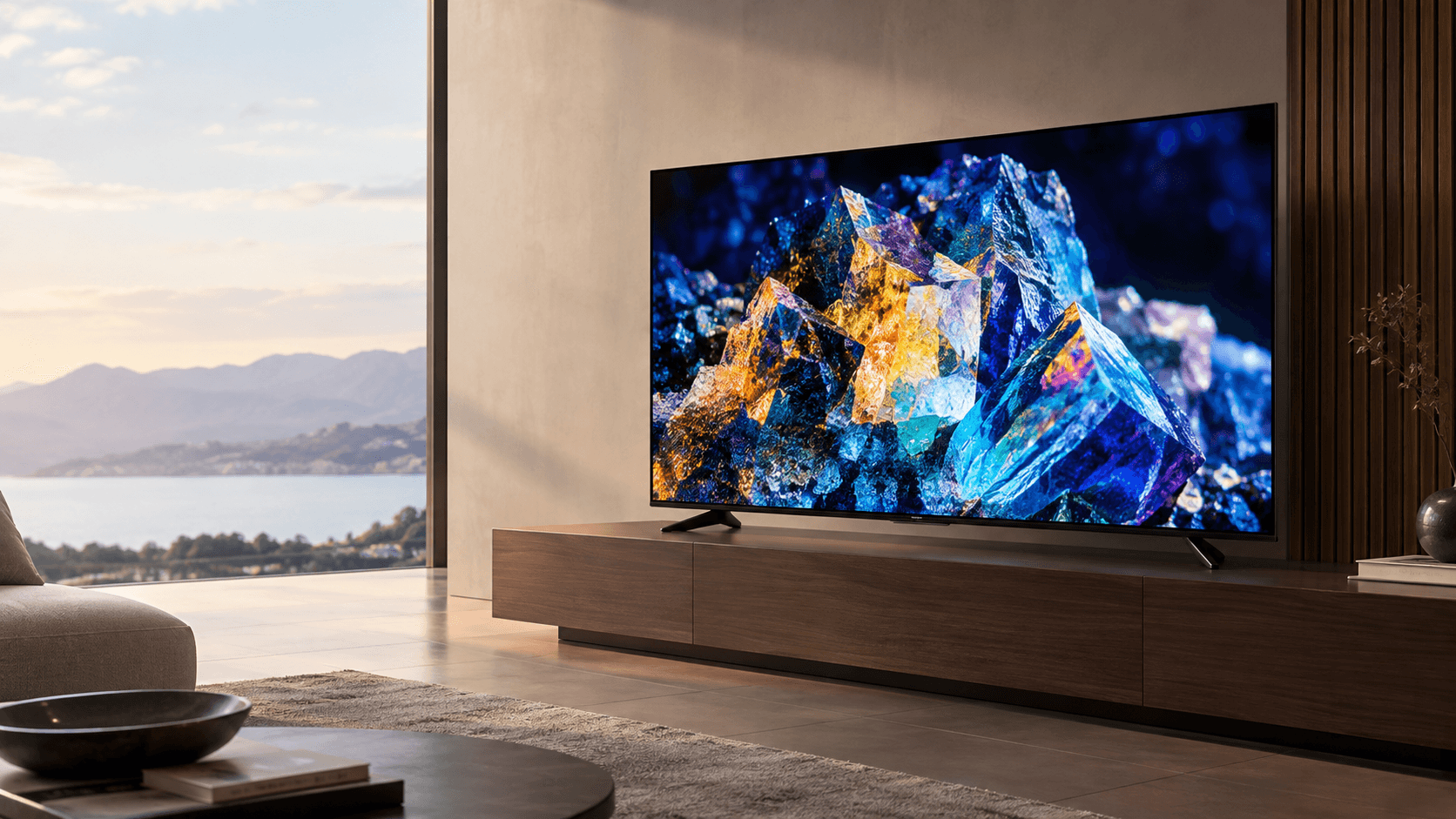
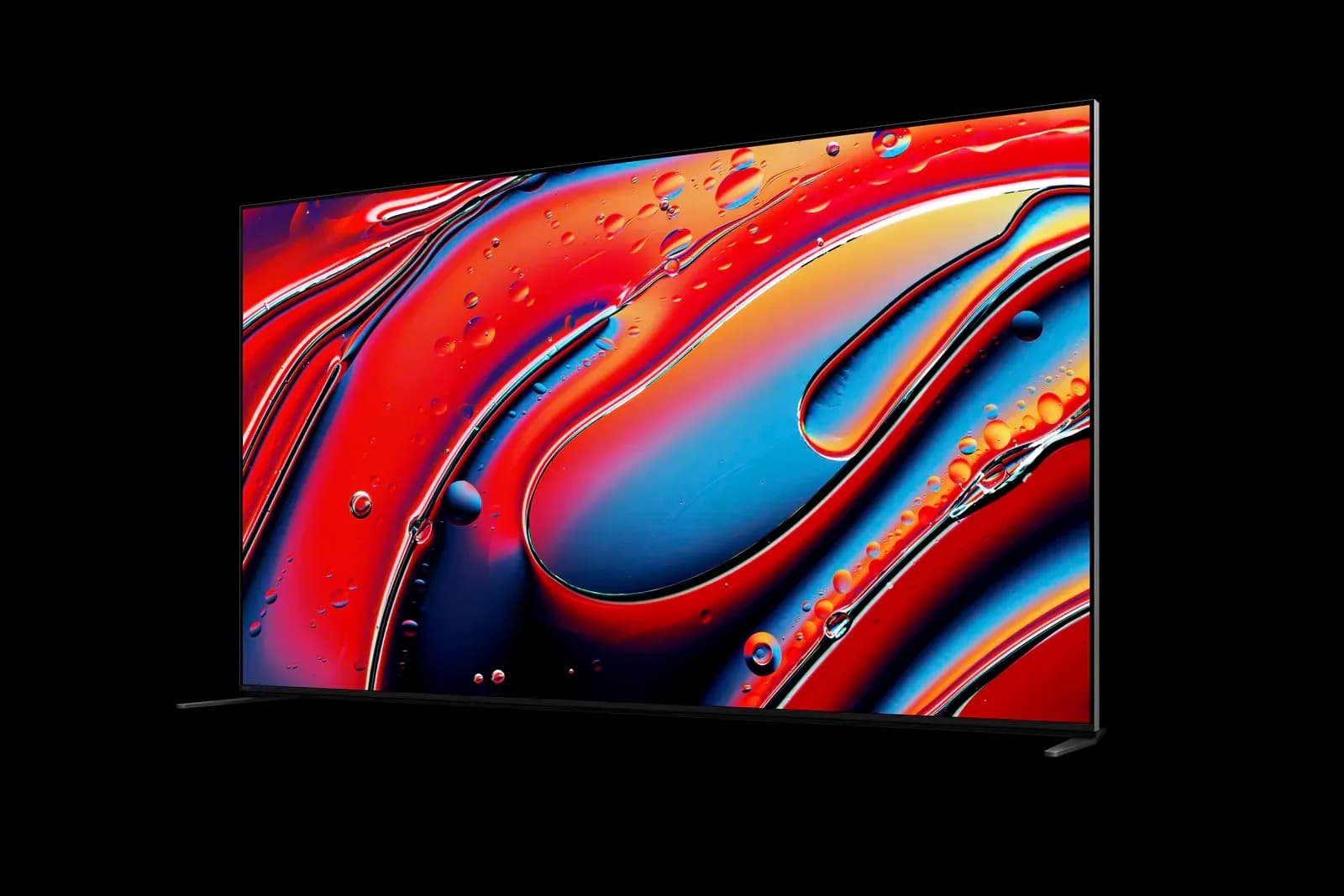
Underneath the glass sits a second-generation QD-OLED panel, driven by Sony's Cognitive Processor XR. Most OLED sets add a white subpixel to push peak brightness, and that subpixel dilutes color purity exactly when a highlight needs punch. Here, quantum dots excited by blue OLED light do all the color work, which keeps full color volume available across a much wider range of light output. Saturated reds, greens, and yellows hold their intensity when HDR content leans on the panel instead of washing out toward pastel.
Processing is where Sony has spent decades building its reputation, and the A95L leans on it hard. Cognitive Processor XR reads focal points on screen the way a human eye does, then spends its detail budget there rather than sharpening every pixel equally. It also runs XR Clear Image, which cleans up visual noise and reins in motion blur while upscaling standard definition and 1080p sources to the native 4K grid — useful if half your library is older broadcast material or DVD-era catalog film. Dolby Vision, HDR10, and HLG are all supported, with tone mapping adjusted frame by frame to hold shadow detail without clipping the bright end.
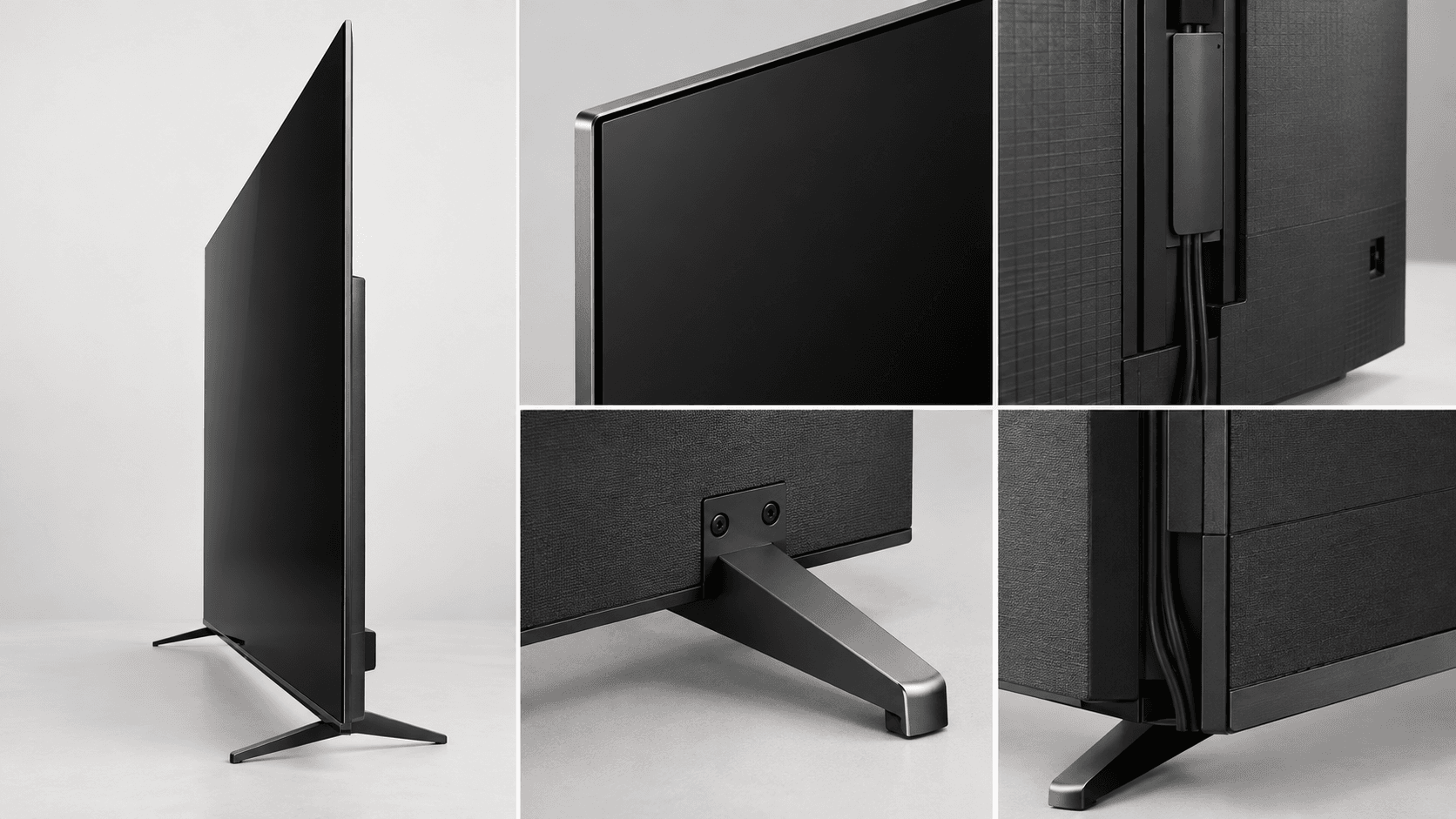
Physically, you get a minimal bezel and multi-position stand legs. Wide media console, narrow credenza, soundbar in the way — the legs reposition to suit the furniture you already own instead of the furniture a designer imagined. Cable management channels run through the rear panel to keep the run tidy. Audio comes from Acoustic Surface Audio+, which mounts actuators directly behind the screen and vibrates the glass panel itself, turning the display surface into the primary speaker, so effects track the on-screen action instead of arriving from somewhere below it. Dual subwoofers handle the low-frequency load.
Connectivity is the part to study before you buy anything else. Four HDMI inputs sounds generous until you look at how they are divided: two of the ports carry full HDMI 2.1 bandwidth for 4K signals at 120Hz, Variable Refresh Rate (VRR), and Auto Low Latency Mode (ALLM), and one of those two doubles as the enhanced Audio Return Channel (eARC). Connect a dedicated sound system over eARC and exactly one high-bandwidth port remains open for a high-frame-rate console or a PC. Software runs on Google TV, which covers the streaming apps, hands-free voice search, and native support for Apple AirPlay 2 and Google Chromecast.
Key Specs and Compatibility
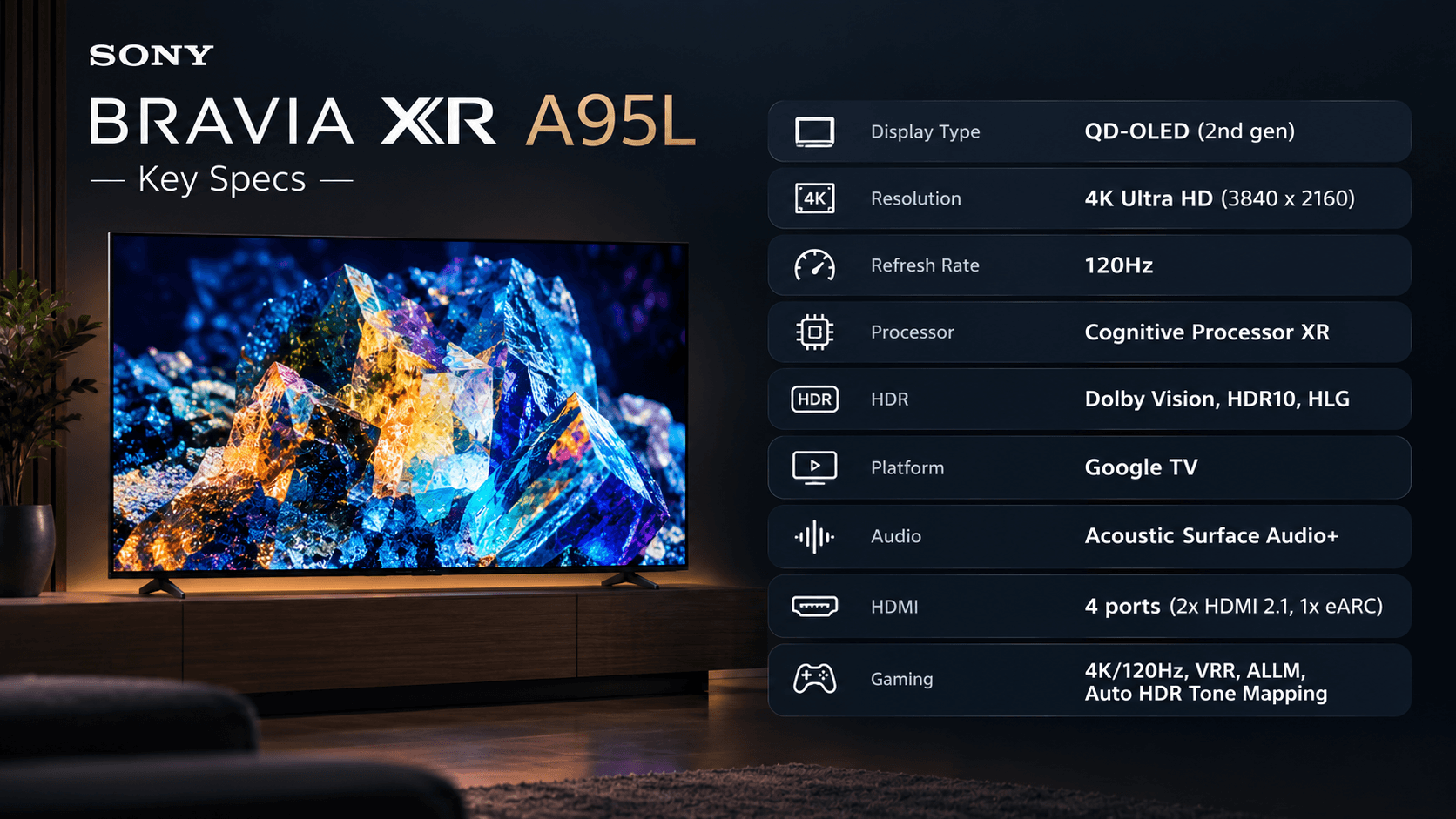
Strip away the marketing and the shape of this television gets clear fast. Panel, processor, refresh rate, and port count tell you almost everything about who it suits, so here is the short version before the analysis continues.
Specification
Value
Display Technology
QD-OLED
Native Resolution
4K Ultra HD (3840 x 2160)
Refresh Rate
120Hz
Processor
Cognitive Processor XR
HDR Formats
Dolby Vision, HDR10, HLG
Smart TV Platform
Google TV
Audio System
Acoustic Surface Audio+
HDMI Connectivity
4 Ports (2x HDMI 2.1, 1x eARC)
Gaming Features
4K/120Hz, VRR, ALLM, Auto HDR Tone Mapping
Fitting it into a wider system runs through eARC audio output, Google Home management, and native Apple AirPlay 2 and HomeKit support, so casting from a phone or folding the TV into an existing smart home routine takes no extra hardware.
What Stands Out
Start with the panel, because everything else follows from it. Second-generation QD-OLED means the infinite contrast of self-lit pixels plus the expanded color volume and higher peak luminance quantum dots allow. Standard WRGB OLED displays lean on a white subpixel to hit their brightness numbers, and that subpixel drains saturation from strong highlights — a sunset ends up bright but pale. Pure red, green, and blue primaries come straight off the A95L's panel instead. Highly saturated tones keep their intensity at peak brightness, so HDR content reads as colored light rather than white glare, and skin tones stay lifelike where lesser panels go waxy.
Cognitive Processor XR does the other half of the work. It analyzes imagery in real time to optimize depth, contrast, and fine detail, but the interesting part is the restraint: instead of applying uniform sharpening across the whole frame, it picks out the main focal point — a character's face, a central object — and enhances clarity there, mirroring how your eye actually treats a scene. That approach pays off most with high-dynamic-range mastering, and the set covers Dolby Vision, HDR10, and HLG. Tone curves map with highly capable accuracy, holding shadow detail through a dark movie scene without clipping bright specular highlights into flat white.
Then there is the sound, which most flat panels treat as an afterthought. Acoustic Surface Audio+ puts actuator drivers directly behind the QD-OLED panel and vibrates the screen itself, turning the entire display into a multi-channel speaker. Dialogue comes from the actor's mouth rather than from a downward-firing driver hidden under the cabinet, and effects pan across the image in step with what you are watching. Integrated subwoofers cover the low end. It is more expansive and far more directional than the speaker array in a typical flat panel — not a reason to cancel your surround system, but a real reason you could delay buying one.
Strengths
Day to day, Google TV carries the experience. Streaming apps, live television, and personalized recommendations land in one hub, and reaching the thing you actually want takes very few clicks. Voice navigation runs through built-in Google Assistant for quick searches, smart home commands, and hands-free control. Sony also folds in SONY PICTURES CORE, its own streaming service, giving film enthusiasts access to high-bitrate pure stream titles — the easiest way to feed this panel 4K HDR that has not been flattened by compression artifacts.
Console gamers, and PlayStation 5 owners in particular, get treatment nobody else ships. Plug in a PS5 and the television recognizes it, switching on Auto HDR Tone Mapping and Auto Genre Picture Mode to sort out high-contrast visuals and lower input latency without a trip into the settings menu. A native 120Hz refresh rate plus Variable Refresh Rate and Auto Low Latency Mode keeps fast action clean and input lag minimal, which is the combination that matters when a firefight turns into a camera whip-pan. A dedicated Game Menu overlay handles real-time adjustments to screen sizing, black equalizer, and motion blur settings mid-match, so you never have to quit out to change something.
Design helps in ordinary living rooms too, and not in a cosmetic way. Thin bezels maximize the visible display surface and keep your attention on the image. The multi-position table-top stand accommodates both wide audio consoles and narrow furniture footprints, and raising the legs leaves clean clearance for a soundbar without covering the bottom edge of the screen.
Weaknesses
Ports are the first real compromise, and for anyone with a loaded rack it is a big one. Four HDMI inputs sound like plenty until you learn that only two of them support the full HDMI 2.1 bandwidth required for 4K playback at 120Hz. Worse, one of those two high-speed ports doubles as the eARC connection. Hook up an external AV receiver or a soundbar and you are down to a single remaining HDMI 2.1 input for every high-frame-rate device you own, which means a PS5 and a gaming PC cannot both sit in the good seats. An HDMI switch solves it, but paying flagship money and then buying accessories to work around the port layout stings.
Panel care is the second trade-off. QD-OLED dissipates heat better than older OLED generations, but self-lit pixels still dislike static content, and the long-term risk of image retention or burn-in has not disappeared. Households that park on news tickers, sports scoreboards, or a game HUD for hours at a stretch are relying on the built-in screen saver features and automatic pixel refresh cycles to protect panel longevity. That is a manageable habit for most viewers, but it is a habit you have to actually keep.
Google TV is the third, in a smaller way. The operating system is feature-rich, though it wants a stable internet connection and the occasional restart to clear background caching slowdowns. Anyone hoping for a plug-and-play screen that turns on and shows a picture will find the recommendation rows, ambient content, and menu layers more than they asked for during everyday channel browsing.
Best Alternatives
Rivals exist, and two of them beat this set on specific numbers. Closest is the LG G4 Series 77-Inch OLED evo 4K Smart TV (OLED77G4WUA), running the Alpha 11 AI Processor 4K with Brightness Booster Max for peak luminance that rivals QD-OLED. The trade-off is concrete: LG gives you a native 144Hz refresh rate across four full-bandwidth HDMI 2.1 ports where the A95L tops out at 120Hz with only two, but you surrender Sony's quantum dot color volume and focal-point processing to get it. PC gamers and anyone planning a flush wall mount tend to land on the LG.
Got a wall of unshaded windows? Look at the Sony Bravia 9 65-Inch Mini LED QLED 4K Smart TV (K-65XR90) instead. Mini LED backlight zones driven by Sony's XR Processor push far higher peak brightness and strong local dimming control through daylight glare, and you keep the same Google TV platform. The trade-off here is contrast for light output: dimming zones cannot match pixel-level precision or the infinite black levels of the A95L, so dark-room film nights lose depth in exchange for an image that holds up at two in the afternoon.
Spending less without leaving OLED behind points to the LG C4 OLED 65-Inch 4K Smart TV (OLED65C4PUA). This one trades panel quality for price: you get webOS 24, four HDMI 2.1 ports running up to 144Hz, and standard WOLED picture quality at a far lower price, but a white-subpixel panel that cannot sustain saturation at peak brightness the way second-generation QD-OLED does, and none of Sony's cognitive video processing. For mixed use across movies, gaming, and general streaming, it remains a highly responsive and versatile pick.
Who Should Buy It
Buy this one if your room is dark and the image is the point. Light-controlled media rooms are exactly where quantum dot color volume, self-lit black levels, and Cognitive Processor XR stack up into depth that very little else on the market can match. Film collectors who care about Dolby Vision accuracy and intelligent 4K upscaling of legacy HD content have the single strongest reason to choose it: no rival combines that color volume with that processing.
PlayStation 5 owners are the other clear fit. Auto HDR Tone Mapping and Auto Genre Picture Mode are built specifically for the console, which means setup is short, calibration guesswork disappears, and 4K 120Hz gaming looks right from the first boot. Anyone already living inside the Google TV ecosystem — app library, voice search, casting from a phone — gets a complete multimedia hub with nothing left to bolt on.
Commission may be earned from this link, at no extra cost to you.
Who Should Skip It
Skip it if you are building a PC-first gaming setup. Capping at 120Hz while restricting full HDMI 2.1 features to just two ports — one of which doubles as the eARC soundbar connection — is the single strongest reason to shop elsewhere, and the LG G4 fixes precisely that. Plan on a PC, multiple current-gen consoles, and a premium audio system running at once, and this port layout creates a connectivity bottleneck the day the boxes arrive rather than somewhere down the road.
Sunlit rooms are the other reason to walk away. Mini LED televisions like the Sony Bravia 9 or the TCL QM8K produce significantly higher sustained brightness to cut through harsh daylight glare, and while QD-OLED panels hit high brightness for organic displays, that gap shows every single afternoon in a room with unshaded windows. Casual viewers on basic cable, daily news, and compressed streams should also pass: little of the A95L's advanced processing is visible in that content, which makes its steep flagship pricing hard to justify.
Sources & References
Specifications and claims in this analysis were cross-referenced against the sources below.
It works best in controlled light. QD-OLED holds color beautifully, but a Mini LED set like the Sony Bravia 9 pushes higher sustained brightness through daylight glare, so rooms with unshaded windows are better served by Mini LED.