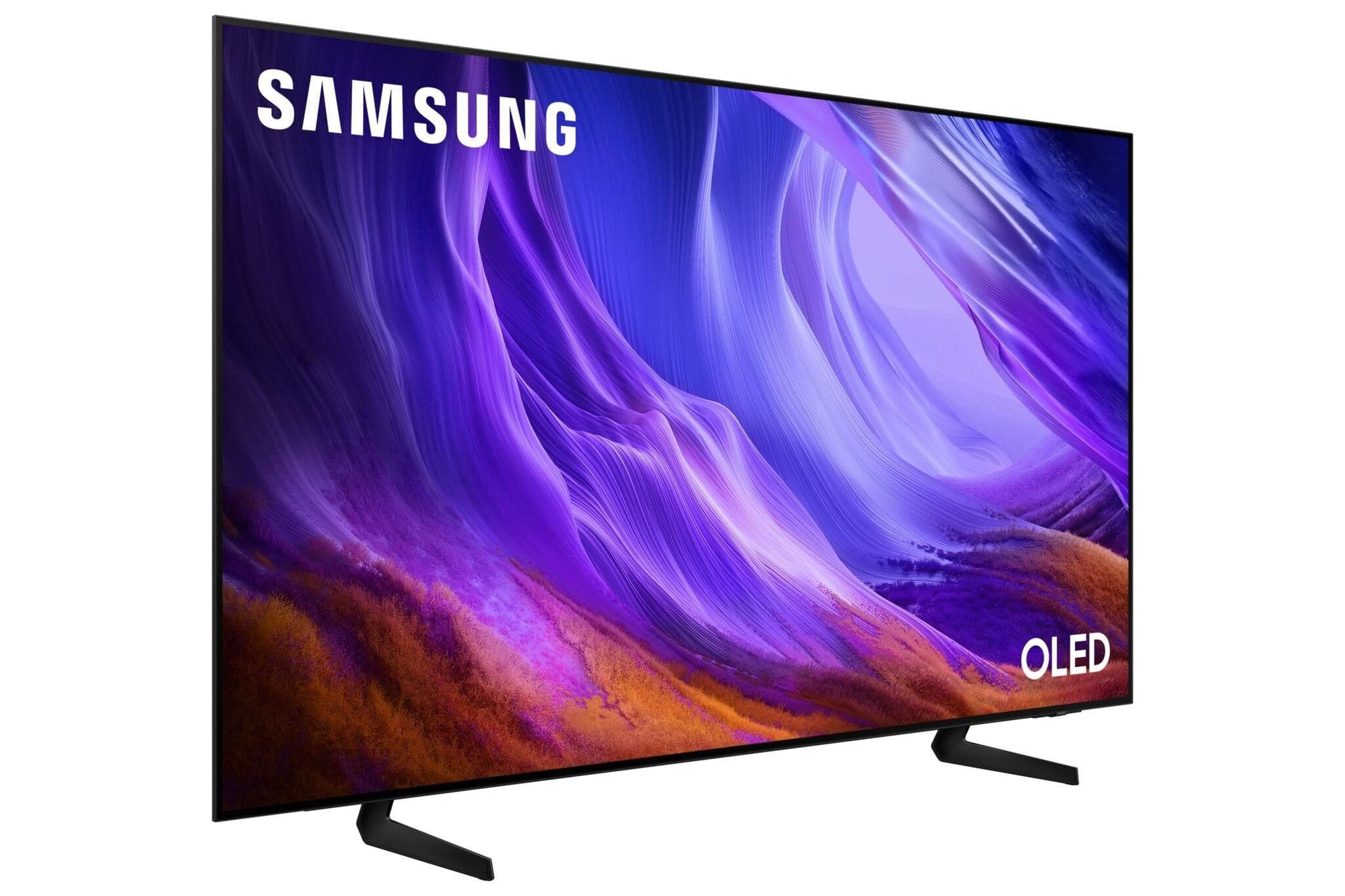
Samsung S85H OLED TV Review: Specs, Picture Quality, and Value
A spec-based look at the Samsung S85H OLED TV: its 120Hz panel, NQ4 AI Gen2 processing, HDR format support, and gaming feature set, plus who it actually suits.
Noureddine M.··Specification analysis — not hands-on tested
Shopping for an OLED in 2026 comes down to one fork in the road: pay flagship money for peak brightness, or keep the per-pixel contrast and spend less. Samsung's S85H takes the second road. It sits on the entry rung of the company's OLED ladder, built for buyers who want self-lit black levels and 120Hz motion without flagship pricing, and it lands squarely against the LG B4 OLED, LG C4 OLED, and Sony BRAVIA 8 OLED.
One thing up front, because it shapes how you should read this Samsung S85H OLED TV review. This is a spec-based analysis using published manufacturer specifications and market comparisons. No hands-on testing was conducted. What follows is a close read of the 55-inch model's datasheet: the processing engine, the color standards, the refresh and sync support. Panel specs tell you a great deal about how a display will behave in a specific room, and they tell you where the corners were cut to hit this price bracket. Both matter here.
Some links in this article are affiliate links, which helps support GadgetPickr at no extra cost to you.
The Quick Take
A dark-room specialist wearing a mid-range badge. You get real per-pixel contrast, strong AI upscaling, and the full 120Hz gaming stack. You give up peak brightness, Dolby Vision, and any hope of serious built-in audio. Right TV for a movie room. Wrong TV for a sun-drenched den.
The short version of this Samsung S85H OLED TV review: it's an entry point to self-lit display technology that gives up remarkably little of what makes OLED worth buying. Deep contrast, absolute black levels, and accurate color arrive without the flagship QD-OLED premium of something like the S95D. The NQ4 AI Gen2 Processor turns legacy 1080p and cable broadcasts into something you can watch on a 55-inch panel without wincing, and Pantone Validation keeps color honest out of the box.
Gamers are well served too. Native 120Hz playback, Motion Xcelerator, AMD FreeSync Premium, and NVIDIA G-SYNC compatibility add up to smooth, tear-free frame rates on current-gen consoles and PCs. Peak brightness and glare handling sit a tier below Mini LED sets like the Sony Bravia 9 and below flagship QD-OLEDs, and that's a real limitation. Against a conventional LED TV, though, the uniform blacks and near-instant pixel response are a significant step up.
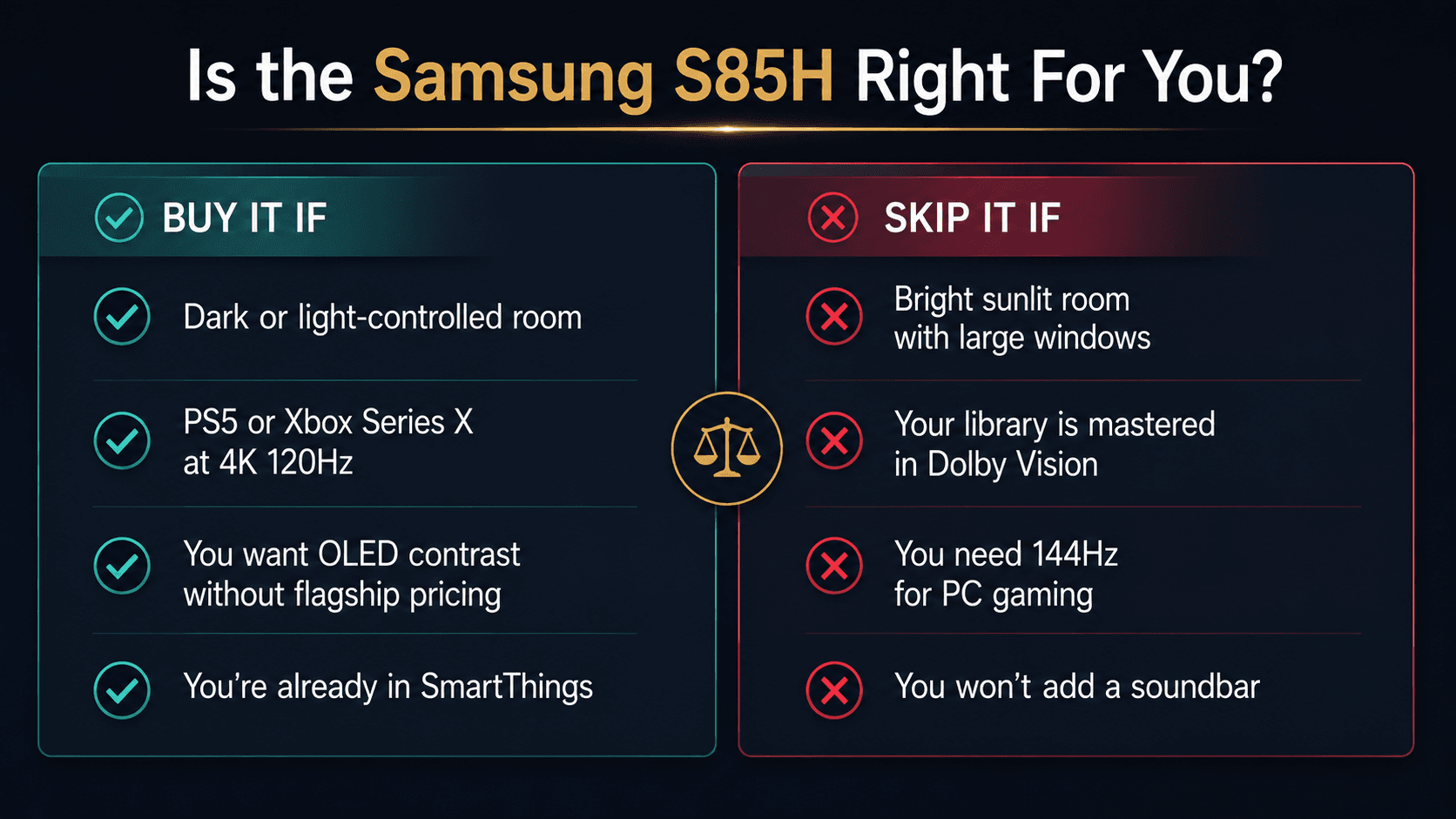
Buy it if your room goes dark and your priorities are movie contrast and low-latency gaming; that combination at this price is the single strongest reason to choose it. Skip it if your living room is flooded with daylight or your collection lives on Dolby Vision, because neither problem has a workaround on this panel. Everyone else in the middle is getting a lot of OLED for the money.
Samsung S85H OLED TV
4K home theater viewing, high-refresh-rate gaming, AI video upscaling
Mid-range positioning in Samsung's 2026 OLED lineup
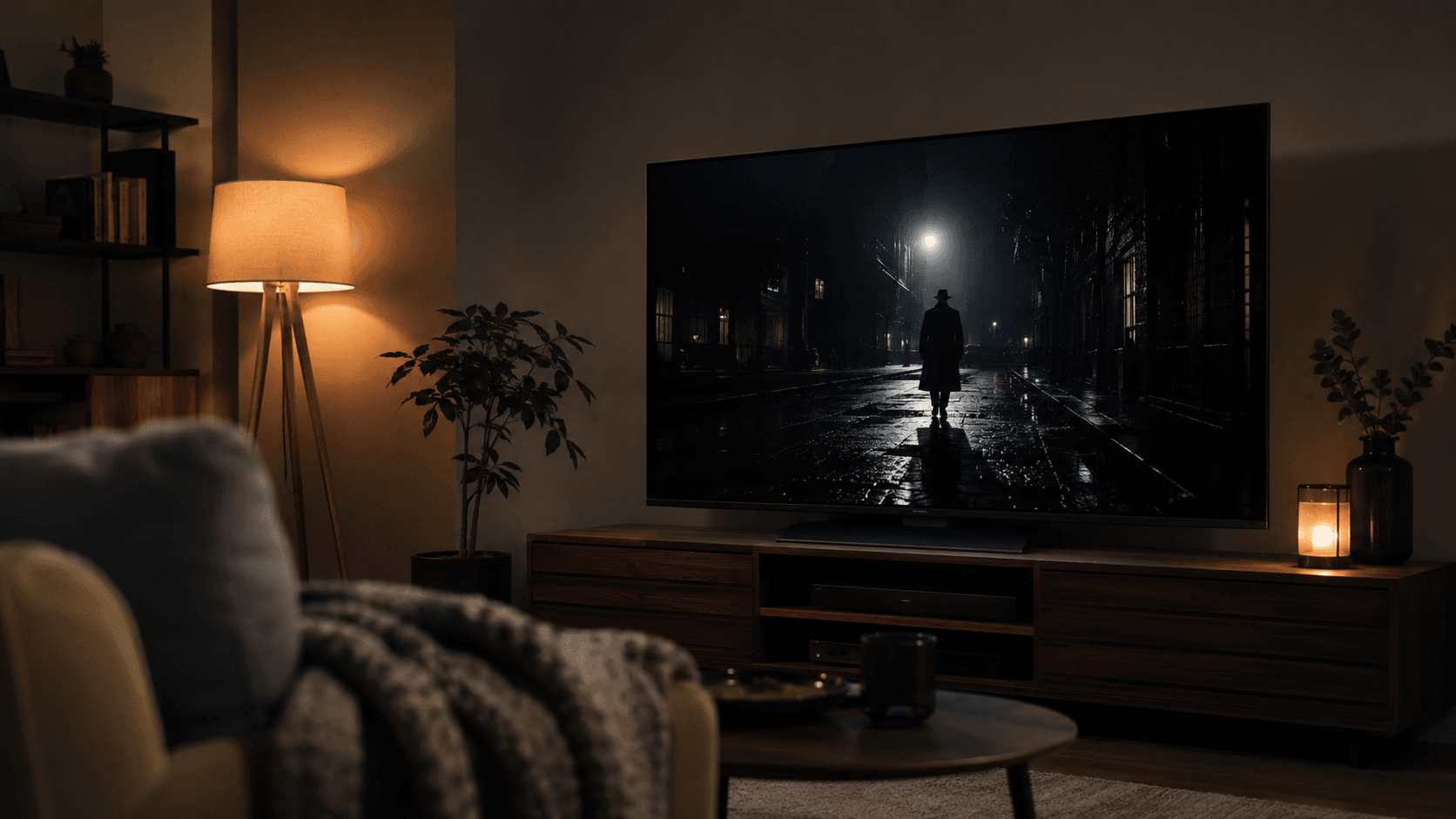
Every pixel makes its own light here, and that single fact drives everything else. Switch one off and it goes black. Not dark grey. Black. No backlight glow bleeding around a spaceship on a night sky, no dimming-zone halo chasing white subtitles across the frame, no bloom softening the edge where shadow meets highlight. Letterbox bars disappear into the wall behind them.
Driving the display hardware is the NQ4 AI Gen2 Processor, a dedicated chip for real-time video signal analysis and resolution enhancement. Neural network models handle the upscaling, reading grain, edge clarity, and color gradients to fit sub-4K sources onto the native 3840 x 2160 panel. Cable news, older streaming libraries, low-bitrate catalog titles: those are the sources that stand to gain, since the aim is rebuilding lost detail rather than cranking a sharpness slider until faces look etched.
On the color side, the 2026 S85H incorporates Pantone Validation along with Samsung's Color Booster Pro feature. Pantone Validation means the panel matches standard reference swatch profiles, which shows up in practice as believable skin tones and foliage that isn't radioactive green. Color Booster Pro adjusts saturation according to scene brightness, so hues hold up when a scene blows out instead of draining toward pastel.
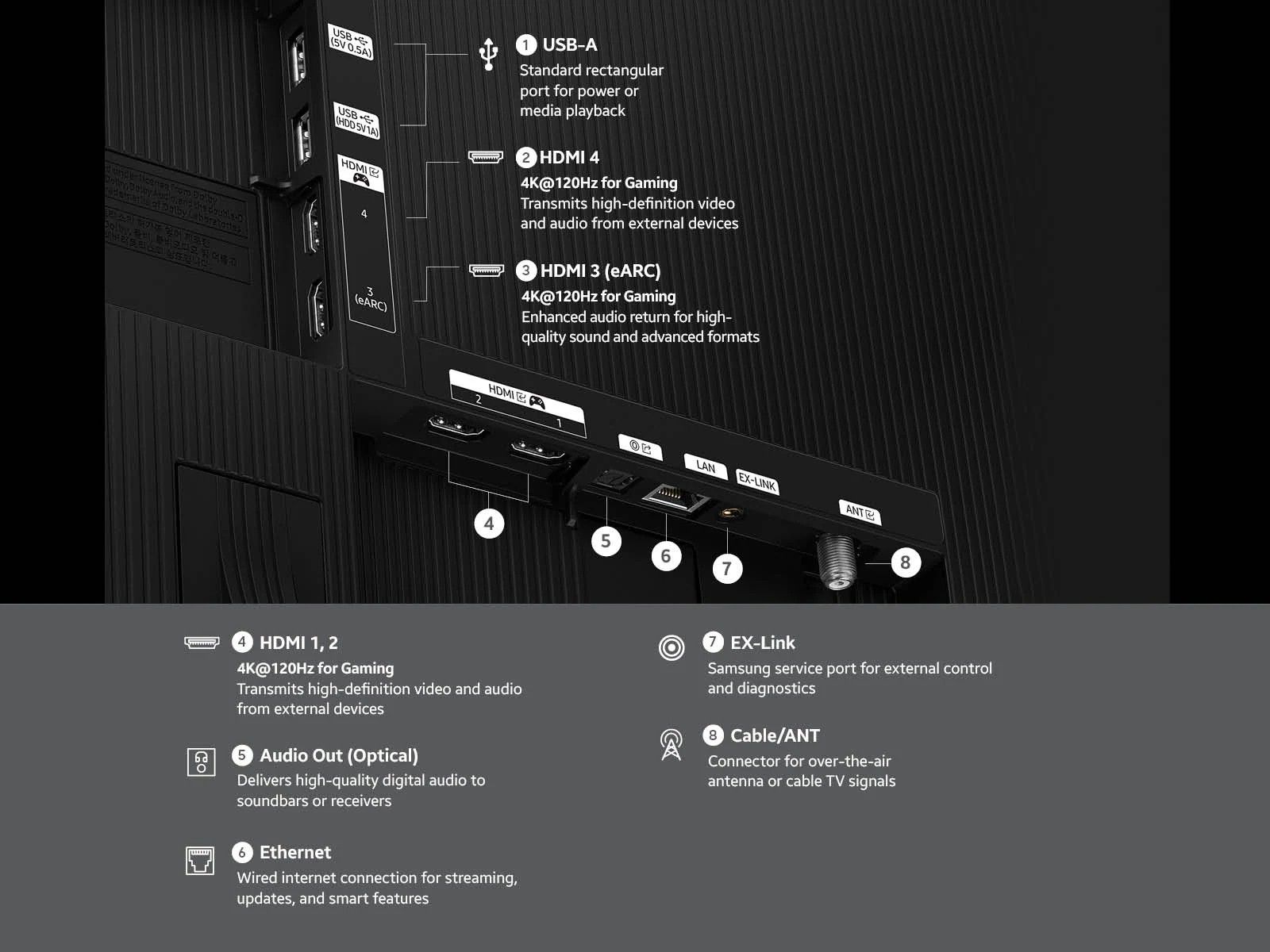
Gamers get the full modern checklist. A native 120Hz panel works alongside Motion Xcelerator 120Hz to cut blur on fast pans, HDMI 2.1 carries 4K at 120 frames per second, and AMD FreeSync Premium plus NVIDIA G-SYNC Compatibility keep tearing and stutter off the screen when frame rates wobble. Tizen handles the software: streaming apps, cloud gaming services, smart home controls, one dashboard.
Key Specs and Compatibility
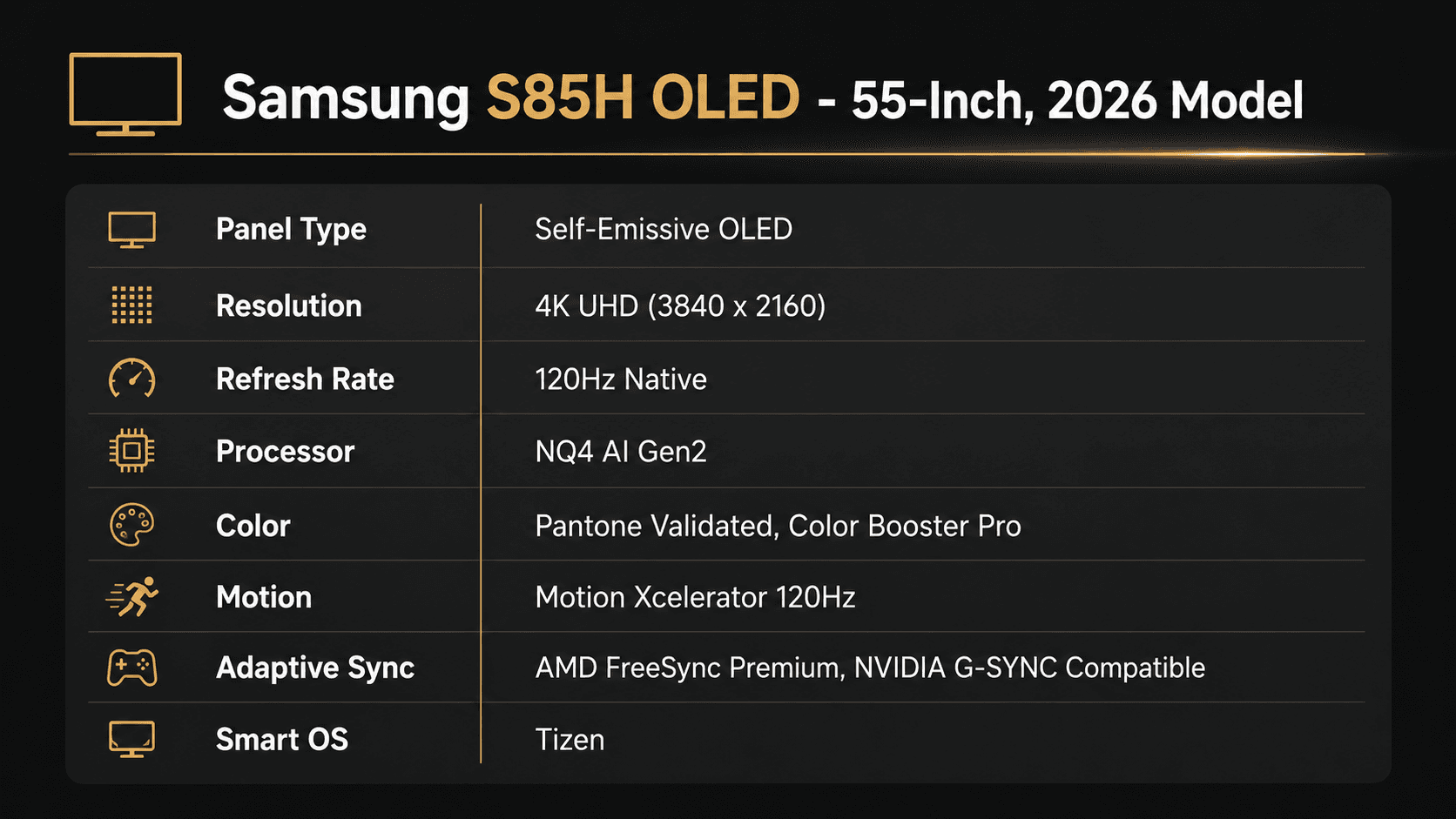
Here is the datasheet in one place, before the argument about what any of it means for your living room.
Specification
Value
Product Name
Samsung 55-Inch Class S85H Series OLED
Model Year
2026 Model
Screen Size
55-Inch Class
Display Type
Self-Emissive OLED
Resolution
4K UHD (3840 x 2160)
Panel Refresh Rate
120Hz Native
Video Processor
NQ4 AI Gen2 Processor
Color Accuracy Standard
Pantone Validated
Color Enhancement Engine
Color Booster Pro
Gaming Motion Tech
Motion Xcelerator 120Hz
Adaptive Sync Support
AMD FreeSync Premium, NVIDIA G-SYNC Compatible
Core Target Market
Mid-Range 4K Home Theater and Gaming
Mounting and connections stay conventional: standard VESA wall mounting, multiple HDMI 2.1 ports for an AV receiver or a pair of consoles, and the built-in Tizen smart OS running platform management.
What Stands Out
Processing is the headline. Pairing flagship-adjacent silicon with an entry-level OLED panel is the whole strategy of this model, and the NQ4 AI Gen2 Processor is doing heavy lifting on the kind of content most people actually watch. Standard-definition broadcasts and 1080p streams get compression artifacts smoothed over without the over-sharpened halos that cheaper upscalers leave around high-contrast edges. Color rendition, meanwhile, targets strict hue accuracy across luminance levels rather than pushing primaries until faces turn orange.
Contrast is the other half of the argument, and it's the half no LED-backlit set can answer. Individual pixels switch off completely, so black is the absence of light rather than a dim approximation, and highlights punch against it without a glow ring giving the game away. Peak brightness does sit below high-end QD-OLED models like the S95D. That gap matters in daylight and barely registers after dark. The inclusion of Real Depth Enhancer adds a sense of dimensionality by processing foreground and background separately, closer to how your eye reads physical distance.
For gamers, the hardware configuration covers the current generation with nothing important missing. Native 120Hz plus Motion Xcelerator 120Hz addresses blur in sports and shooters; AMD FreeSync Premium and NVIDIA G-SYNC compatibility address tearing when a console drops frames mid-firefight. Auto low latency mode switches the panel into game mode without you hunting through a settings menu. Console, gaming PC, or both at once, the connectivity is there.
Smart features run through Samsung's Tizen platform, which pulls streaming services, smart home device control, and voice recognition through built-in Alexa and Bixby functionality into a single interface. Media hubs and cloud gaming sit a couple of clicks apart. Flagship panels add secondary emissive layers or quantum dot overlays for more color volume at maximum luminance; this one skips that and keeps the processing, which is a sensible place to draw the line at this price.
Strengths
In a room where you control the light, this is where the money goes furthest. HDR movies lean on the panel's absolute black levels, and shadow detail survives without bleed or blooming around subtitles. Off-axis seating holds up too, since OLED keeps color and contrast stable at angles that make LED panels look washed and grey from the end of the couch. Six people, one sofa, one armchair off to the side: everyone sees the same picture.
Daily viewing benefits from the same processor doing the cinematic work. Dialogue clarity is clean by spec, and motion handling on 120Hz sports broadcasts avoids the soap-opera smoothing that ruins film. Tizen also doubles as a smart home dashboard, so compatible devices answer from the on-screen menu or hands-free through Alexa. Netflix, Prime Video, YouTube, back to live TV, all natively.
Console gaming is where the spec sheet reads best. Connect a PlayStation 5 or Xbox Series X and the panel drops into game mode on its own, with 120Hz, VRR, and low input lag all on the hardware list rather than the wish list. FreeSync Premium and G-SYNC compatibility cover variable rendering workloads where frame rates swing. The slim chassis and minimal bezel also let the set sit on a media console or low-profile mount without dominating the room.
Weaknesses
Peak brightness is the first trade-off, and it's the one that will decide this purchase for a lot of people. As an entry-to-mid-range OLED, the S85H cannot match the bright-room output of high-end QD-OLED or Mini LED sets like the TCL QM8K or Sony Bravia 9. Big uncovered windows, afternoon sun, specular HDR highlights that should sparkle: expect them to flatten, and expect glare to sit on top of darker scenes. Bright-room buyers should be shopping Mini LED instead.
Then there's Dolby Vision, or rather the absence of it. HDR10, HDR10+, and HLG are supported; Dolby Vision, used heavily across major streaming platforms and 4K Blu-ray, is not. The TV relies on its own internal dynamic tone mapping instead. That's a workable fallback, but if you want native frame-by-frame Dolby Vision playback, competing OLEDs from LG or Sony — the LG C4 or B4 series among them — are where you'll find it.
Sound is the last compromise, and the easiest to fix. Onboard drivers handle news, talk shows, and background viewing fine. They have no sub-bass and no real dynamic range, which blockbusters expose within about ninety seconds. Budget for a Dolby Atmos soundbar or a receiver setup alongside the TV, not eventually.
Best Alternatives
Staying inside Samsung's lineup, the S95H Series is the step up. Same broad platform, but with advanced HDR Pro capabilities, Object Tracking Sound+, and an anti-glare screen coating aimed directly at ambient light. The trade-off is straightforward: you pay meaningfully more than the S85H and get brightness and built-in audio that survive a bright living room.
Outside of Samsung, the LG C4 OLED is the most direct competitor. The 65-inch LG C4 features four full-bandwidth HDMI 2.1 ports, webOS 24, and an expanded 144Hz panel refresh rate compared to the 120Hz cap on the S85H. Trade-off in one line: the C4 gives PC gamers extra refresh headroom and adds Dolby Vision, an HDR format Samsung displays consistently omit in favor of HDR10+, while the S85H keeps you inside the SmartThings ecosystem for less.
If brightness is what you're chasing, Mini LED is the honest answer. The TCL QM8K stacks thousands of local dimming zones for extremely high output at a competitive price, and the Sony Bravia 9 brings sharper processing and cinematic tone mapping at flagship money. The trade-off both share against the S85H: you gain full-screen brightness for sunny rooms and lose absolute per-pixel black levels, since dimming zones can only get so small.
Who Should Buy It
Movie watchers with light control should be looking hard at this one. Curtains, a lamp, evening viewing: that's the environment where infinite contrast and self-emissive pixels pull ahead of any LED-backlit set, and the NQ4 AI Gen2 Processor keeps older 1080p libraries watchable at 4K instead of mushy. Pantone Validated color accuracy means you get sensible skin tones without a calibration session.
Console gamers are the second clear fit. Native 4K at 120Hz, FreeSync Premium, G-SYNC compatibility, and low input lag under Motion Xcelerator cover everything a PlayStation 5 or Xbox Series X can output today, with no tearing when frame rates dip. Add SmartThings households to the list: the TV works as a control hub for connected devices, which is a real convenience if you're already invested there.
Commission may be earned from this link, at no extra cost to you.
Who Should Skip It
Bright rooms are the deal-breaker. Floor-to-ceiling windows, south-facing exposure, daytime sports with the blinds up — high ambient glare will wash the contrast that you're paying for right off the screen. Mini LED displays like the TCL QM8K or Sony Bravia 9 handle those rooms far better, and no amount of picture-mode fiddling closes that gap.
Dolby Vision devotees should also keep walking. Samsung continues to exclude the format, relying on HDR10+ and standard HDR instead, so a library mastered largely in Dolby Vision gets played back through a substitute pipeline. The LG C4 OLED or Sony BRAVIA 8 covers that ground properly. Competitive PC gamers pushing past 120Hz belong on a 144Hz-capable OLED or a dedicated high-refresh monitor, full stop.
Sources & References
Specifications and claims in this analysis were cross-referenced against the sources below.
No. It handles HDR10, HDR10+, and HLG, and falls back on its own internal dynamic tone mapping for other content. If your movie library is mastered in Dolby Vision, an LG or Sony OLED is the better match.