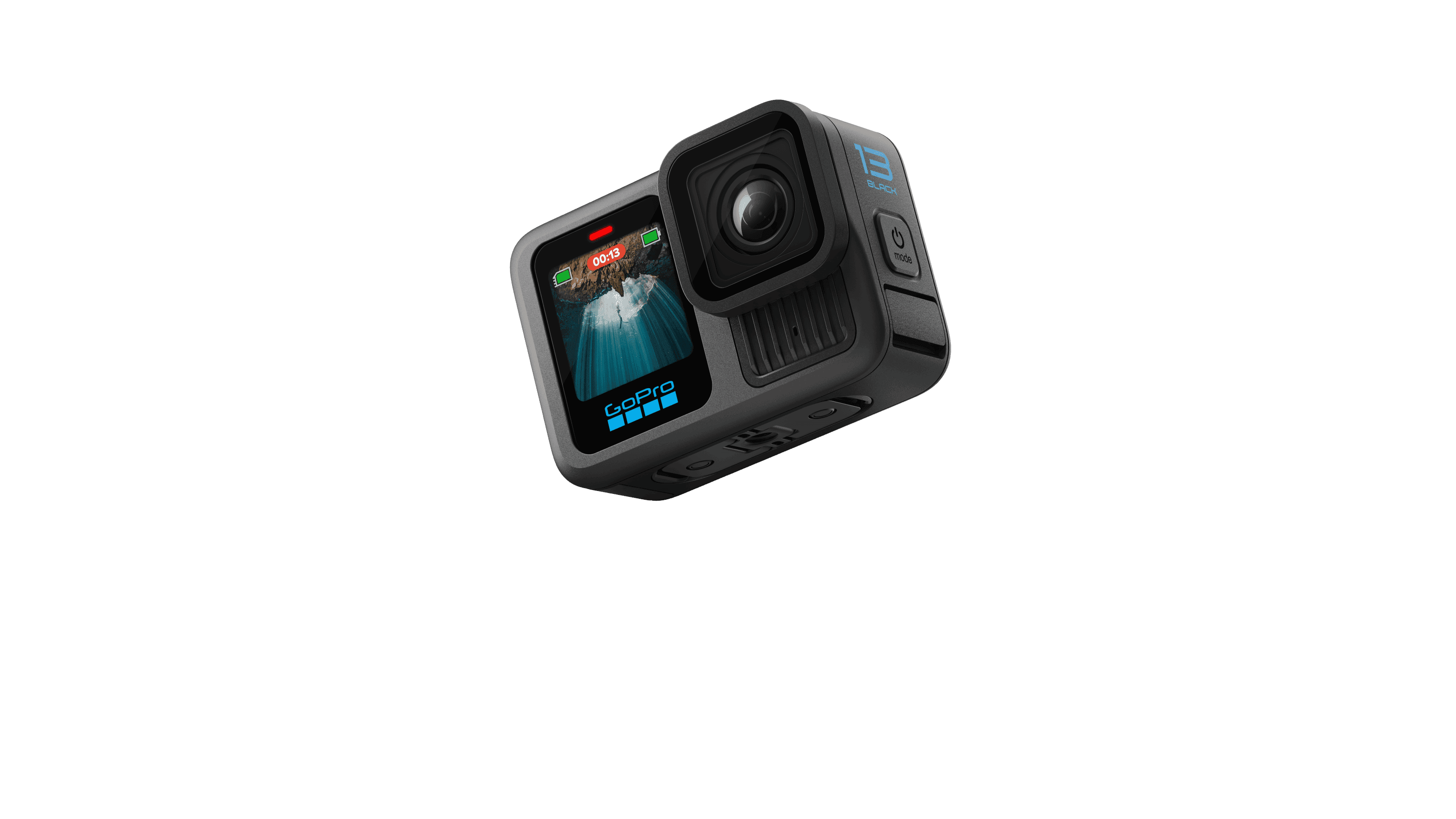
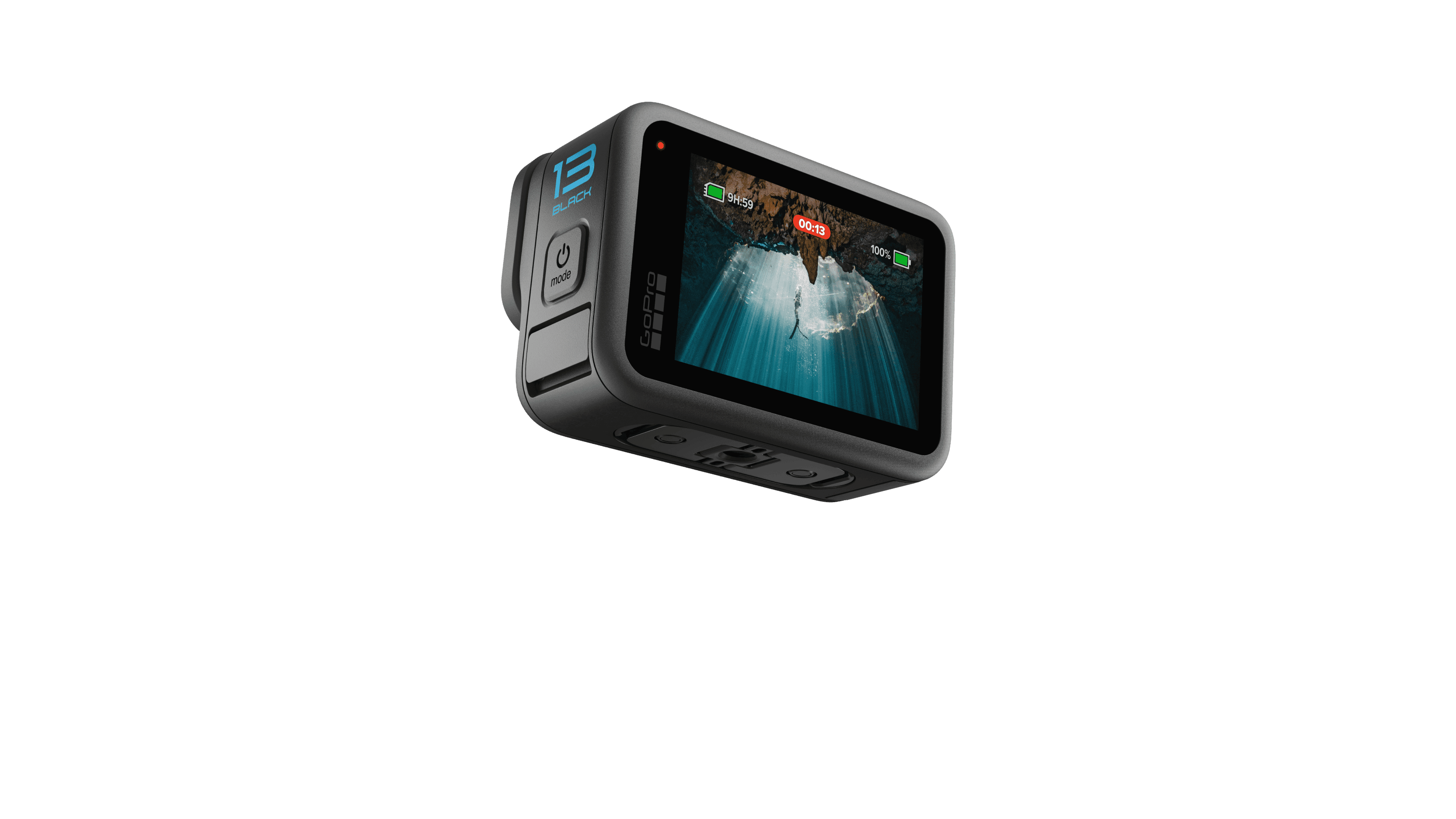
Swapping an action camera from a helmet to a handlebar should not eat the few minutes you have to catch a run. In this GoPro HERO13 Black review, that practical question matters more than another round of resolution bragging. GoPro kept the familiar 5.3K60 video and 27MP photos, then changed the pieces around them: a quick-release mounting option, a larger Enduro battery, and HB-Series lenses that the camera recognizes automatically. If you move between point-of-view footage, close-ups, and wide establishing shots, those additions have a clear purpose.
There is a catch. The lens mods and magnetic latch mount cost extra, while a HERO12 Black already covers much of the core recording job. Rivals such as the DJI Osmo Action 5 Pro and Insta360 Ace Pro also offer different answers to low-light shooting and self-framing. HERO13 Black makes the strongest case for buyers who will actually use its accessory system; if the standard wide view is all you need, the upgrade is harder to justify.
Some links in this article are affiliate links, which helps support GadgetPickr at no extra cost to you.
The Quick Take
Buy the GoPro HERO13 Black if you regularly change mounts or want its auto-detecting Macro, Ultra Wide, ND, and Anamorphic accessories. Skip it if your HERO12 Black already handles your wide-angle footage: the main video and photo specifications are similar, and the new lenses and magnetic latch add to the total cost.
This GoPro HERO13 Black review comes down to a simple buying rule: choose it for its modular shooting system. The combination of auto-detecting HB-Series optics, optional quick-release magnetic mounting, folding fingers, and a tripod thread gives an active creator several ways to change shots without changing cameras. GoPro backs that flexibility with 5.3K60 video, 27MP photos, HyperSmooth 6.0, and a waterproof body.
Buy it if you will move between mounts or use the dedicated lenses often; that is where the HERO13 Black earns its place in a kit. Skip it if you are happy with a HERO12 Black's standard wide view, because the core resolution figures remain the same and the new accessories require more spending. Night shooters have a stronger reason to compare DJI or Insta360. Among upper-tier action cameras, this GoPro is the practical choice for varied daytime perspectives, provided you account for the extra gear and the new battery format.
GoPro HERO13 Black
Best for action shooters who will use quick mount changes and HB-Series optics.
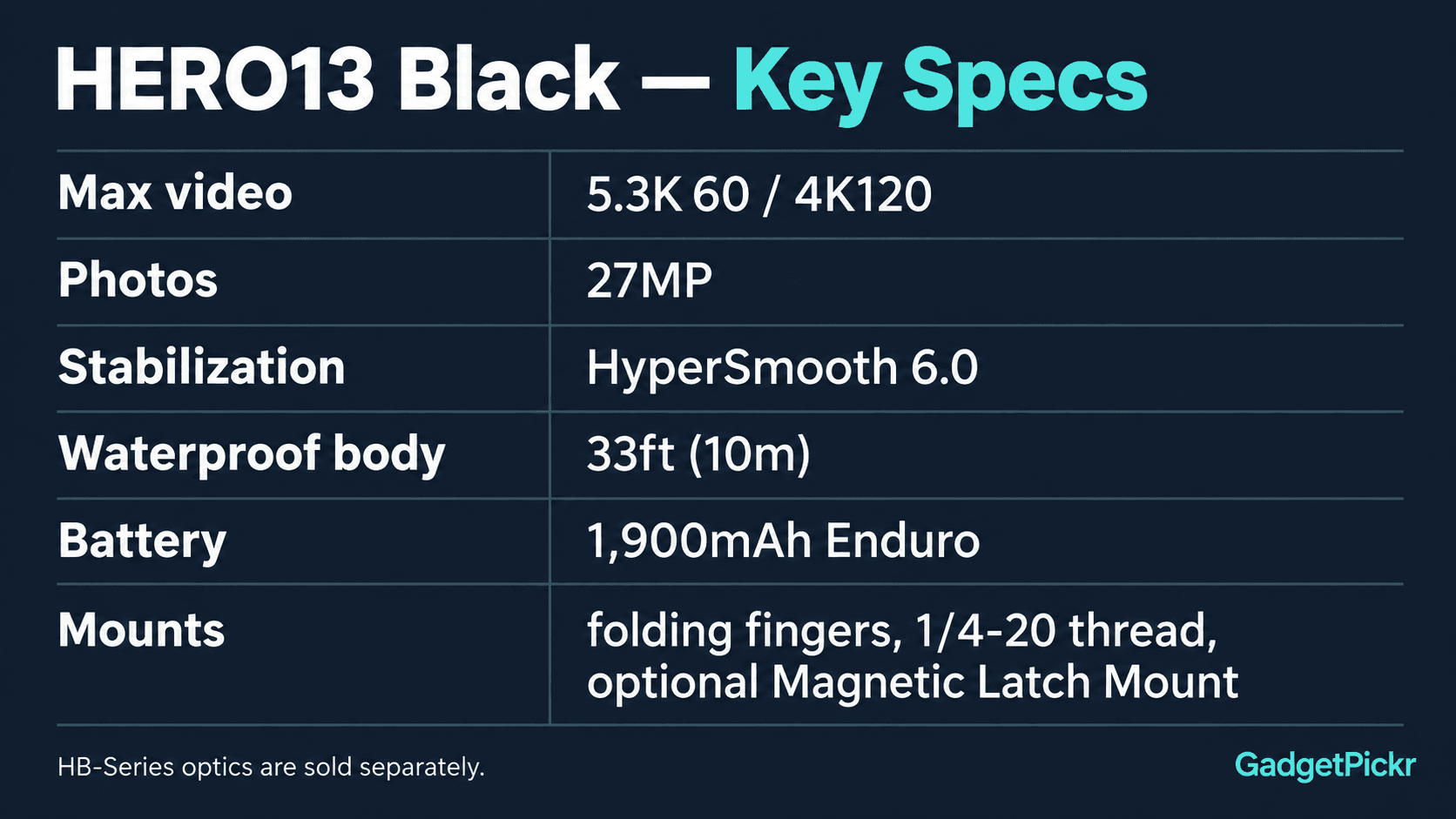
HERO13 Black records up to 5.3K at 60 frames per second or 4K at 120 fps, and it captures 27MP stills. HyperSmooth 6.0 supplies in-camera stabilization. Those are capable numbers, but they are not the reason to replace a recent GoPro: the HERO12 Black also offers 5.3K60 and 27MP capture.
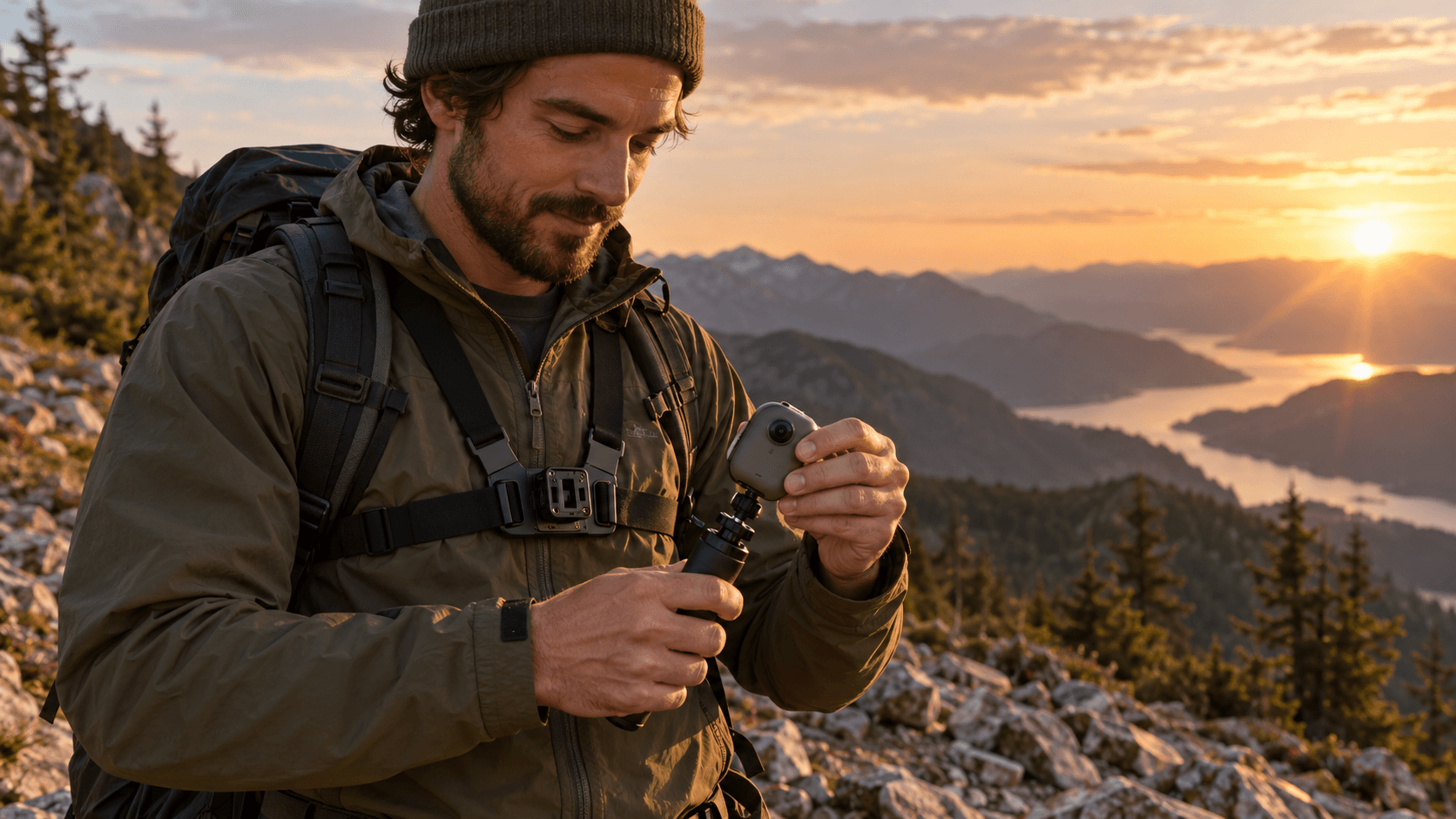
Instead, look at how the camera attaches to everything around it. Built-in folding fingers still work with familiar GoPro mounts, and a 1/4-20 thread accepts standard tripod hardware. Add GoPro's separate Magnetic Latch Mount and magnets align the camera before spring-loaded latches secure it. That can shorten a switch from a body mount to a grip, though GoPro recommends the built-in fingers for high-shock and high-vibration activities.
HB-Series optics tackle a different interruption: changing the shot itself. Fit the optional Ultra Wide, Macro, Anamorphic, or ND accessory, and HERO13 Black detects it and selects the corresponding mode. You still choose your framing and exposure; the benefit is that you do not have to remember which lens profile to set after every swap.
Its redesigned Enduro battery has a 1,900mAh capacity and a new connector, so older GoPro batteries will not fit. GoPro quotes more than 2.5 hours at 1080p30 and more than 1.5 hours at 4K30 or 5.3K30 under specified conditions. Those figures are useful for comparison, but they should not be mistaken for a guarantee at the camera's 5.3K60 maximum. The body is waterproof to 33 feet (10 meters) without a separate housing.
Key Specs and Compatibility
Headline specifications tell only half the story. Mount and battery compatibility will matter just as much if you already own GoPro gear.
Specification
Value
Max Video Resolution
5.3K at 60 fps / 4K at 120 fps
Photo Resolution
27MP
Image Stabilization
HyperSmooth 6.0
Water Resistance Depth
33ft (10m)
Lens Ecosystem
HB-Series Lenses
Lens Detection
Automatic lens and filter recognition
Mounting Interface
Optional Magnetic Latch Mount, built-in folding fingers, 1/4-20 threads
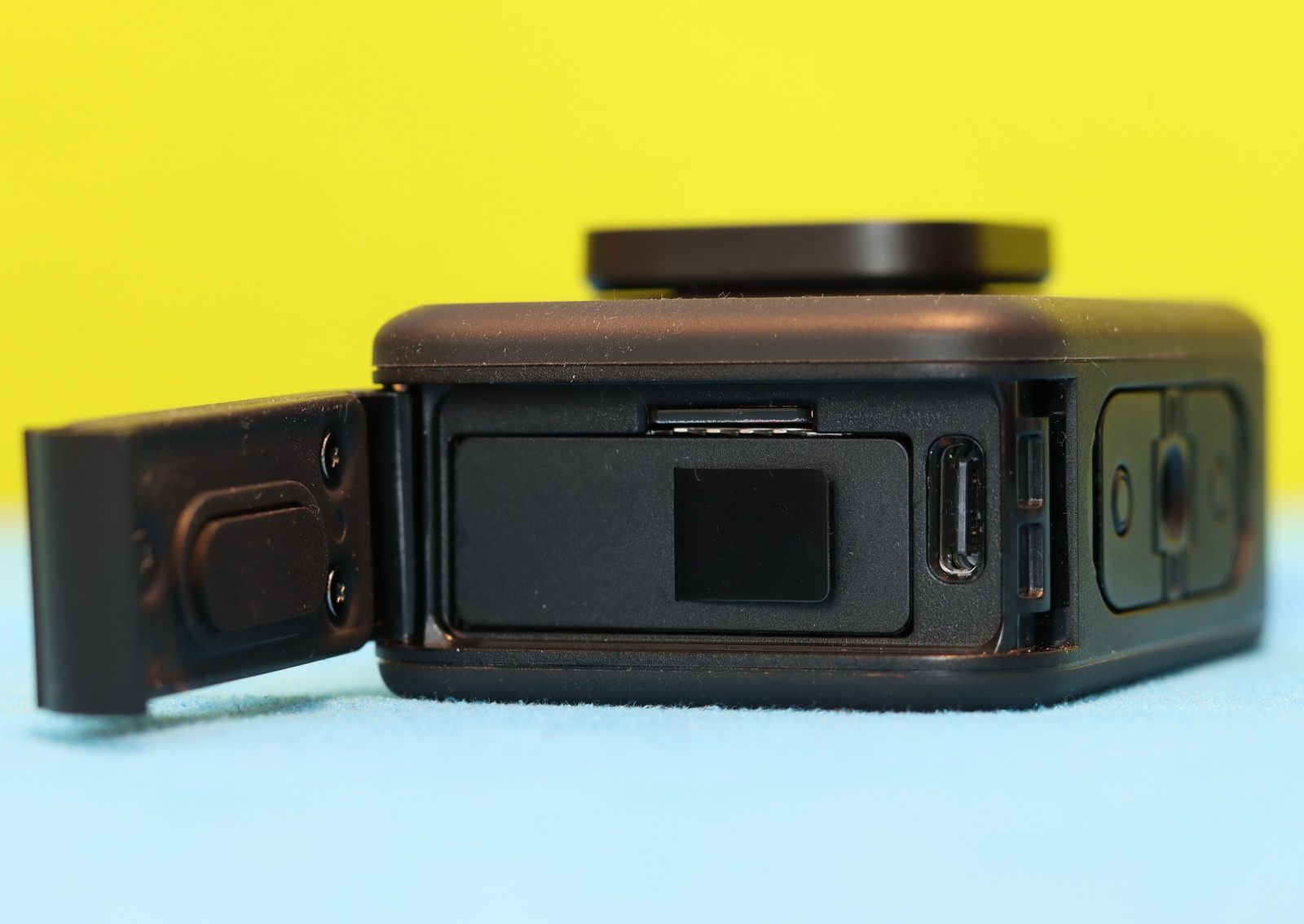
A USB-C connection handles charging and wired transfers. The new Enduro cell is exclusive to this generation, while GoPro says the body still fits the HERO12 Black Protective Case and Media Mod. That mix of old and new compatibility matters: existing mounts remain useful, but a drawer full of older spare batteries does not.
What Stands Out
The strongest argument for HERO13 Black is its HB-Series lens system. GoPro sells the optics separately, and the camera changes modes when one is attached. A Macro Lens Mod brings focus much closer than the standard lens; the Ultra Wide Lens Mod broadens the view for chest- or helmet-mounted footage. The Anamorphic Lens Mod adds a 21:9 option, while the ND filters help set up motion blur in bright light.
That is more useful than treating every scene as the same wide shot. Imagine filming a bike ride, then stopping for a close-up of a component or a landscape view: the accessory changes the perspective, and auto-detection removes one menu step. It does not turn the camera into a conventional interchangeable-lens model with autofocus and a full lens catalog. Each mod is a specific tool with its own limits.
GoPro's mounting arrangement is similarly practical when used for the right job. Magnetic alignment and auto-engaging latches make a grip-to-chest-mount change quicker than undoing a thumbscrew each time. Yet GoPro retained folding fingers and a tripod thread, so buying into the new latch system is optional. That flexibility is valuable if you already have a bag of GoPro accessories.
Battery and recording improvements are more incremental. The larger Enduro cell is rated for longer sessions than its predecessor, and GoPro also brought back GPS data capture for overlays in Quik. HyperSmooth 6.0 remains a useful foundation for rough movement, while the tall 8:7 capture option gives you room to crop one recording for horizontal and vertical posts. Those features make the camera adaptable, although they do not erase the HERO12 Black's considerable overlap.
Strengths
First, the recording toolkit is substantial without requiring an external stabilizer. You can choose 5.3K60 when detail and reframing matter, 4K120 for high-resolution slow motion, and HyperSmooth 6.0 when the camera is fixed to moving gear. The 27MP still-photo mode is handy when a trip calls for a photo as well as video, though it does not replace a larger-sensor camera in difficult light.
Next, HB-Series recognition makes the optional optics easier to use. The camera identifies the attached lens or filter and switches to its matching settings, instead of leaving you to correct the profile after a hurried change. The Macro accessory is particularly relevant for close product or gear details; the Ultra Wide accessory is the better fit for a broad point-of-view frame. These are concrete additions to the shots the standard lens can make.
Mounting choice is another strength. Folding fingers preserve established GoPro mounts, 1/4-20 threads connect to conventional supports, and the optional latch makes repeated swaps quicker. Because the magnetic adapter locks mechanically after aligning, the camera does not rely on magnetic pull alone. Still, the recommended attachment changes with the activity; for rough, high-vibration use, GoPro directs buyers back to the built-in fingers.
Finally, the standard body can go underwater to 33 feet (10 meters) without a housing, and the redesigned Enduro battery is rated for longer runs in both hot and freezing conditions. That pairing suits trips where a camera may move from a trail to a shoreline in the same day. Just separate the body's waterproof rating from accessory guidance: GoPro specifically says the Ultra Wide Lens Mod is not intended for underwater use.
Weaknesses
Accessories also raise the cost. HB-Series lenses, ND filters, and the Magnetic Latch Mount are optional purchases, so the most persuasive version of HERO13 Black costs more than the basic camera. One latch also does little for a multi-mount setup unless you equip the other positions with compatible adapters. Buyers who only record through the standard lens may be paying for a system they will never use.
The battery change creates a second cost for existing owners. HERO12 Black and older spare cells cannot be moved into this camera, and an older compatible charger cannot charge the new pack. GoPro's published endurance figures apply to 1080p30, 4K30, and 5.3K30 under its stated conditions; long 5.3K60 sessions call for realistic expectations and, often, another battery.
Lens mods carry their own compromises. The Ultra Wide Lens Mod delivers its wide view and Horizon Lock at up to 4K60, so you give up the standard camera's 5.3K60 ceiling when using it. GoPro also warns against taking that mod underwater, despite the bare camera's 33-foot rating. More glass and adapters make a mounted setup bulkier, especially on a helmet or lightweight rig.
Low light remains a reason to compare rivals closely. The DJI Osmo Action 5 Pro and Insta360 Ace Pro use larger sensors and offer dedicated low-light approaches, while independent reviews describe HERO13 Black's darker footage as a weaker point. HyperSmooth can correct motion; it cannot supply the light that a dark scene lacks. If most of your footage is after sunset, the lens ecosystem is unlikely to be the deciding advantage.
Best Alternatives
DJI's Osmo Action 5 Pro is the clearest alternative for dark scenes. Its 1/1.3-inch sensor, SuperNight mode, front and rear OLED touchscreens, and built-in storage make it a different package from GoPro's accessory-led design. You trade HERO13 Black's 5.3K60 ceiling and auto-detecting HB-Series optics for DJI's 4K-focused recording and stronger low-light emphasis. DJI also has quick-release mounting, so fast rig changes alone are not a reason to rule it out.
Insta360 Ace Pro suits someone who frames themselves often. Its flip-up touchscreen is easier to see from in front of the camera, and PureVideo targets night scenes; the larger 1/1.3-inch sensor is central to that pitch. The trade-off is a different shape and no equivalent to GoPro's auto-recognized HB-Series lens collection. Choose it for the screen and night-video priorities, not for the modular GoPro workflow.
Already own a HERO12 Black? That may be the most sensible alternative of all. It shares the headline 5.3K60 and 27MP capture figures, so keeping it makes sense if the existing lens and screw-on mounts already cover your work. HERO13 Black earns its upgrade cost through the new battery, magnetic latch option, GPS return, and HB-Series compatibility, rather than a dramatic jump in basic image resolution.
A smartphone remains the lower-friction option for occasional holiday clips, especially when you do not need a helmet mount or underwater body. You give up the action camera's mounting options and 33-foot waterproof rating in exchange for a device already in your pocket. That is a real trade-off, not a reason for every casual buyer to buy another camera.
Who Should Buy It
Buy HERO13 Black if your shoots involve repeated mount changes and distinct viewpoints. A rider moving between a chest harness, a handlebar, and a handheld grip has a reason to add magnetic latch adapters. A creator who actually wants macro details, ultra-wide point-of-view footage, or anamorphic framing has a reason to buy the HB-Series optics. The camera's strongest improvement is how those accessories work together, not a new headline resolution.
It also makes sense for someone moving up from a much older GoPro, particularly if their existing camera lacks the current stabilization and 5.3K60 options. Fold-out mounting fingers let many GoPro accessories carry forward, and the 1/4-20 thread broadens tripod choices. Budget for the new Enduro batteries and whichever optional lens or latch you will use; the camera body alone will not deliver every workflow improvement described here.
If you publish the same outing in wide and vertical formats, the tall 8:7 capture mode gives you more room to reframe one clip. GoPro's 27MP stills and 33-foot waterproof body add flexibility for travel and sport. These are reasons to choose a dedicated action camera when you need it on equipment or in water, rather than another reason to leave your phone behind for every shot.
Commission may be earned from this link, at no extra cost to you.
Who Should Skip It
Skip HERO13 Black if your HERO12 Black already records the wide-angle 5.3K footage you need. You would keep the same headline video resolution and 27MP still specification, while avoiding a new battery pool. Unless an HB-Series lens, magnetic latch, or returned GPS data solves a specific problem, the upgrade offers little reason to retire a working setup.
Also look elsewhere if most of your shooting happens at night. DJI's Osmo Action 5 Pro makes a clearer pitch with its larger sensor and SuperNight mode, and the Insta360 Ace Pro pairs a larger sensor with PureVideo. GoPro's stabilization and lens mods are useful, but neither changes the basic light available to the sensor.
Casual vloggers who mainly film themselves should consider whether they would benefit more from the Ace Pro's flip screen or simply from a phone. An action camera can be convenient on a bike or in the surf; for a stationary talking-head clip, HB-Series accessories and multiple mounts may be unnecessary complexity. Deep divers also need to plan beyond the bare camera's 33-foot limit and check accessory-specific water guidance.
Sources & References
Specifications and claims in this analysis were cross-referenced against the sources below.
No. HERO13 Black uses a redesigned 1,900mAh Enduro battery and a different connector. Older GoPro spare batteries will not fit, so include replacements in your upgrade budget.