A look at the Garmin Fenix 8 Solar Sapphire 47mm: up to 28 days of solar-assisted battery, multi-band GPS, and a 40-meter dive rating. We break down who this watch actually fits and who should save their money.
Buying a flagship multisport watch comes down to two questions: what does the hardware actually do, and how long does it run before you need a cable? Garmin's Fenix 8 Solar Sapphire 47mm is the company's attempt to bolt modern lifestyle features onto a watch endurance athletes already trusted. What follows in this Garmin Fenix 8 review is a look at the structural changes in this generation, and how they line up against rivals like the Apple Watch Ultra 2 and the Suunto Race. Historically, this line went after people who cared more about battery longevity and offline mapping than app stores. That net is wider now — recreational divers and anyone who wants voice input on the wrist are in scope too. If you're weighing an upgrade from an older Fenix, or a jump out of another ecosystem entirely, the architectural updates are where the decision actually lives. Sensors, durability, battery configurations. That's what we're breaking down.
Some links in this article are affiliate links, which helps support GadgetPickr at no extra cost to you.
The Quick Take
A focused hardware update rather than a reinvention: Garmin adds audio and dive gear to a chassis that was already built for abuse, and keeps the multi-week battery profile intact.
Verdict
Buy the Fenix 8 Solar Sapphire 47mm if you spend days away from power and need offline maps — the multi-week solar-assisted runtime is the single reason, and nothing else at this level matches it.
Skip it if you charge your watch at your desk every night anyway, because then you're paying a large premium for endurance you'll never draw on.
Adding a speaker and microphone closes a feature gap Garmin had lived with for years, and it does so without softening the rugged identity the line is known for. The 40-meter dive rating pushes utility further still, across land and water in one device.
That said, this sits at the top of Garmin's pricing, which makes it a specialized purchase rather than an impulse one. The display is a deliberate trade — sunlight legibility and battery efficiency in exchange for the vibrancy of AMOLED. Know which side of that you're on before you buy.
Everything in this Garmin Fenix 8 review points the same direction: it's the strongest outdoor watch Garmin makes, aimed squarely at people whose training happens where the outlets don't.
Garmin Fenix 8
Multisport tracking, outdoor navigation, diving, health monitoring, voice control
Sits at the top end of the multisport GPS watch market
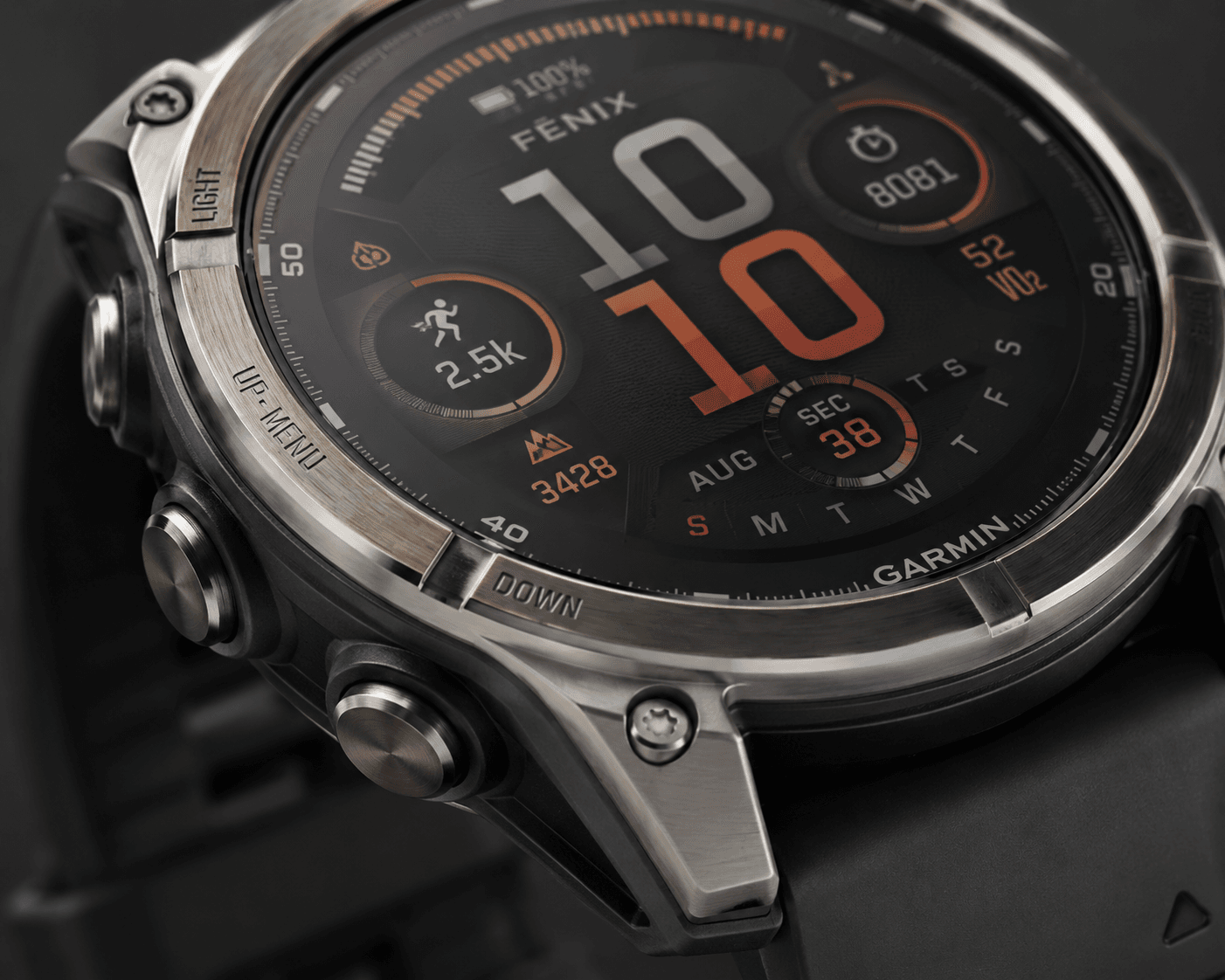
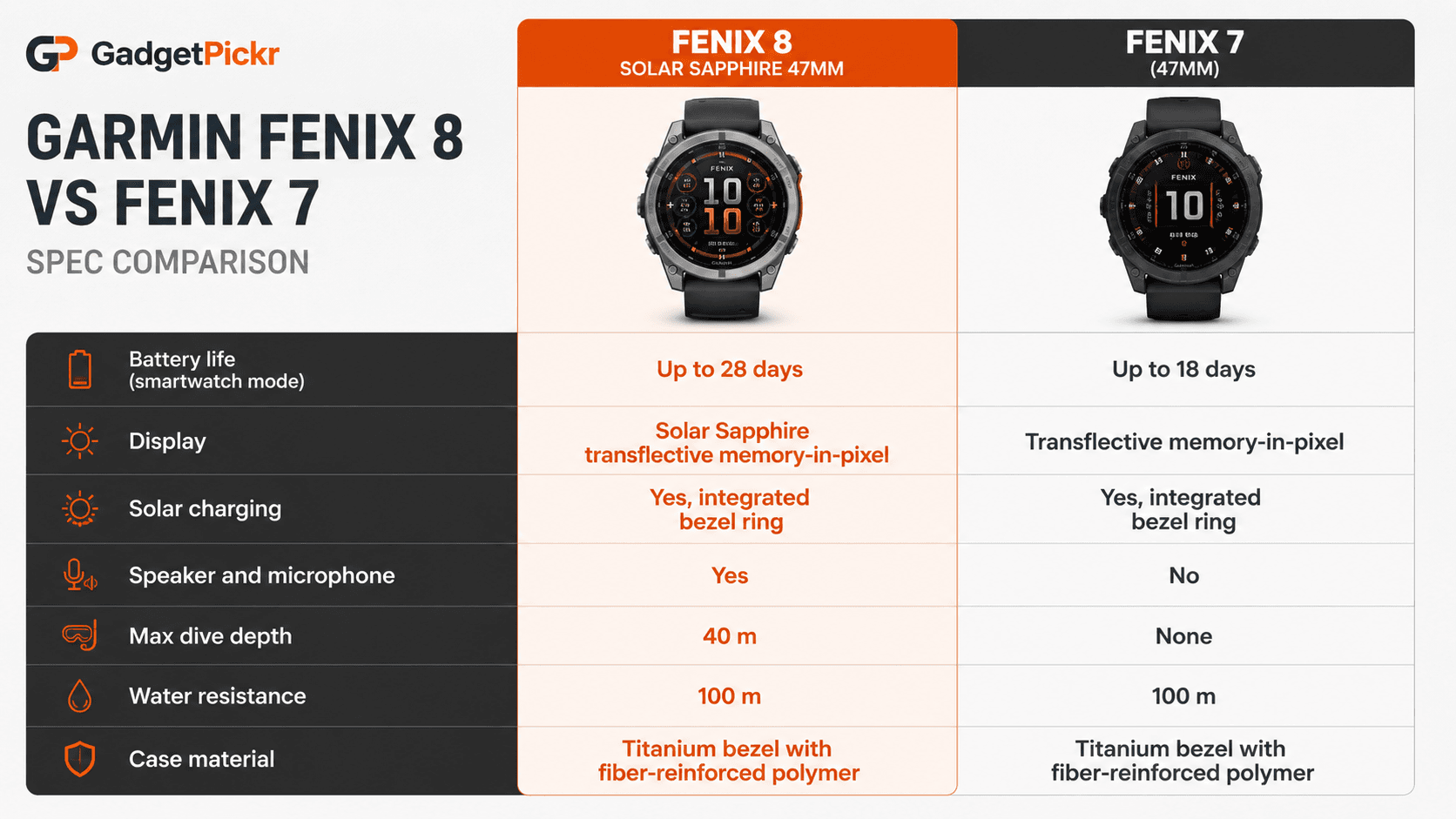
Start with the shell. A fiber-reinforced polymer case, a titanium bezel, and a scratch-resistant Solar Sapphire crystal make up the body, and that lens pulls double duty — it harvests sunlight to feed the battery. Garmin rates the 47mm at up to 21 days in smartwatch mode, or up to 28 days with solar — its test assumes about three hours a day outdoors in bright sunlight. Fewer charging stops on a multi-day traverse, in other words.
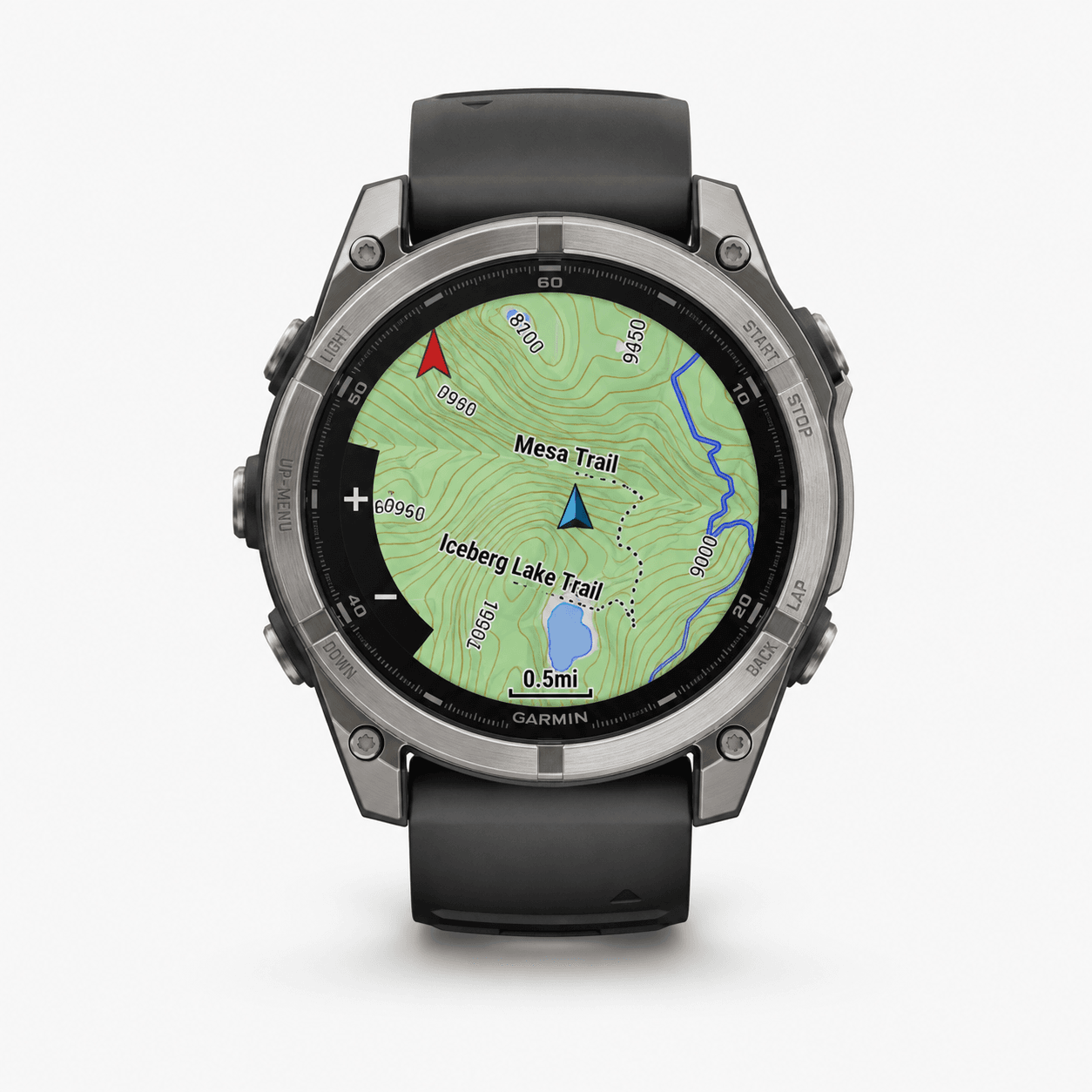
Sensors are where the money goes. Multi-band GPS keeps positioning tight under dense forest canopy and between tall buildings, the two places single-band watches reliably wander. Sitting alongside it: a barometric altimeter, a wrist-based heart rate monitor, and a Pulse Ox sensor for blood oxygen saturation. Those feed training load, recovery time, and altitude acclimation calculations.
Then there's the genuinely new part. A built-in speaker and microphone put voice control on the wrist for the first time in this line — start an activity, set a timer, or talk to your phone's assistant without digging the phone out of a jacket pocket.
Water is the other expansion. Water resistance is rated at 10 ATM (100 meters). With leakproof metal buttons and an integrated depth sensor, it supports recreational diving down to 40 meters, a job that used to require a separate dive computer on the other wrist.
Put that configuration next to a mainstream smartwatch and the split is obvious. Apps and ecosystem breadth go to the phone-first crowd; offline navigation, hard physical construction, and long runtime go here. Adding audio and dive depth extends daily usefulness without gutting the tracking core the Fenix name was built on.
Key Specs and Compatibility
Here's the hardware sheet in one place, stripped of marketing language.
Specification
Value
Case Size
47mm
Display Material
Solar Sapphire
Battery Life
Up to 21 days (28 with solar)
Water Resistance
100m (Diving capable)
Maximum Dive Depth
40 meters
Audio Hardware
Built-in speaker and microphone
Core Sensors
GPS, Heart Rate, Pulse Ox, Barometric Altimeter
Primary Functions
Multisport tracking, outdoor navigation, health monitoring, voice control
Competitors
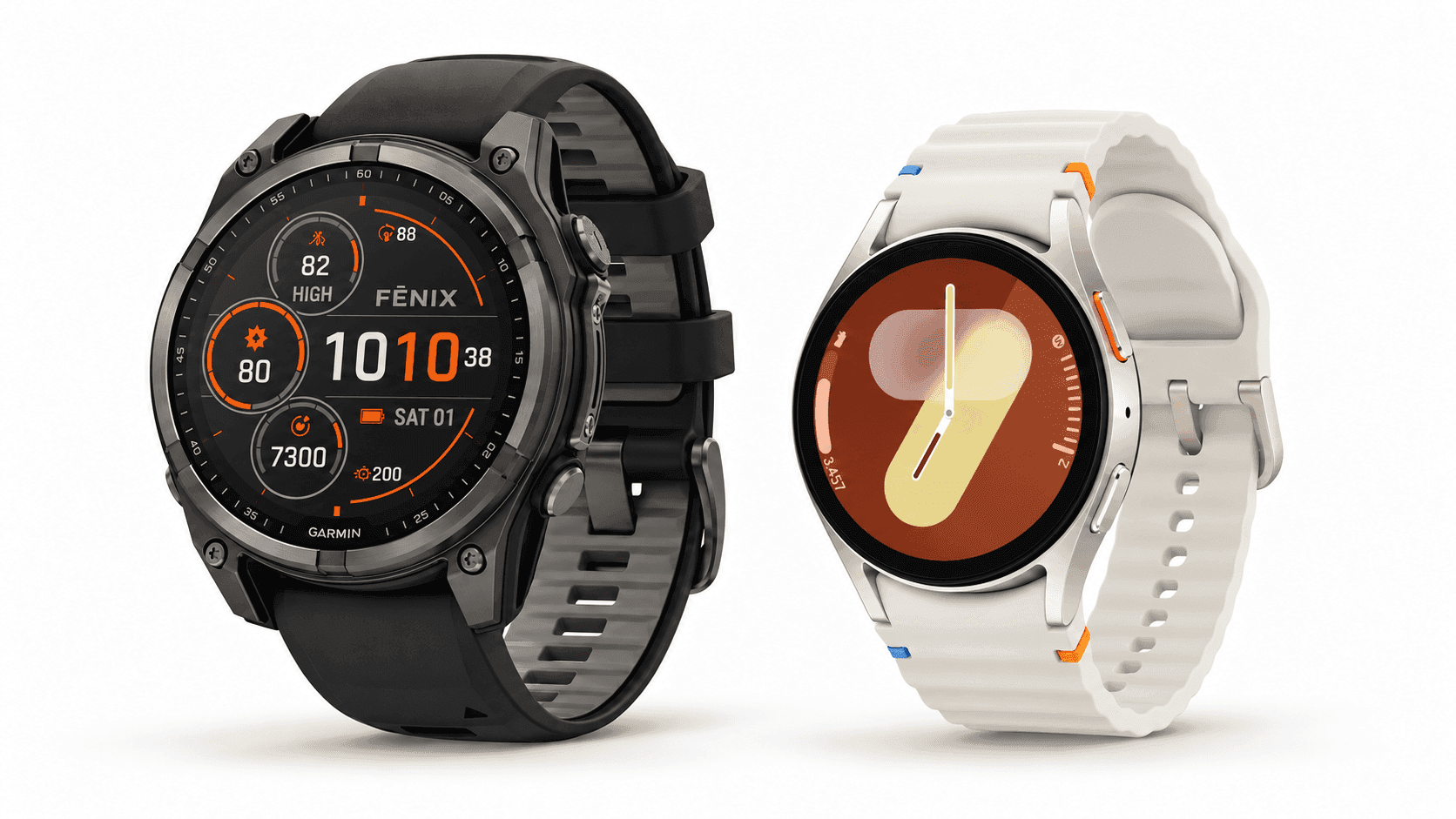
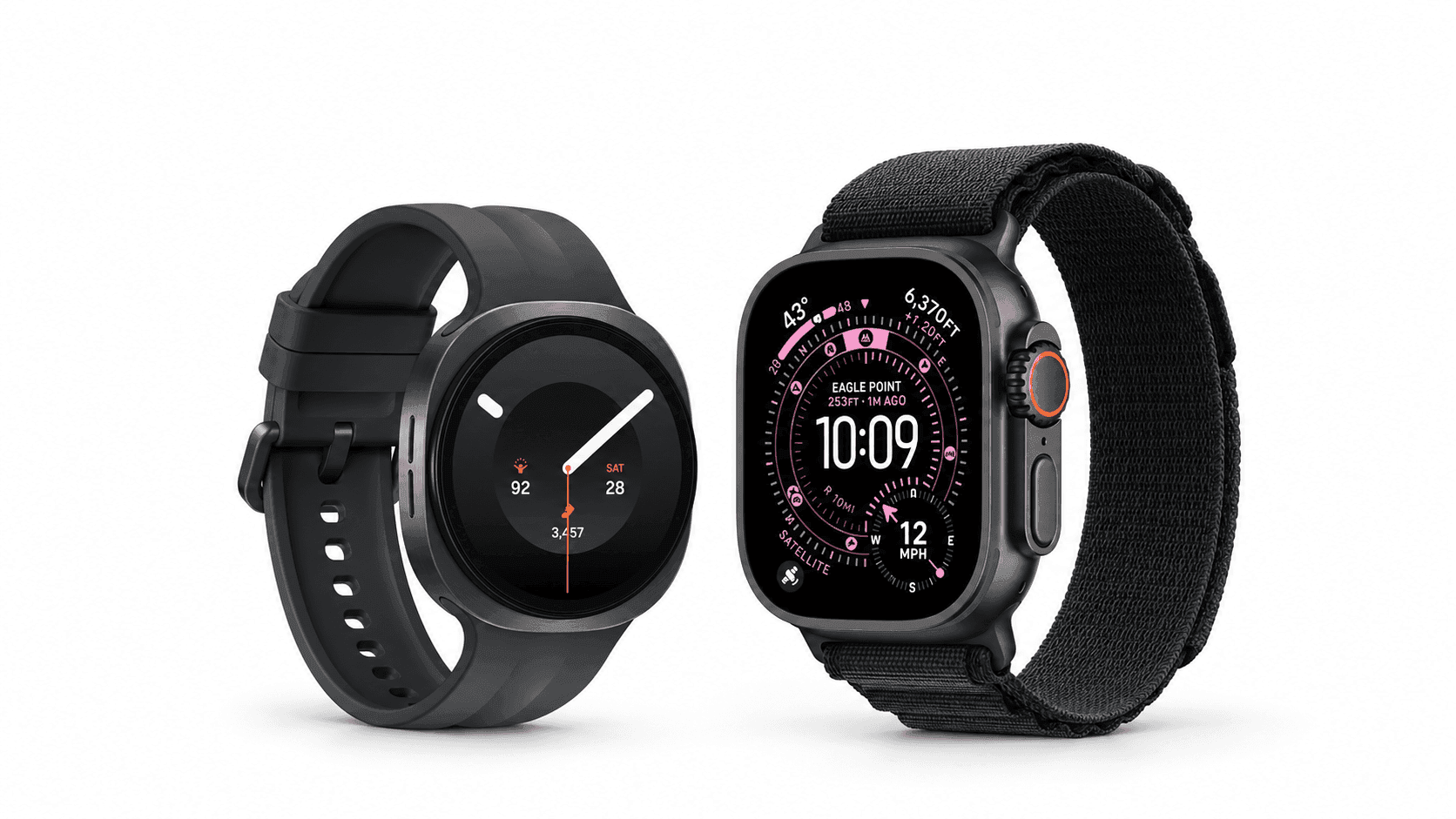
Apple Watch Ultra 2, Suunto Race, Coros Vertix 2S
Everything syncs through Garmin Connect, and the watch pairs with external ANT+ and Bluetooth sensors, uses Garmin's proprietary charging cable, and pushes data out to third-party fitness platforms.
Garmin Fenix 8 Review: What Stands Out
Three hardware decisions define this generation, and the loudest one is audio. A speaker and microphone bring voice commands and voice memos to the Fenix line for the first time, and a subset of those commands run locally — start an activity, set a timer, drop a waypoint, no phone required. Pair it to a handset and you can take calls and reach a digital assistant from the wrist.
Diving is the second. Leakproof metal buttons plus a depth sensor earn it a recreational dive rating to 40 meters, which closes most of the gap between a multisport watch and a purpose-built dive computer.
Display is the third, and the most divisive. Choosing a Solar Sapphire crystal lens on the 47mm model puts outdoor legibility and continuous passive charging ahead of everything else. This sunlight-visible transflective memory-in-pixel display leverages ambient sunlight to extend the watch's battery life up to 28 days in smartwatch mode. On a two-week route with no outlets, that's the whole argument.
Build quality backs it up: high-strength titanium bezel, fiber-reinforced polymer case, protective rear cover over the sensor array. Add multi-band GPS, a 3-axis compass, heart rate, and Pulse Ox, and you get a watch that reads as survival kit first and wearable second.
Strengths
Day to day, the strongest argument here is maintenance — or the absence of it. An autonomous health and navigation hub that you charge every few weeks changes how you pack for a trip.
Up to 28 days under good solar conditions means a thru-hike, a hundred-miler, or three weeks abroad without the cable. Set against smartwatches that want a charger every night, that's not an incremental gain.
Multi-band reception is the other practical win. Two frequencies instead of one is what keeps pace and distance honest under canopy and beside buildings, where single-band units start inventing detours.
Voice hardware earns its place for a different reason: hands. Dictating a note or answering a call mid-climb, mid-run, or mid-glove is the kind of small friction removal you notice weekly.
Background health tracking runs continuously — heart rate variability, sleep, training readiness, blood oxygen — and rolls into readiness scores that tell you whether to push or back off. Widgets for weather trends, pressure changes, and step goals sit a button press away. And the titanium-and-polymer build reads as appropriate in an office without pretending it isn't built for a mountain.
Weaknesses
Cost is the first wall. This sits at the very top of Garmin's range, well above what a casual fitness tracker buyer would consider reasonable.
Display is the real trade-off, though. Memory-in-pixel panels win in direct sunlight and sip power, but they cannot produce the contrast, deep blacks, or color saturation of an AMOLED screen. Indoors and after dark, that means leaning on the backlight — a step down if your reference point is a phone display.
Voice features, welcome as they are, don't replicate what a phone-tethered smartwatch does. Assistant access depends on a live Bluetooth link, and the offline command set covers basic system functions rather than anything elaborate. Apple Watch Ultra 2 owners will still have the deeper app ecosystem.
Size matters too. A 47mm ruggedized titanium and polymer case is a lot of watch, and smaller wrists will feel it — particularly overnight, which is exactly when the recovery data gets collected.
Last one: complexity. Between navigation tools, dive configurations, and dozens of physiological metrics, there's a real learning curve. Buy this for step counting and you've bought a lot of menus you'll never open.
Best Alternatives
Three watches compete directly for this buyer, and each one trades something specific away.
Apple Watch Ultra 2 gives you a better app ecosystem, cellular, and tighter iPhone integration, but you'll be charging it daily or every other day instead of every few weeks.
Coros Vertix 2S targets ultra-endurance runners with dual-frequency GPS and a rugged case at a lower price, minus the speaker, microphone, and 40-meter dive rating.
Suunto Race brings a bright display, strong offline maps, and a digital crown for less money, but without the solar charging, voice commands, or the depth of Garmin's health-tracking platform.
Decide by what you actually run out of: charge, apps, or budget.
Who Should Buy It
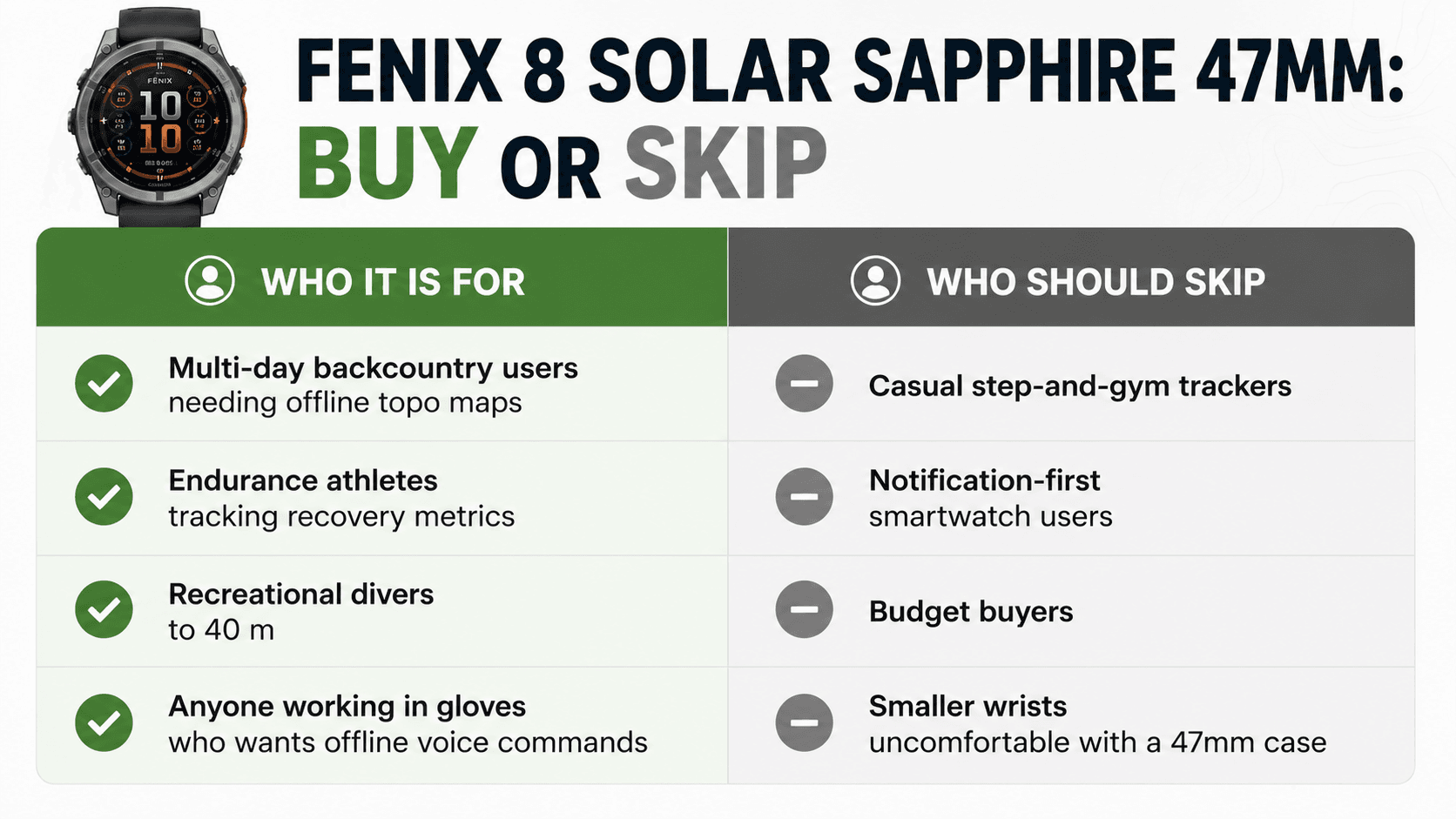
Serious multisport athletes, backcountry navigators, and endurance racers are the target, plainly.
Spend consecutive days off-grid and the solar charging plus up-to-28-day runtime turns this from a nice watch into functioning navigation equipment. Recreational divers get the 40-meter rating and leakproof metal buttons, so one watch covers the trail and the reef.
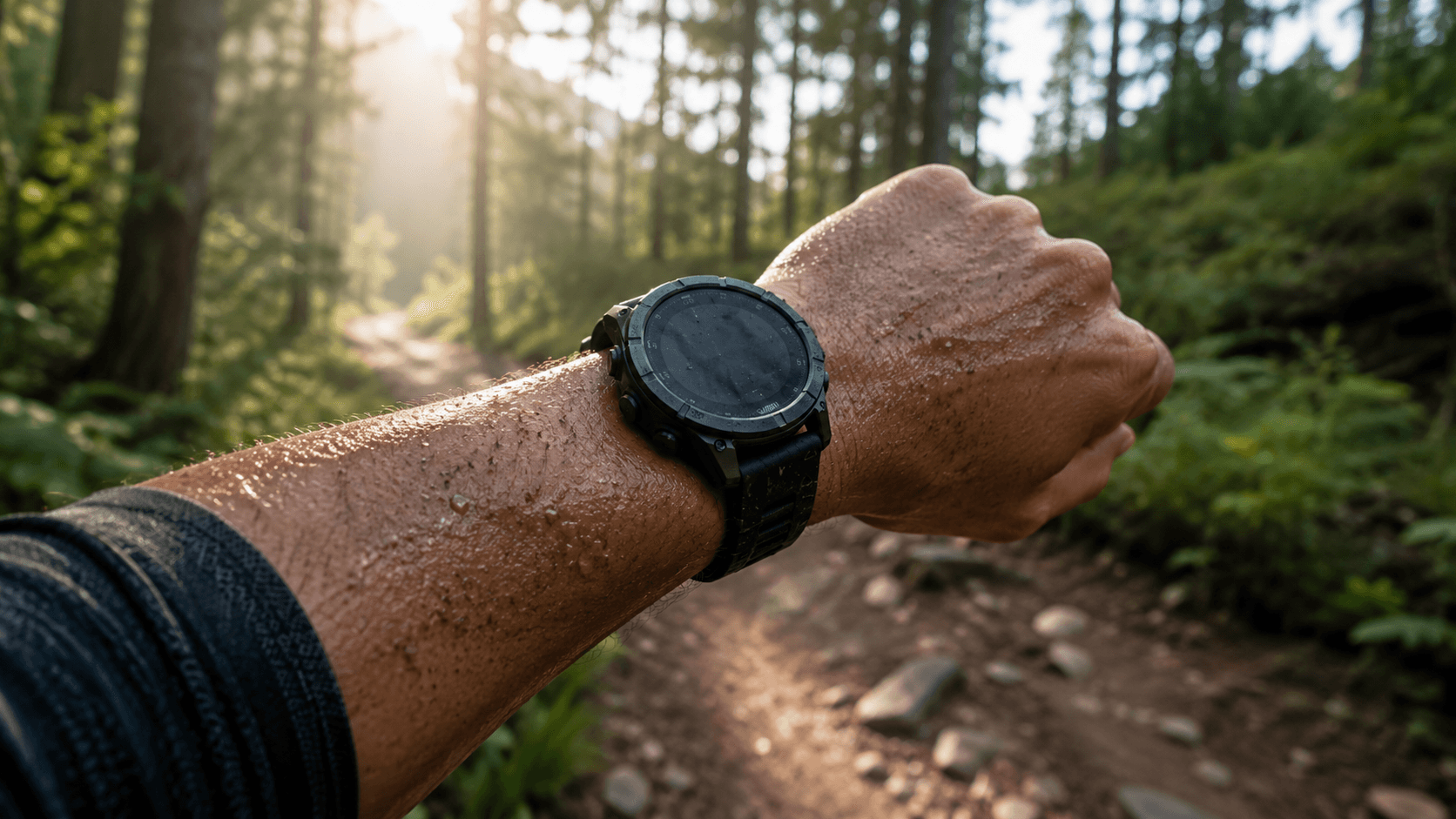
Rough conditions favor the Solar Sapphire lens and titanium bezel for scratch and impact resistance. Anyone working in gloves or over technical terrain will use the speaker, microphone, and offline voice commands more than they expect. And if detailed offline topo maps, multi-band tracking, and recovery metrics genuinely shape your training week, the cost lands as justified rather than indulgent.
Commission may be earned from this link, at no extra cost to you.
Who Should Skip It
Casual users, mostly. Track steps, a few runs, and gym sessions and you're paying for multisport telemetry and route navigation you'll never open.
Notification-and-messaging people should also look elsewhere — an Apple Watch or a Wear OS device gives a smoother, more interactive experience for a fraction of the money.
Budget buyers, same answer: skipping the dive rating, solar charging, and offline maps means skipping most of what you'd be paying for. And smaller wrists will find the 47mm utilitarian case too bulky for round-the-clock wear, which makes slimmer sports watches the better everyday health tracker.
Sources & References
Specifications and claims in this analysis were cross-referenced against the sources below.
Garmin rates the Solar Sapphire 47mm at up to 21 days in smartwatch mode, or up to 28 days with good sun exposure (about three hours a day outdoors). Heavy multi-band GPS use drains it much faster, but it still outlasts daily-charge smartwatches by a wide margin.