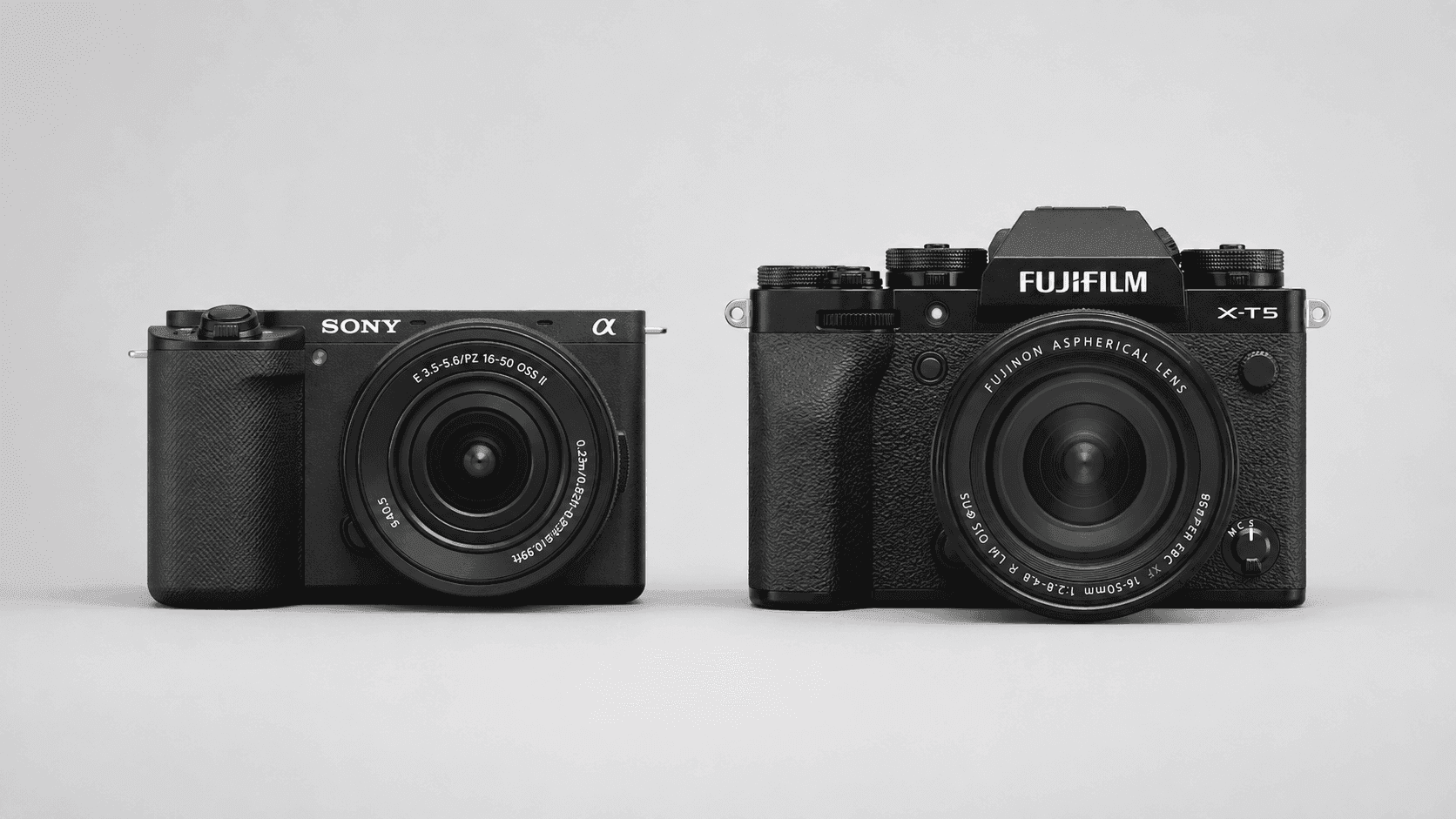
Two APS-C bodies, two completely different answers to the same question: what do you actually make? The Sony ZV-E10 II vs Fujifilm X-T5 matchup isn't a close spec race — it's a fork in the road.
Sony built the ZV-E10 II around content creators. A 26.0MP Exmor R CMOS sensor, fast autofocus tracking, and vertical video interface options tell you exactly who it's for. Fujifilm went the other direction with the X-T5: a 40MP X-Trans CMOS 5 HR sensor, mechanical control dials, and an electronic viewfinder aimed at photographers who want resolution and hardware feedback under their fingers.
Both capture sharp video. Both produce crisp images. Where they split is sensor architecture, stabilization, and how you physically operate them. The ZV-E10 II drops the shutter dial and viewfinder for a lighter chassis, a directional microphone array, and a fully articulating touchscreen, while the X-T5 counters with 7-stop in-body image stabilization and dedicated dials for ISO, shutter speed, and exposure compensation. Work out your main output — vlogs, social clips, landscape prints, event coverage — and the decision mostly makes itself.
The Quick Take
If your output is vlogging, tutorials, or live streaming, the Sony ZV-E10 II is the clearer fit. Its 759-point phase-detection autofocus locks onto faces and eyes and holds on even when a subject moves quickly across the frame. Shooting stills for print? Skip ahead to the X-T5.
Sony ZV-E10 II
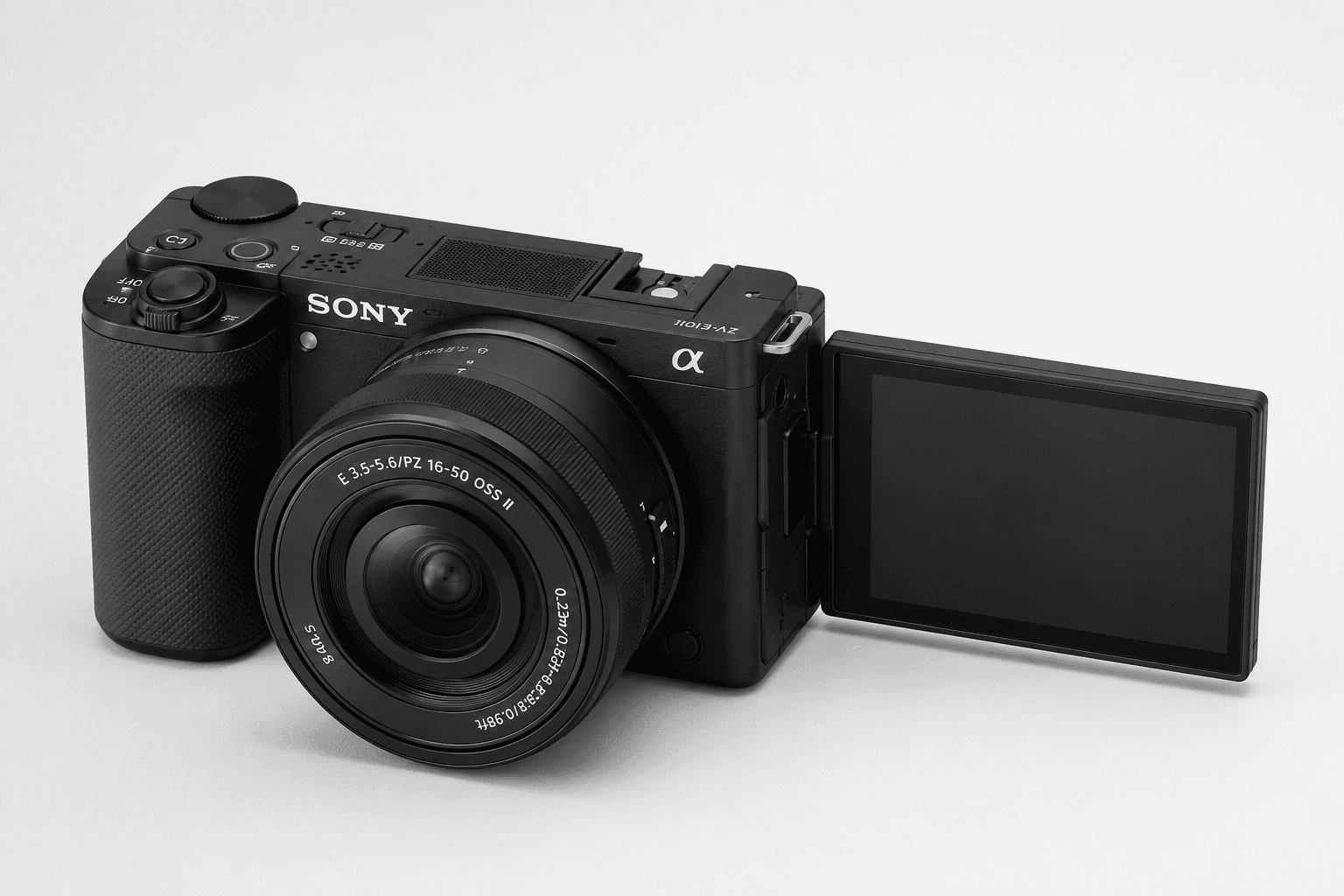
The lighter, video-first pick: 26.0MP sensor, 4K60p, side-flip screen, no viewfinder.
Check Price on AmazonFujifilm X-T5
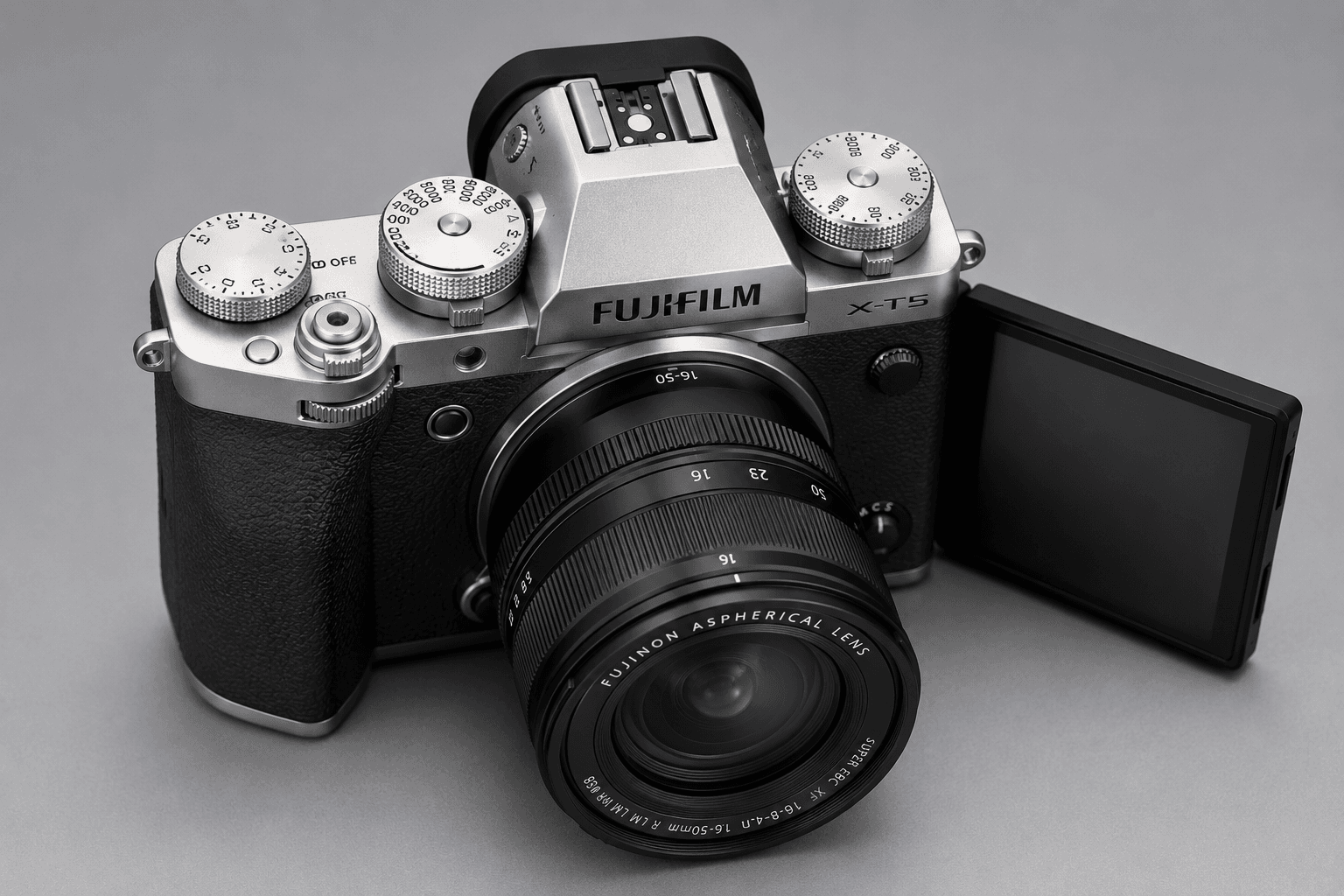
The stills specialist: 40MP resolution, 7-stop IBIS, mechanical dials, OLED viewfinder.
Check Price on AmazonSony ZV-E10 II vs Fujifilm X-T5: Specs Compared
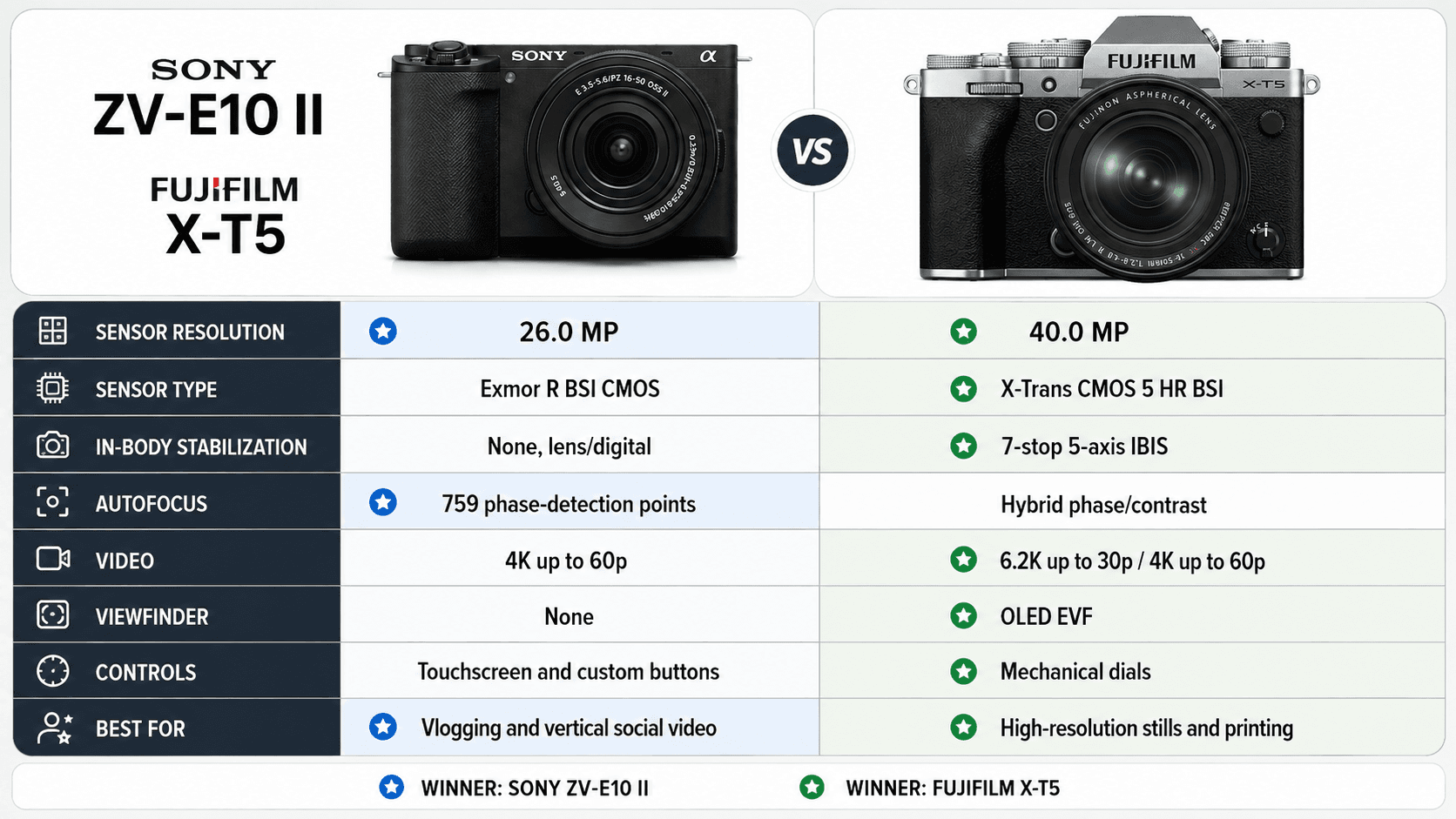
Numbers first, opinions after. Here's how the two bodies line up on the hardware that actually changes what you can shoot.
| Specification | Sony ZV-E10 II | Fujifilm X-T5 |
|---|---|---|
| Sensor Resolution | 26.0 MP | 40.0 MP |
| Sensor Type | Exmor R BSI CMOS | X-Trans CMOS 5 HR BSI |
| In-Body Image Stabilization | None (Lens/Digital) | 7-stop 5-axis IBIS |
| Autofocus System | 759 Phase-Detection Points | Hybrid Phase/Contrast AF |
| Video Recording | 4K up to 60p | 6.2K up to 30p / 4K up to 60p |
| Electronic Viewfinder | None | Yes (OLED) |
| Control Layout | Touchscreen & Custom Buttons | Mechanical Physical Dials |
| Best For | Solo vloggers and travel creators shooting handheld 4K and vertical social clips on the lighter-priced body | Landscape, studio and street photographers who crop hard, print large, and will pay more for dials and sealing |
Design & Build Quality
Hold these two and you're holding different philosophies. Sony's body is small, plain, and built to vanish into a bag — easy to clamp onto a mini tripod, a U-grip, or a gimbal without fighting the balance. Instead of dense dials you get a top-mounted record button, a tally light, and a stripped-back control set tuned for shooting fast. The trade-off: no electronic viewfinder at all, so the rear screen is your only window.
Fujifilm went classic. Dedicated analog dials for shutter speed, ISO, and exposure compensation sit on the top plate of the X-T5, so changing exposure means turning something rather than diving through menus. Weather-resistant construction backs that up for outdoor work.
Eye-level framing comes from a high-resolution electronic viewfinder, which is what saves you when direct sun washes out a rear screen. This body is heavier and larger than the Sony. That's the cost of the deeper grip, the sealing, and the dials — and for a dedicated stills shooter, it usually reads as money well spent rather than bulk.
Performance & Key Features
Under the shell, the split gets sharper. A 26.0MP APS-C Exmor R CMOS sensor drives the ZV-E10 II, paired with a 759-point phase-detection autofocus system. That combination records 4K video up to 60p with real-time eye and face detection that stays locked through movement instead of hunting, and Sony includes 10-bit color support and S-Cinetone for creators who grade their footage.
Framing is handled by a side-articulating vari-angle touchscreen LCD. Flip it out and it clears any top-mounted shotgun mic or light — a small detail that matters enormously when you're filming yourself, alone, in vertical.
Fujifilm's 40MP APS-C X-Trans CMOS 5 HR BSI sensor is the headline on the other side. That's 14MP more than the Sony sensor, and it shows up as cropping room, fine detail rendition, and print headroom for landscape, portrait, and commercial work. Keeping all that resolution steady falls to the 7-stop In-Body Image Stabilization system, which lets you shoot handheld at shutter speeds that would otherwise smear.
Screen strategy diverges too. A three-way tilting LCD keeps the X-T5's optical axis in line with the lens, which is ideal for waist-level and overhead stills and awkward for talking to camera. So one body leans on lens or electronic stabilization plus automated tracking; the other pairs high resolution with true sensor-shift IBIS. Different problems, different fixes.
Pros & Cons: Sony ZV-E10 II
Capable content-creation tool with a couple of omissions worth knowing about before you buy.
Pros: the 26.0MP Exmor R CMOS sensor delivers crisp stills and oversampled 4K recording up to 60p; the 759-point phase-detection autofocus system tracks faces and eyes reliably; the fully articulating side-flip touchscreen makes self-framing painless for vertical video; and the light, compact form factor slips into a travel bag or onto a small gimbal setup. Cons: there's no sensor-shift stabilization and no viewfinder, so walking shots depend on a stabilized lens or electronic cropping, and bright-daylight framing gets harder.
Pros & Cons: Fujifilm X-T5
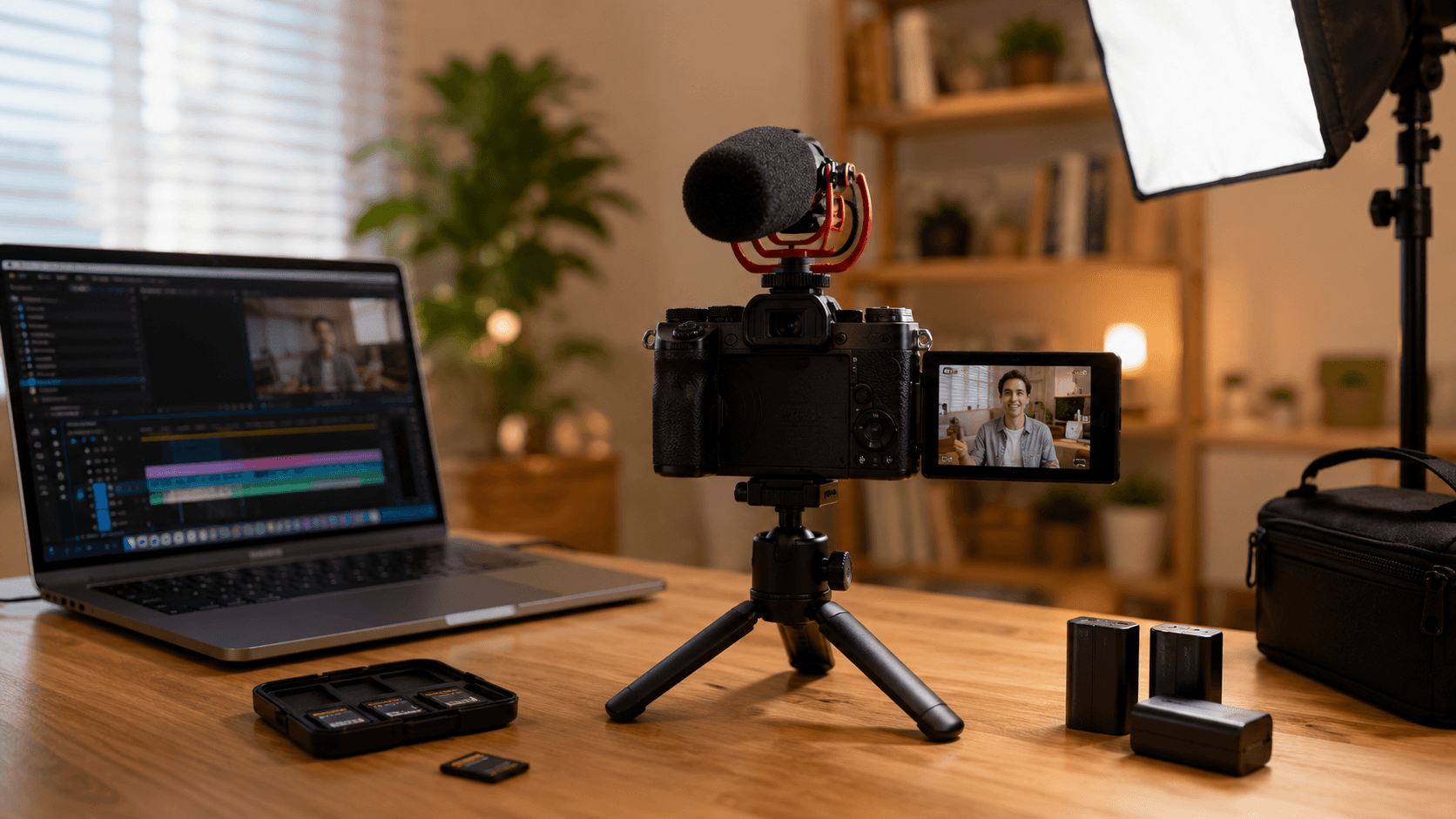
A stills-focused workhorse with real hybrid ability. Its main strength is the 40MP APS-C X-Trans CMOS 5 HR BSI sensor, which supplies the resolution and detail that high-end landscape work and commercial portraiture actually consume. The 7-stop in-body image stabilization steadies handheld shooting at slow shutter speeds, so you leave the tripod at home more often than you'd expect. Dedicated mechanical dials for shutter speed, ISO, and exposure compensation give you a tactile, immediate interface that experienced photographers tend to prefer.
Those strengths come with costs. This body sits well above the Sony ZV-E10 II in price as a standalone purchase, which makes it a serious commitment next to creator-focused options. It's also physically larger and heavier — less appealing if you're a casual vlogger or mobile video creator chasing a small kit. Video performance is solid, but you don't get the vlogging conveniences: no side-flip articulating screen (the three-way tilting LCD favors photography), no specialized vlogging audio controls, and no tally light out of the box.
Real Buyer Scenarios
Picture your actual shooting week. If it involves filming on the move, banging out quick product reviews, or feeding vertical clips to social platforms, the ZV-E10 II is the companion that fits. YouTubers, travel vloggers, and solo creators get a light body, a side-articulating screen, 759-point phase-detection autofocus, and 4K60p — enough to produce polished footage without hauling a rig or a stabilizer.
Now picture a different week: golden hour on a ridgeline, a studio session, a day of street shooting. That's X-T5 territory. Photojournalists and hybrid shooters who need maximum detail get a 40MP sensor and 7-stop IBIS for low-light steadiness, analog dials for instant manual control, and an electronic viewfinder that stays usable in harsh sun. If you print large or crop aggressively, the raw headroom here is the whole argument.
Put simply: creators who want a compact, low-fuss tool for dynamic video work get more out of the Sony. Anyone who treats photography as the craft — and wants resolution, weather sealing, and sensor stabilization — should take the Fujifilm.
Alternatives Worth Considering
Neither body is the only route to these results. Like Sony's autofocus and lens ecosystem but need mechanical controls, a viewfinder, and in-body stabilization in one package? Look at the Sony A6700. It lands between creator ergonomics and traditional camera design, with strong video specs and proper stills handling.
Drawn to Fujifilm's color science and dials, but the X-T5's resolution and price feel like more than you need? The Fujifilm X-S20 is the sensible step down. Fully articulating touchscreen for self-recording, built-in stabilization, deep video features, and the same X-mount lens catalog — a direct rival to dedicated vlogging bodies.
Final Verdict
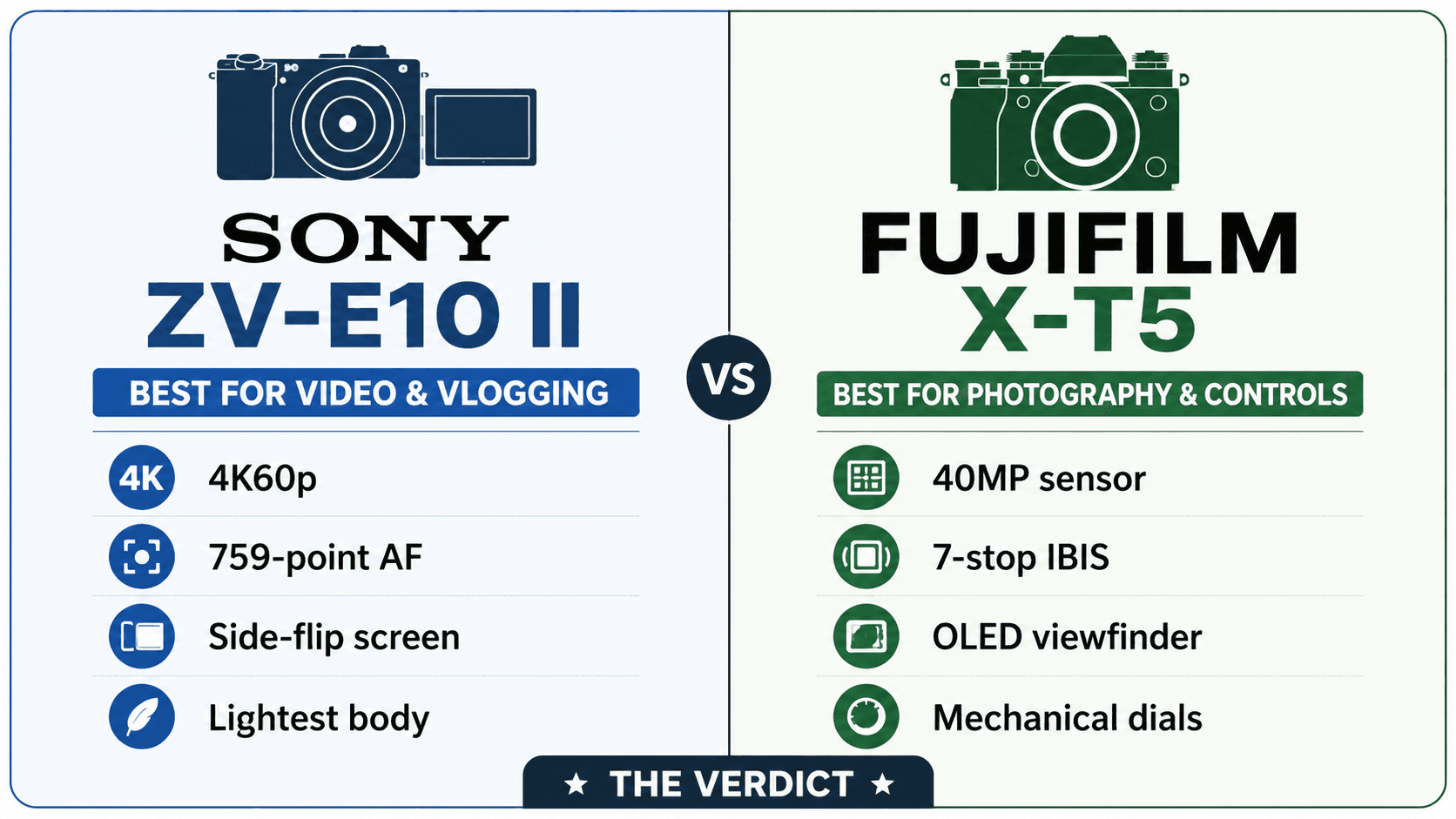
Choose the Sony ZV-E10 II if you shoot vlogs, tutorials, or live streams. The 759-point phase-detection autofocus holds faces and eyes through fast movement, 4K at 60 frames per second gives you smooth motion and room to slow footage down, and the small body stays manageable across long handheld sessions.
Choose the Fujifilm X-T5 if you shoot stills for print, client work, or heavy cropping. The 40MP sensor takes aggressive crops without falling apart, 7-stop in-body image stabilization buys you sharp handheld frames at slow shutter speeds in dim light, and the electronic viewfinder makes bright outdoor framing far more reliable than a rear screen alone.
Split evenly between the two? Go by medium, not by mood. That's the Sony ZV-E10 II vs Fujifilm X-T5 call in one line: video tracking and a streamlined vlogging layout point to the Sony, while resolution, physical exposure dials, and sensor stabilization point to the Fujifilm.
Sources & References
Specifications and claims in this analysis were cross-referenced against the sources below.
- Sony ZV-E10 II Review | The Best Camera On The Market For ...slrlounge.com
- Sony ZV-E10 II review: Sony perfects its vlogging formuladigitalcameraworld.com
- Sony ZV-E10 II Review - PCMagpcmag.com
- Sony ZV-E10 II in-depth review - DPReviewdpreview.com
- Sony ZV-E10 II Vlogging Camera Review - DustinAbbott.netdustinabbott.net
- Sony ZV-E10 II reviewtomsguide.com
- Fujifilm X-T5 Review | 5050 Travelog5050travelog.com
- Fujifilm X-T5 review – A 40MP mirrorless sensationamateurphotographer.com
Frequently Asked Questions
The ZV-E10 II, clearly. Its side-flip articulating screen, 759-point autofocus, tally light, and light body suit self-recording and vertical clips. The X-T5's three-way tilting LCD works against you when you're filming yourself.