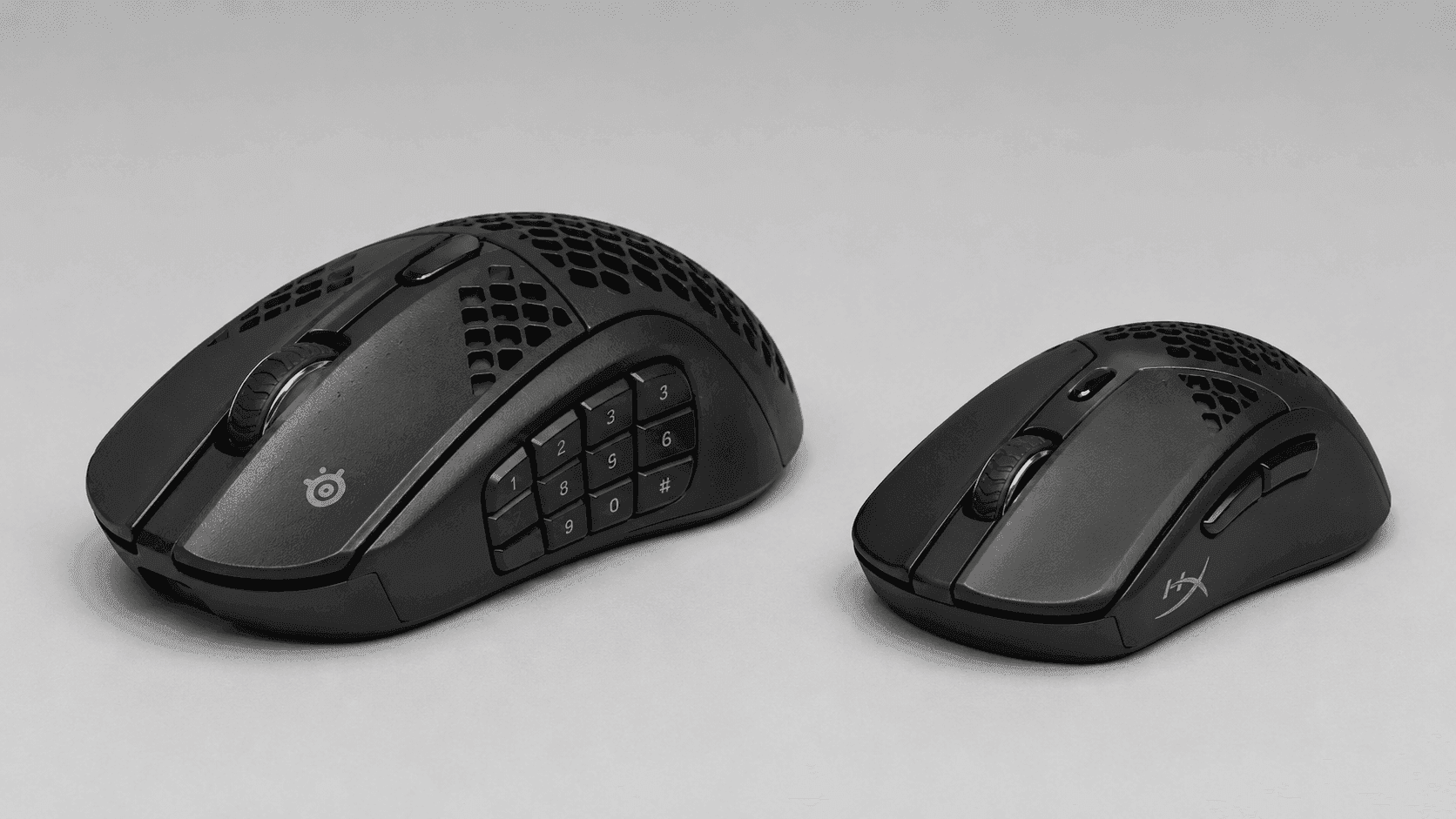
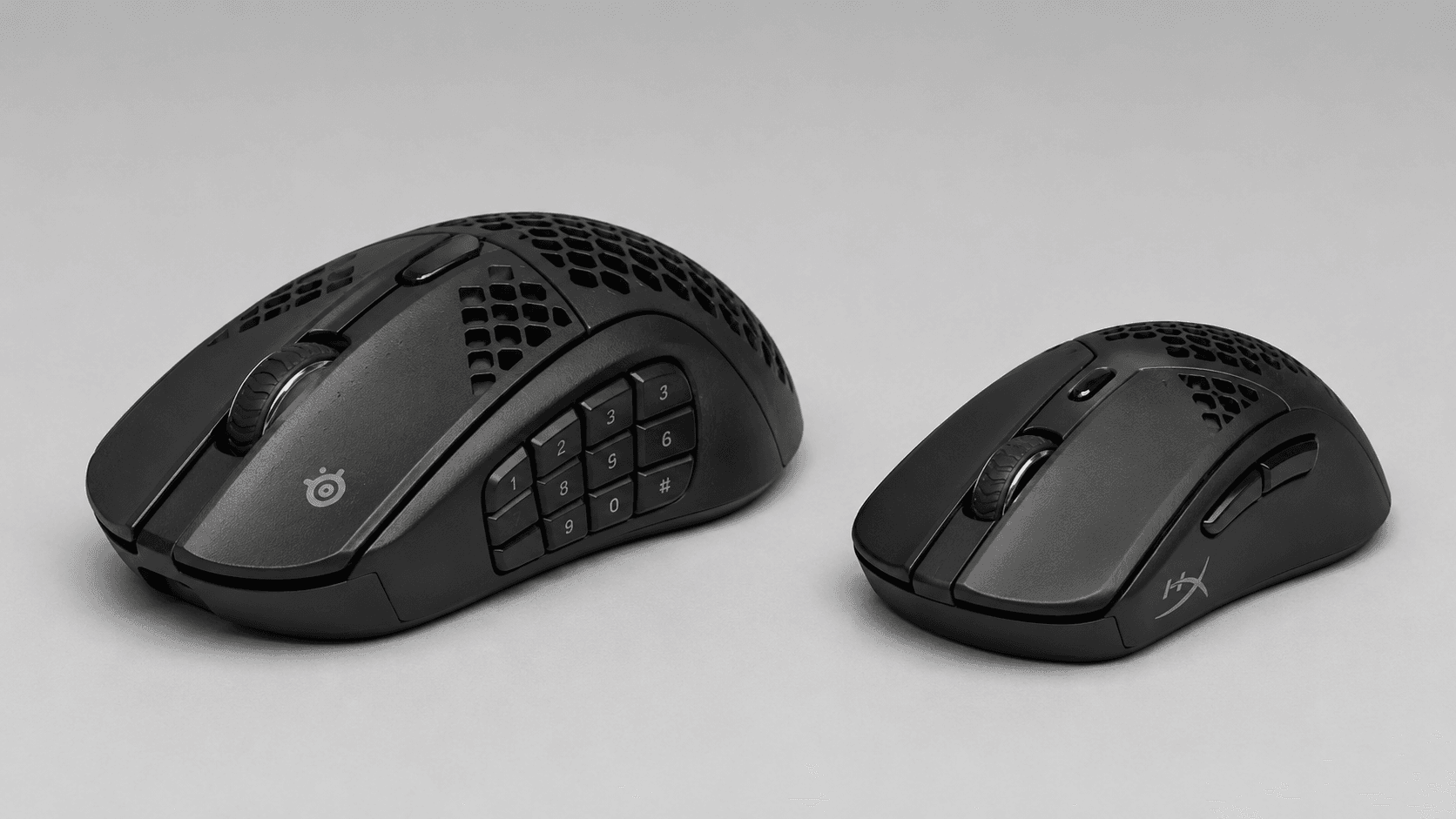
Pick a wireless gaming mouse and you are really picking a philosophy. SteelSeries Aerox 5 vs HyperX Pulsefire Haste 2 Mini is that argument in miniature: one hands you nine programmable buttons and a runtime measured in weeks, the other strips the body down to 59 grams and dares you to miss the extras. Both run dual wireless — a 2.4GHz USB dongle plus Bluetooth — so cable clutter is off the table either way.
Similarities end about there. Aerox 5 Wireless wraps its multi-button layout in an IP54-rated AquaBarrier shell and aims at players who bounce between shooters, MOBAs, and long tactical sessions. HyperX went the other way entirely. Scaled down 9.6 percent from the standard Haste 2 Wireless shell, the Mini chases claw and fingertip grips, smaller hands, and backpack-friendly setups.
So the real question is input depth and runtime against raw maneuverability. This is a spec-based analysis using published manufacturer specifications and market comparisons. No hands-on testing was conducted.
The Quick Take
Genre first, hand size second, desk space third. Sort those three and this matchup resolves itself fast — macros and marathon battery on one side, featherweight flicks on the other.
SteelSeries Aerox 5 Wireless
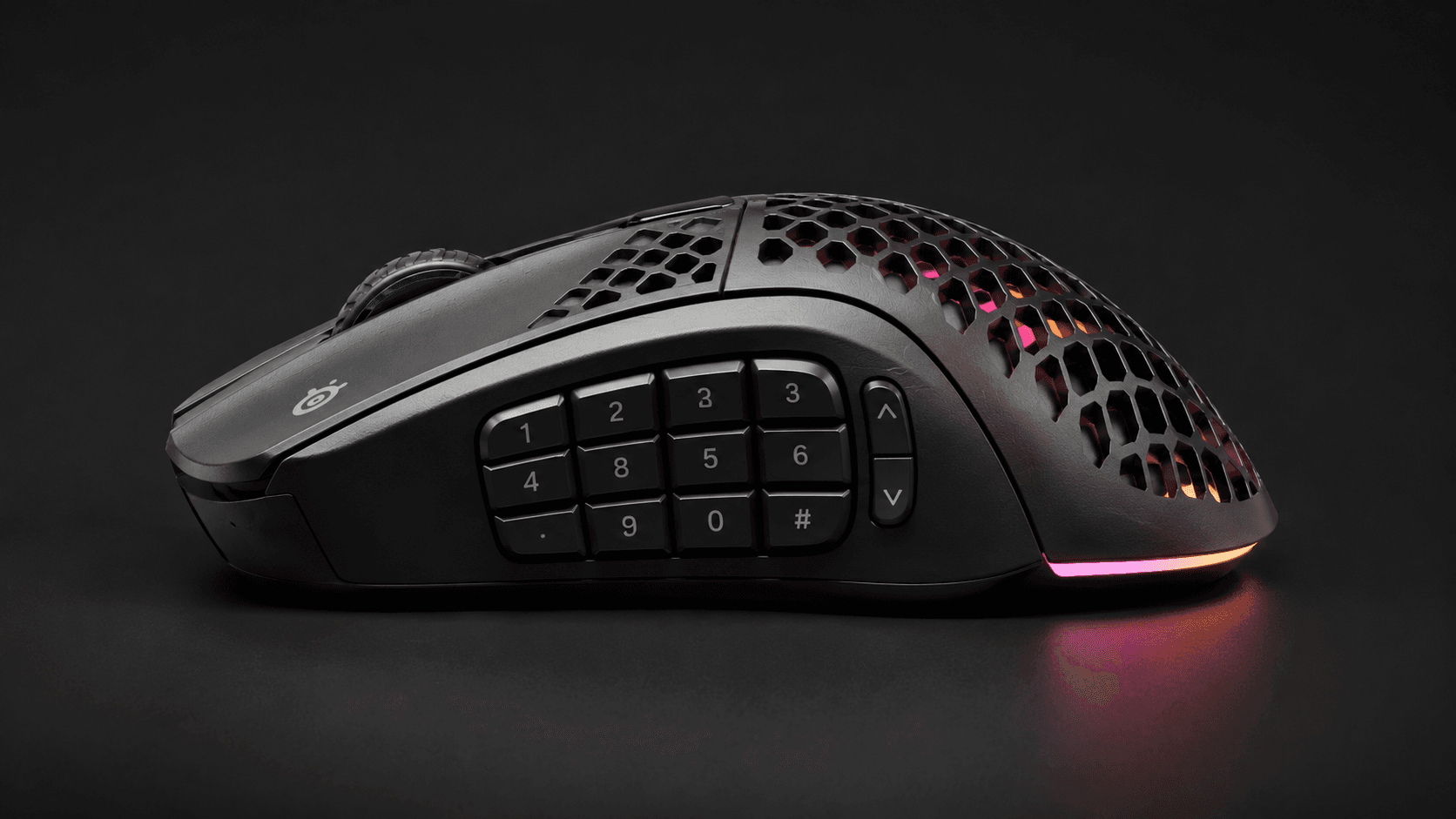
Nine programmable inputs, spill protection, and the longer runtime of the pair.
Check Price on AmazonHyperX Pulsefire Haste 2 Mini Wireless
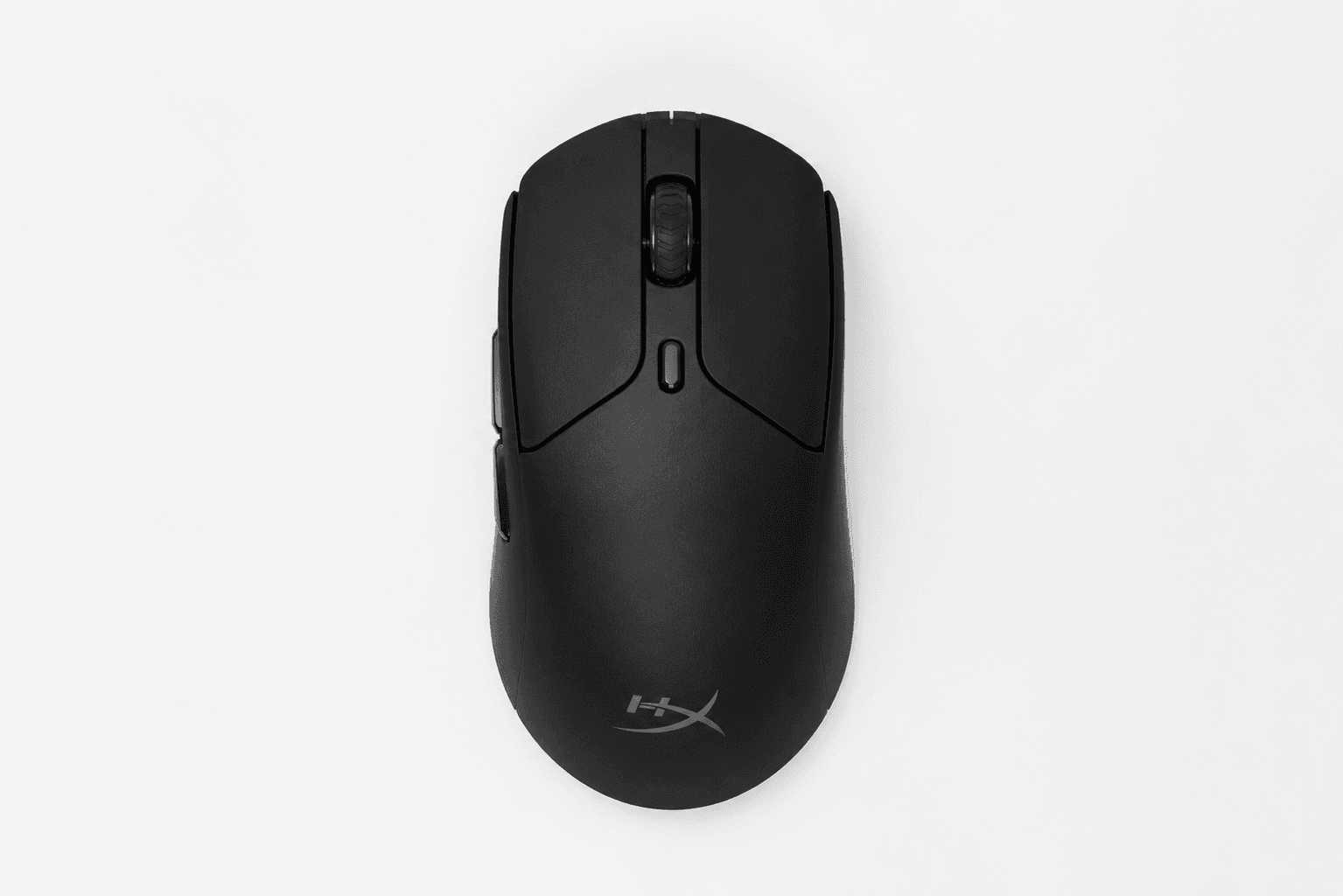
59 grams, the higher sensor ceiling, and a shell sized for small hands and travel.
Check Price on AmazonSteelSeries Aerox 5 vs HyperX Pulsefire Haste 2 Mini: Specs Comparison
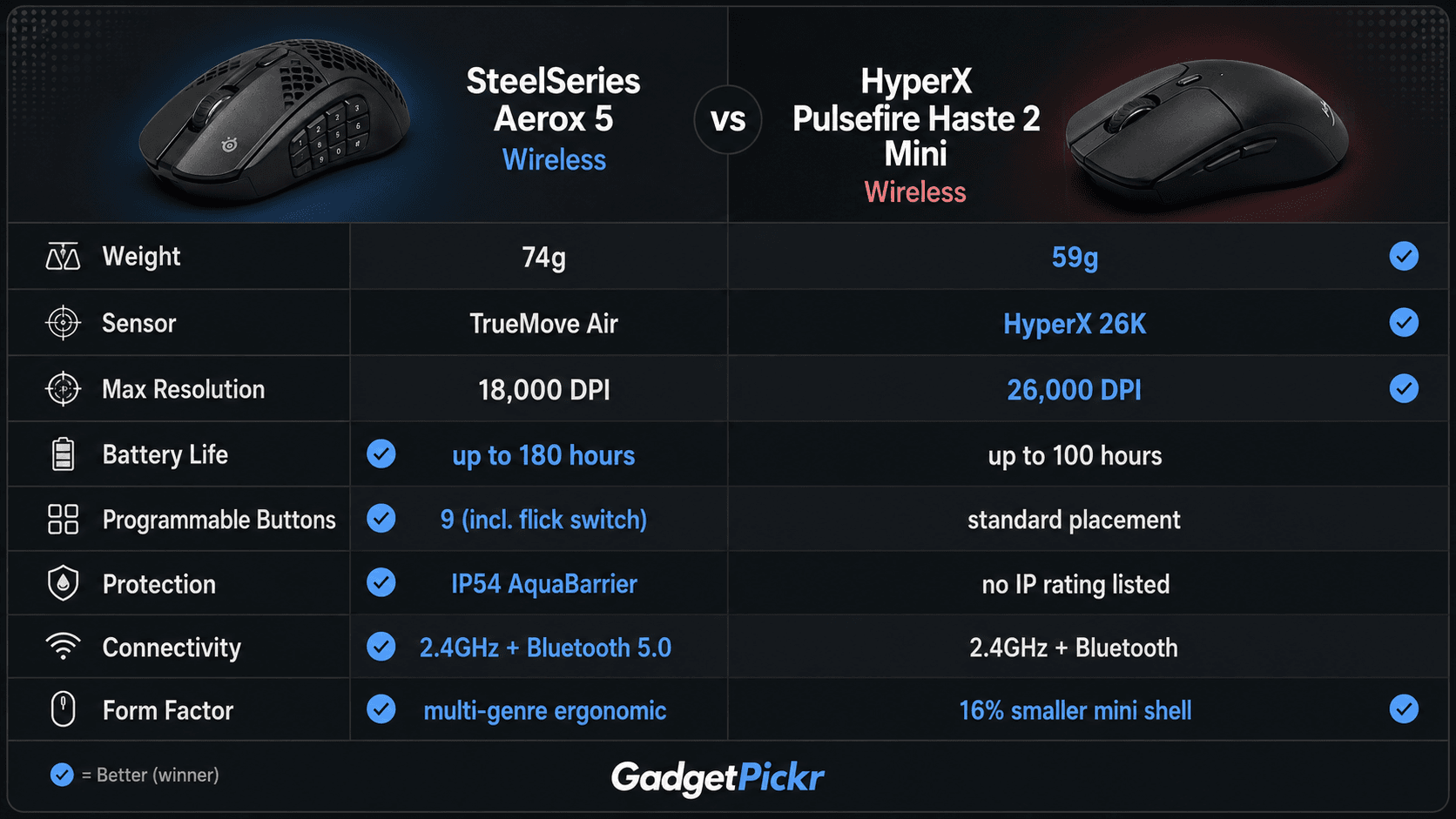
Weight, buttons, and battery all pull in opposite directions here. Sensor resolution is the one line where the smaller, cheaper mouse leads outright.
| Specification | SteelSeries Aerox 5 Wireless | HyperX Pulsefire Haste 2 Mini Wireless |
|---|---|---|
| Weight | 74g | 59g |
| Sensor Model | TrueMove Air | HyperX 26K |
| Maximum Resolution | 18,000 DPI | 26,000 DPI |
| Battery Life | Up to 180 hours | Up to 100 hours |
| Programmable Buttons | 9, including an up/down flick switch | Standard button placement |
| Environmental Protection | IP54 AquaBarrier | No IP rating listed |
| Connectivity Options | 2.4 GHz / Bluetooth 5.0 | 2.4 GHz / Bluetooth |
| Form Factor Style | Multi-genre ergonomic | Compact mini (16% smaller shell) |
| Best For | Desk-bound MOBA, MMO, and battle royale players who bind abilities to the mouse and hate charging | Budget-minded FPS players with small hands, plus anyone packing a mouse into a laptop bag |
Design & Build Quality
Start with the shells, because that is where the two philosophies stop being subtle. Aerox 5 Wireless runs a 74g honeycomb chassis, and SteelSeries patched the obvious weakness in that design with an IP54-rated AquaBarrier — an internal membrane sitting between the open mesh and the electronics, blocking dust, crumbs, and the occasional drink spill. Perforated mice have a reputation for dying young. This one argues back.
That longer, contoured body also earns its length. It carries 9 programmable buttons, including a custom up/down flick switch built for rapid macro execution, which turns the mouse into a command hub rather than just a pointing device. RGB accents glow through the open chassis if you want the light show.
Haste 2 Mini takes the opposite bet. At 59 grams it undercuts its rival by fifteen, and it gets there with a solid outer shell instead of visible mesh — rigidity without the holes, and no exposed innards to worry about. Small hands, fingertip grips, and claw grips are the stated targets. So are laptop bags.
Styling follows function. Where one mouse advertises itself with cutouts and lighting, the other keeps a stealthy silhouette and standard button placement. Fewer inputs, less mass, less to catch on a mousepad edge.
Performance & Key Features
Sensor tech is where each brand plants its flag. Aerox 5 Wireless uses the TrueMove Air optical sensor with tracking accuracy up to 18,000 DPI, running over Quantum 2.0 Wireless — low-latency 2.4GHz for competitive play, Bluetooth 5.0 when you want it paired to a second machine. Battery endurance reaches up to 180 hours on Bluetooth, which for most players means charging roughly once a month.
Nine buttons is the headline, though. Map an entire spell rotation, a weapon wheel, or a stack of utility macros onto your thumb and you gain something a lighter mouse simply cannot offer in MOBAs, MMOs, and battle royales. Muscle memory does the rest.
HyperX answers with resolution and restraint. Its proprietary HyperX 26K sensor pushes up to 26,000 DPI for ultra-fine tracking, and dual 2.4GHz plus Bluetooth connectivity covers gaming rigs, handhelds, and phones without fuss. Runtime lands at up to 100 hours — shorter, but hardly short.
What you gain for that trade is inertia, or rather the lack of it. Fifteen grams sounds trivial written down; across a thousand flick corrections in a Valorant session, your wrist keeps a running tally. One mouse optimizes for input depth and endurance. The other optimizes for how little it fights you.
Pros & Cons: SteelSeries Aerox 5 Wireless
Feature density is the selling point here, aimed at players who want customization and long wireless endurance in the same package. The cost is mass and footprint: extra buttons and a longer body put it above the true ultra-lights.
Pros: Versatile 9-button programmable layout with a custom flick switch for macro-heavy games. IP54-rated AquaBarrier gives strong protection against dust, dirt, and liquid spills. Reliable battery endurance reaching up to 180 hours of continuous operation. Flexible dual-mode connectivity using Quantum 2.0 2.4GHz wireless and Bluetooth 5.0. Cons: 15 grams heavier than the Haste 2 Mini, a lower maximum DPI ceiling, and a larger shell that suits palm grips more than fingertip users.
Pros & Cons: HyperX Pulsefire Haste 2 Mini Wireless
Different pitch, different buyer. This one wins on mass and accessibility and gives ground on everything that needs physical space.
Pros: Extremely light at 59 grams, cutting hand fatigue during long, fast-paced FPS sessions. Compact mini form factor, scaled 16% smaller than the standard Haste 2 Wireless, tailored to small hands and fingertip or claw grips. Dual wireless with low-latency 2.4GHz for competitive play and Bluetooth for everyday productivity. High-precision tracking from the native HyperX 26K sensor and up to 26,000 DPI sensitivity. Affordable positioning that puts fast wireless tracking within reach of a modest budget. Cons: Roughly 80 fewer hours of rated runtime, no listed IP rating, standard button placement with no macro column, and a shell that will feel cramped to large-handed palm-grip players.
Real Buyer Scenarios
Think about what you actually launch on a Tuesday night. If it is a MOBA, an action RPG, or a battle royale where keybinds pile up faster than fingers allow, Aerox 5 Wireless is the answer — those 9 programmable buttons and the flick switch pay for themselves the first time you swap loadouts mid-fight. Desktop players who never move their setup get a second bonus: 180 hours between charges, plus IP54 protection for the inevitable spill.
Now flip it. Tactical shooters, small hands, or a mouse that lives in a backpack pocket all point one direction. Haste 2 Mini's 59g frame and 26,000 DPI sensor reward players whose aim depends on fast, repeated micro-corrections, and its footprint disappears into a laptop bag for LAN nights or hotel-desk sessions. You give up macro buttons and about 80 hours of runtime. For a lot of FPS players, that is a bargain.
Alternatives Worth Considering
Neither shell fitting your hand? A couple of nearby options cover the same ground from different angles, and both sit in similar territory on price.
Chasing the travel-friendly profile in particular, look at the Razer Orochi V2. It carries an ultra-lightweight build under 60 grams and an 18,000 DPI sensor, connects over 2.4GHz or Bluetooth, and skips the internal cell entirely — a hybrid slot takes a single AA or AAA battery instead. Because of that, it offers up to 950 hours of battery life over Bluetooth and uses a 5G optical sensor with up to 18,000 DPI, which makes it a practical pick for mobile setups and cramped desks where charging cables are a nuisance.
Final Verdict
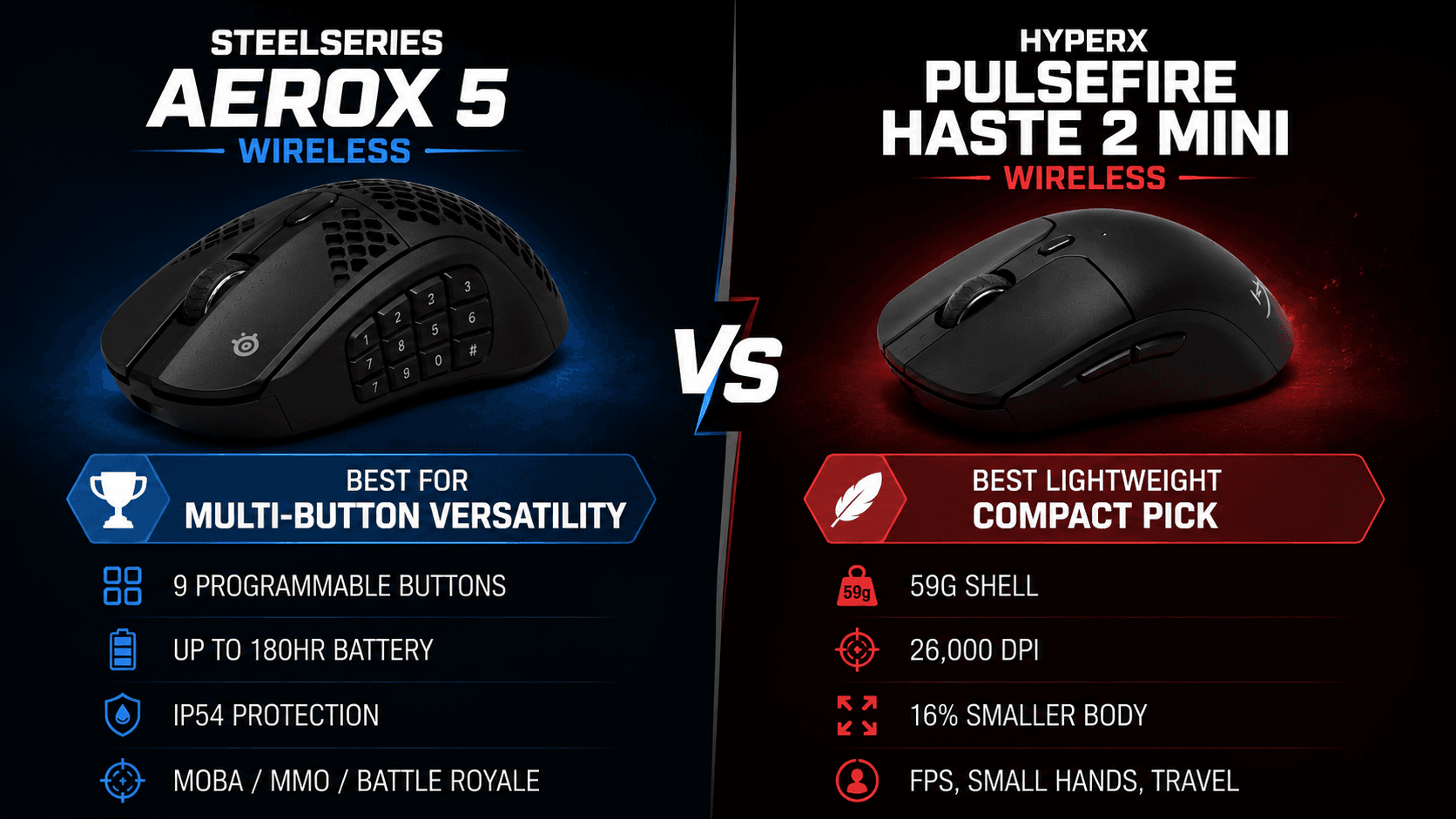
No hedging on SteelSeries Aerox 5 vs HyperX Pulsefire Haste 2 Mini — the split is clean, and it runs along genre and hand size rather than quality.
Choose the SteelSeries Aerox 5 Wireless if you play MOBAs, MMOs, or battle royales and want abilities under your thumb, if you use a palm grip or have larger hands, if your mouse never leaves the desk, or if a 180-hour battery and IP54 spill protection matter more to you than fifteen grams. Choose the HyperX Pulsefire Haste 2 Mini Wireless if tactical shooters like Valorant or Counter-Strike 2 are your main diet, if your hands are on the smaller side or you play fingertip and claw, if the mouse travels with a laptop, or if you want the higher 26,000 DPI ceiling for less money. Fast flicks: HyperX. Deep binds and long runtime: SteelSeries.
Gaming Mouse Buying Checks
Before you commit to any wireless mouse, measure your hand from wrist crease to middle fingertip and compare it against the shell length — grip style and hand size predict comfort better than any spec on the box. Then check the things you cannot change later: button count, whether the receiver is 2.4GHz or Bluetooth-only, charge port type, and rated runtime at the polling rate you actually use.
Weight deserves a sanity check too. Sub-60g bodies help with flick-heavy shooters, while a slightly heavier shell with more inputs usually serves ability-driven games better. Sensor ceilings above 18,000 DPI are headroom, not a daily setting.
Sources & References
Specifications and claims in this analysis were cross-referenced against the sources below.
- HyperX Pulsefire Haste 2 Mini | Wireless Gaming Mousehyperx.com
- HyperX Pulsefire Haste 2 Mini Wireless Black Gaming Mousejoinhoney.com
- Massive 76% discount knocks HyperX's Pulsefire Haste 2 Mini lightweight wireless gaming mouse down to $19 all-low9to5toys.com
- Aerox 5 Wirelesssteelseries.com
- HyperX Pulsefire Haste 2 Mini - Souris gaming sans filfr.hyperx.com
- Aerox | Our Lightest Gaming Mousesteelseries.com
Frequently Asked Questions
Haste 2 Mini. Its 59g shell and 26,000 DPI ceiling suit flick-heavy shooters like Valorant and Counter-Strike 2. Aerox 5 Wireless is fifteen grams heavier, and that shows up across long tracking sweeps.